Short, plain-English definitions of the most common Elliott Wave terms. Each entry links to the lesson where you can learn more.
Use this glossary as a quick reference while you read our market pages and lessons. Terms are listed in alphabetical order.
A
Alternate count
A backup wave count kept in case the primary count is invalidated.
Alternation
The tendency for waves 2 and 4 to differ in shape, depth or time.
C
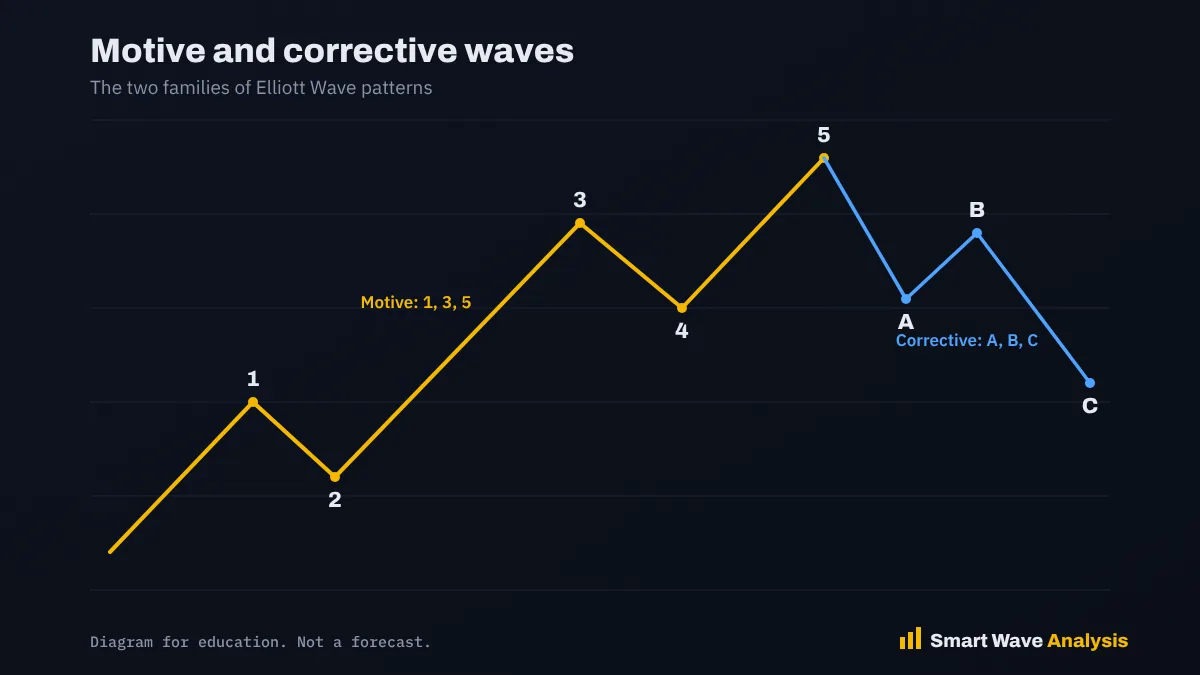
Corrective wave
A wave that moves against the larger trend, such as waves 2, 4, A, B and C in an uptrend.
D
Degree
The size of a wave within the overall structure, from Grand Supercycle to Subminuette.
Diagonal
A wedge-shaped motive pattern in which wave 4 usually overlaps wave 1.
Divergence
When price makes a new extreme but a momentum indicator does not, often seen in wave 5.
Double three
A sideways complex correction made of two simple patterns joined by an X wave.
Double zigzag
Two zigzags joined by an X wave, forming a steep correction labelled W-X-Y.
E
Ending diagonal
A 3-3-3-3-3 wedge that appears at the end of a larger move, often followed by a sharp reversal.
Expanded flat
A flat where wave B goes beyond the start of wave A and wave C goes well beyond the end of wave A.
Extension
An elongated motive wave whose smaller waves are almost as large as the other main waves.
F
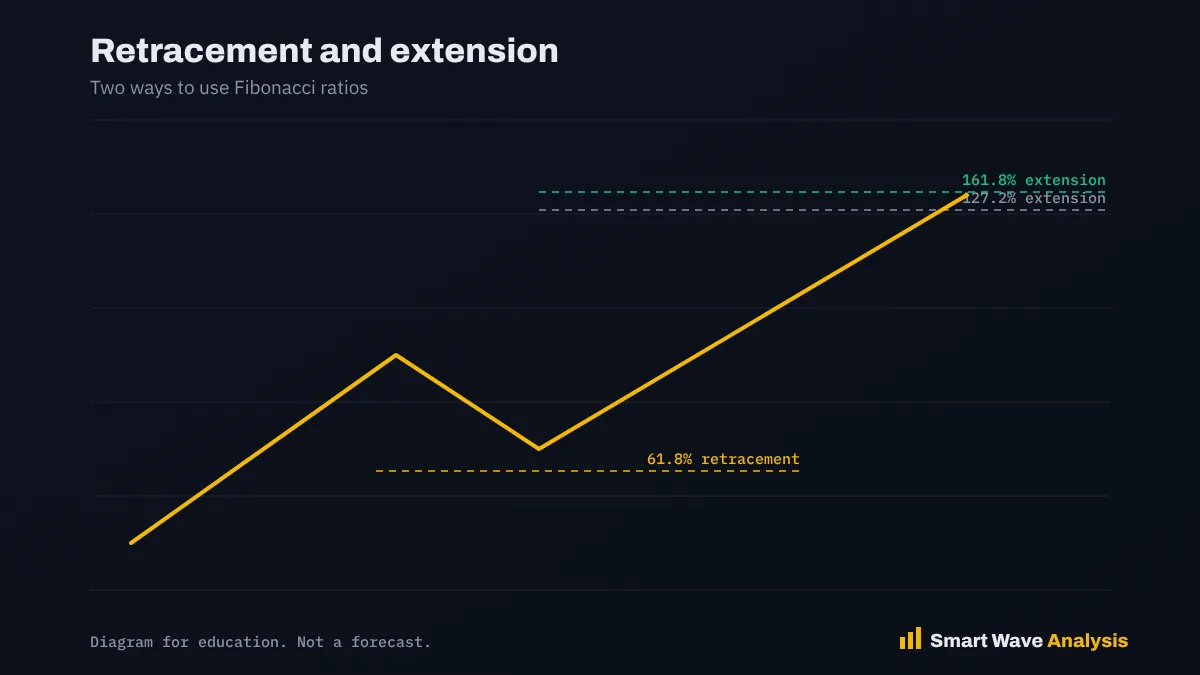
Fibonacci extension
A level beyond a prior move, such as 161.8 percent, used to project targets.
Fibonacci retracement
A level within a prior move, such as 38.2 or 61.8 percent, used to find pullback zones.
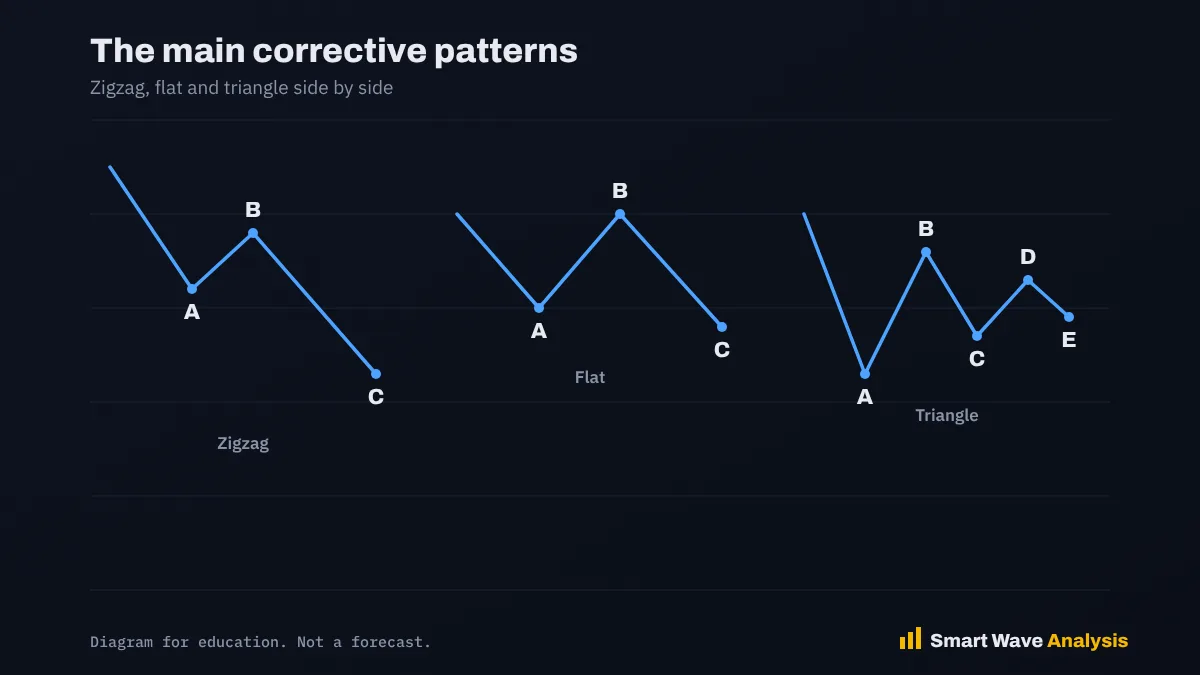
Flat
A 3-3-5 sideways correction in which wave B returns close to the start of wave A.
Fractal
A pattern that repeats at different scales; waves contain smaller waves of the same form.
G
Golden ratio
The number 1.618, the limit of the ratio between consecutive Fibonacci numbers.
I
Impulse
A five-wave motive pattern that follows all three Elliott Wave rules.
Invalidation level
The price at which a wave count breaks a rule and must be abandoned.
L
Leading diagonal
A wedge-shaped pattern in the wave 1 or wave A position.
M
Motive wave
A wave that moves in the direction of the larger trend, such as waves 1, 3 and 5.
O
Overlap
When wave 4 enters the price range of wave 1, which is not allowed in a standard impulse.
P
Primary count
The analyst's preferred wave count based on current evidence.
R
Running flat
A flat in which wave C fails to reach the end of wave A, showing a strong underlying trend.
S
Subdivision
The smaller waves that make up a larger wave, such as 5-3-5-3-5 for an impulse.
T
Thrust
The fast move out of a triangle when it ends.
Throw-over
A brief move beyond a channel or diagonal trend line, often near the end of a trend.
Triangle
A sideways 3-3-3-3-3 correction labelled A-B-C-D-E that appears before the final move.
Triple three
A rare complex correction of three simple patterns joined by two X waves.
Truncation
A fifth wave that fails to move beyond the end of wave 3.
W
Wave 1
The first motive wave of an impulse, often doubted by most traders.
Wave 2
A correction of wave 1 that cannot retrace more than 100 percent of it.
Wave 3
The strongest wave in most impulses; never the shortest of waves 1, 3 and 5.
Wave 4
A correction of wave 3 that does not overlap wave 1 in a standard impulse.
Wave 5
The final motive wave of an impulse, often with weaker momentum.
Wave A
The first wave of a correction, often mistaken for a normal pullback.
Wave B
The middle wave of a correction, often a trap that looks like the trend resuming.
Wave C
The final wave of a correction, often fast and powerful.
X
X wave
A connecting corrective wave that joins patterns in a complex correction.
Z
Zigzag
A sharp 5-3-5 correction in which wave C moves beyond the end of wave A.
Educational content only. Nothing on this page is financial advice or a recommendation to buy or sell. Trading involves risk and you can lose money. Elliott Wave counts are probabilities, not certainties. Read our full disclaimer and affiliate disclosure.