The Wave Principle says that market prices move in repeating patterns because they reflect crowd psychology. A trend unfolds in five waves, and a correction unfolds in three. This lesson explains the idea in plain terms.
Who was Ralph Nelson Elliott?
Ralph Nelson Elliott (1871 to 1948) was an American accountant. After an illness forced him to retire in the late 1920s, he spent years studying decades of yearly, monthly, weekly, daily and even half-hourly data on the Dow Jones averages. He noticed that prices did not move at random. They moved in repeating patterns that he called waves.
Elliott published his findings in a short book, The Wave Principle, in 1938, and expanded them in Nature’s Law in 1946. His work was largely forgotten until A. J. Frost and Robert Prechter published Elliott Wave Principle in 1978, which made the method popular with traders around the world.
The basic idea: 5 waves up, 3 waves down
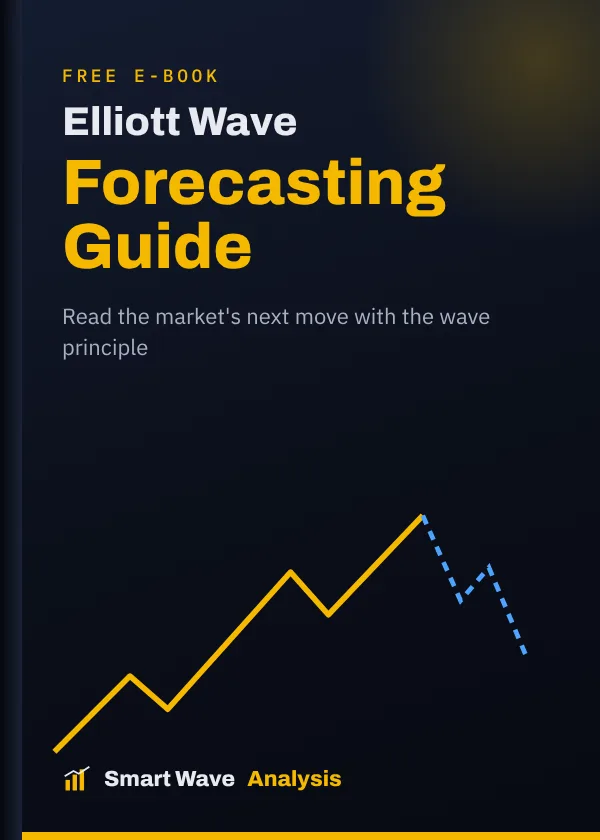
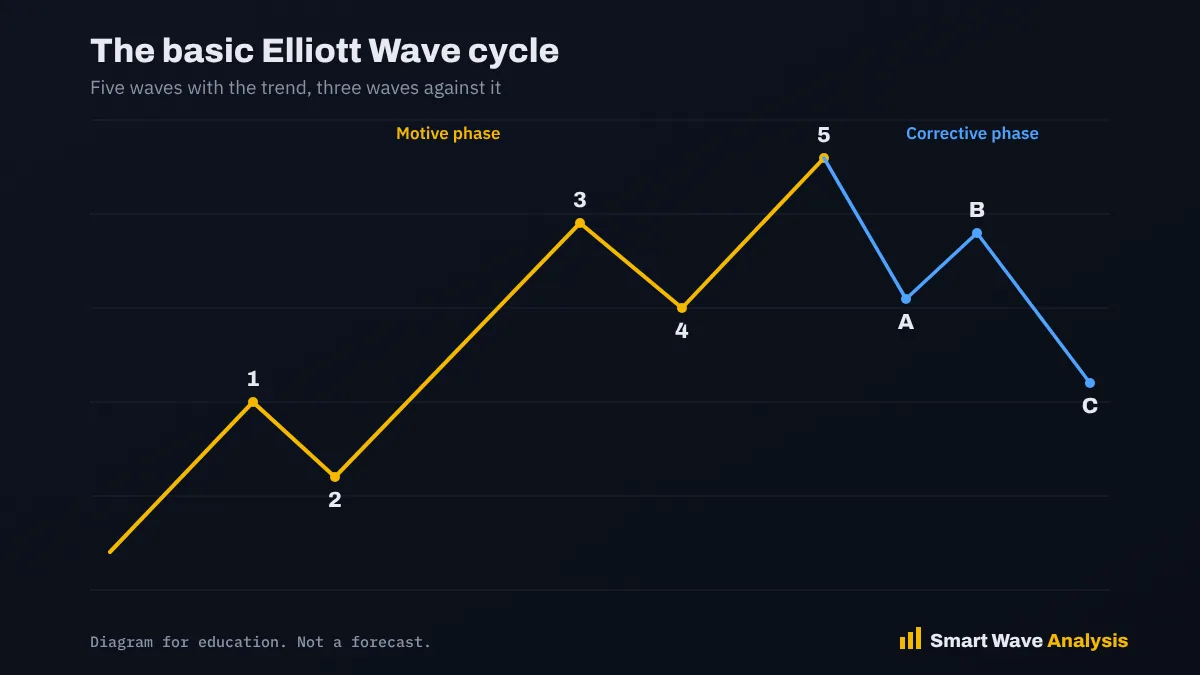
Elliott found that a market moving in the direction of its main trend does so in five waves. These are labelled 1, 2, 3, 4 and 5. Waves 1, 3 and 5 move with the trend and are called motive waves. Waves 2 and 4 move against it and are called corrective waves.
After the five-wave move ends, the market corrects in three waves, labelled A, B and C. Together, the five waves and three waves form one complete cycle of eight waves.
- Wave 1: the first push, often doubted by most traders.
- Wave 2: a pullback that retraces much of wave 1 but does not go below its start.
- Wave 3: usually the strongest and longest wave, when the crowd joins the move.
- Wave 4: a sideways or shallow pause.
- Wave 5: the final push, often with weaker momentum.
- Waves A, B and C: the correction of the whole five-wave move.
Why do markets move in waves?
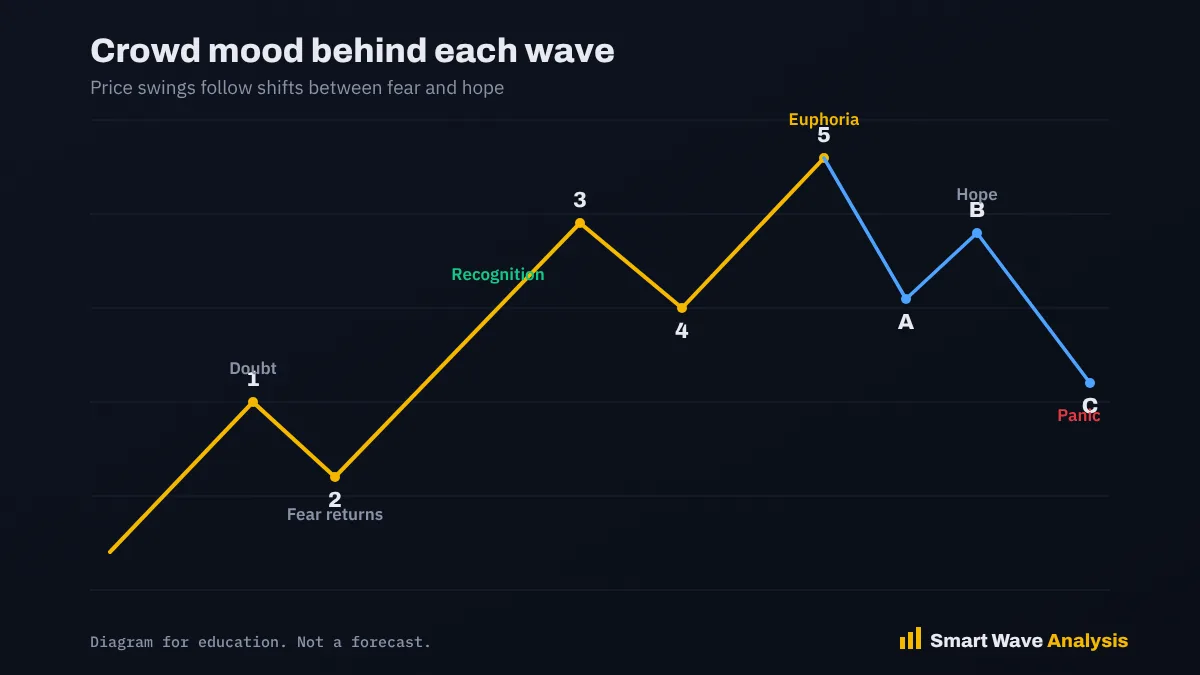
Prices are set by people. People are social and tend to follow the crowd, swinging between hope and fear. Elliott believed these mood swings follow a natural rhythm. Optimism builds slowly, then spreads, then peaks. Pessimism follows the same path. Because human nature does not change, the same patterns repeat across centuries and across markets, from stocks to currencies to Bitcoin.
Waves within waves
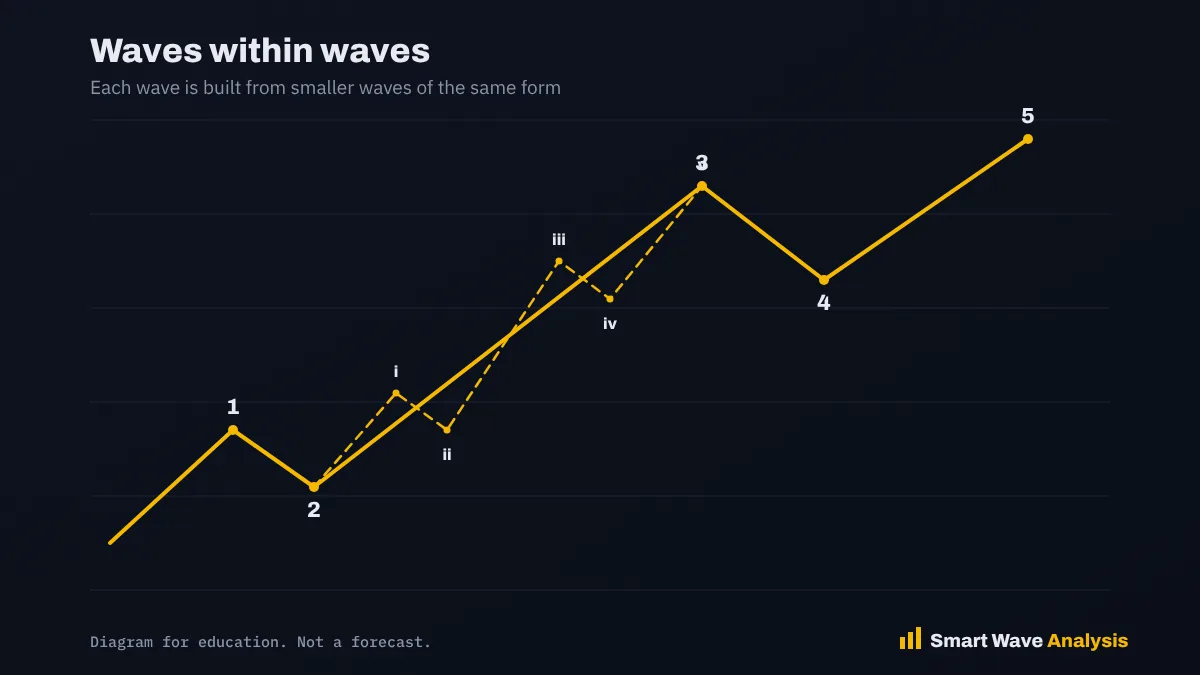
Each wave is made of smaller waves, and each is part of a larger one. A five-wave advance on a daily chart may be just wave 1 of a larger five-wave advance on a weekly chart. Inside that daily wave 3, you can find five smaller waves on an hourly chart. This property is called fractal: the pattern looks similar at every scale. Elliott named nine levels of size, called degrees, from the Grand Supercycle lasting centuries to the Subminuette lasting minutes.
What the Wave Principle is and is not
The Wave Principle is a way to describe where the market may be in its cycle and what is likely to come next. It does not predict exact prices or dates with certainty. Most analysts keep a main count, called the primary count, and a backup, called the alternate count. They also set an invalidation level, the price at which the primary count is proven wrong.
Used this way, the Wave Principle gives traders a plan: where to enter, where to place a stop and where a move may end. That is why it is still used more than 85 years after Elliott first described it.
Next steps
Read the three unbreakable rules next. They are the foundation for every count you will make.
Frequently asked questions
Who invented Elliott Wave theory?
Ralph Nelson Elliott, an American accountant, developed it in the 1930s and published The Wave Principle in 1938.
What is the 5-3 wave pattern?
A trend moves in five waves (1 to 5), followed by a correction in three waves (A, B and C).
Does Elliott Wave work on all markets?
It is applied to stocks, indices, currencies, commodities and crypto. It works best in liquid markets with many participants, because it reflects crowd behavior.
Sources and further reading
- Elliott wave principle (Wikipedia)
- Frost, A. J. and Prechter, R. R., Elliott Wave Principle: Key to Market Behavior (1978) (Wikipedia (author page))
- Elliott Wave Theory: What You Need to Know (Investopedia)
Educational content only. Nothing on this page is financial advice or a recommendation to buy or sell. Trading involves risk and you can lose money. Elliott Wave counts are probabilities, not certainties. Read our full disclaimer and affiliate disclosure.