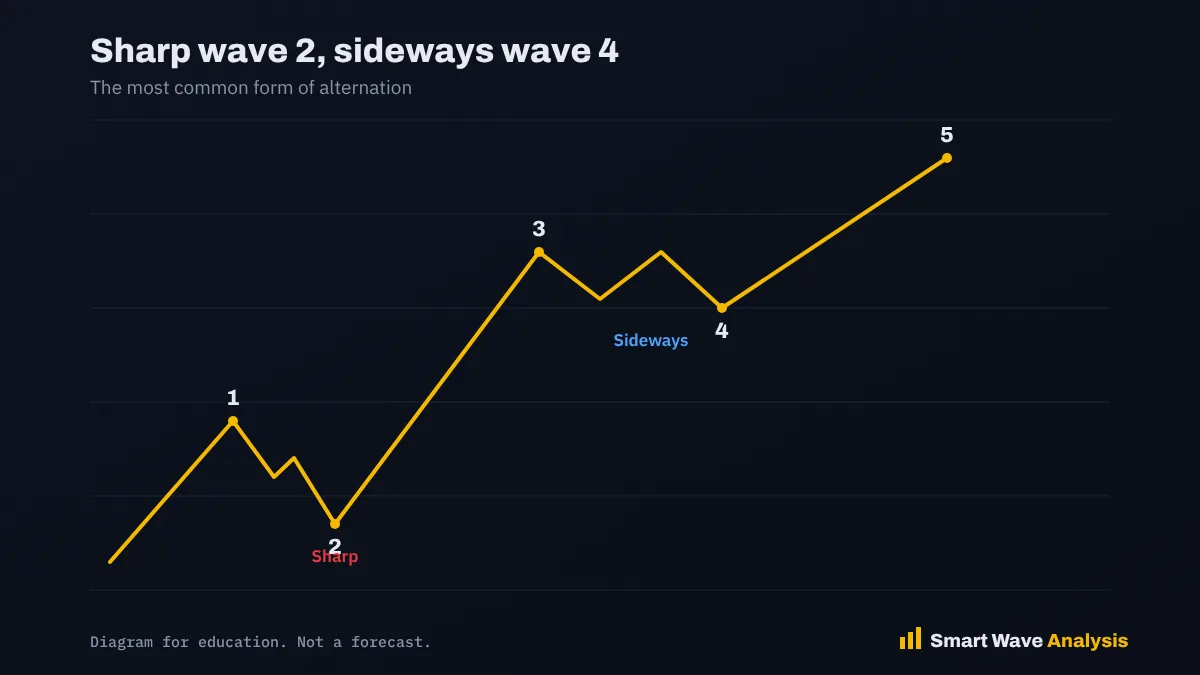
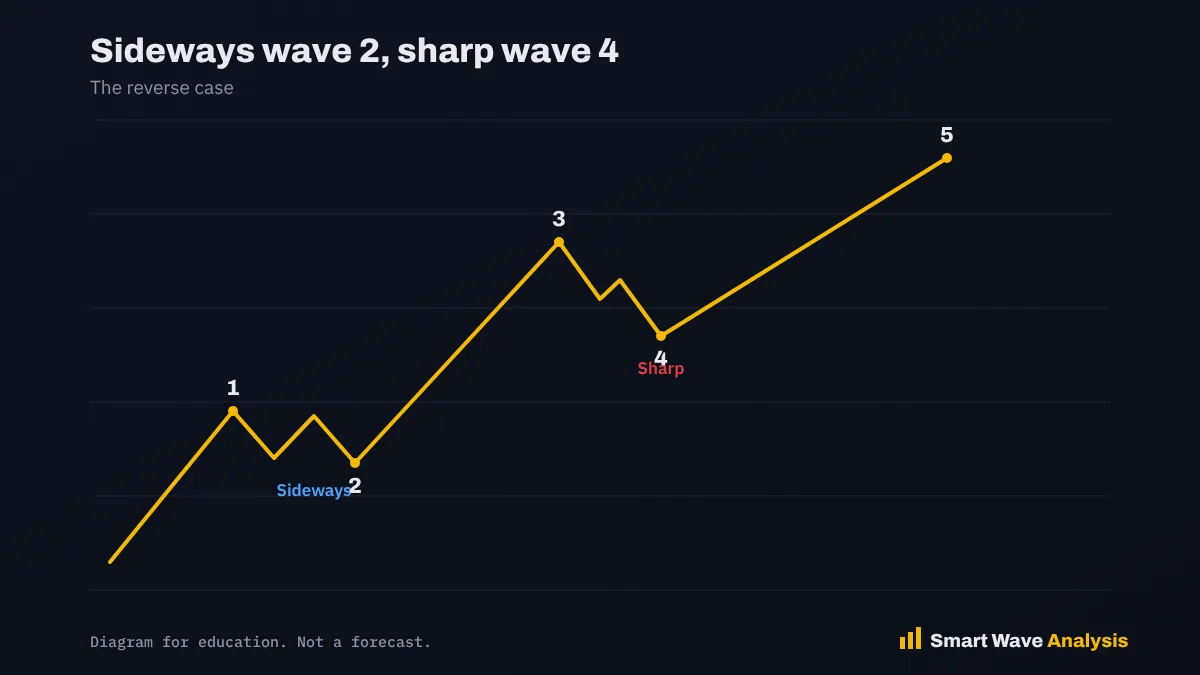
The guideline of alternation says that waves 2 and 4 of an impulse usually differ in form. If wave 2 is a sharp correction, such as a zigzag, wave 4 is likely to be sideways, such as a flat or triangle, and the reverse is also common.
What alternation means
Markets rarely repeat the same corrective pattern twice in a row within an impulse. Elliott described this tendency, and Frost and Prechter expanded it into the guideline of alternation. It is a guideline, not a rule, but it is one of the most reliable tools for forecasting wave 4.
How waves 2 and 4 alternate
- Shape: a sharp zigzag in wave 2 often leads to a sideways flat or triangle in wave 4.
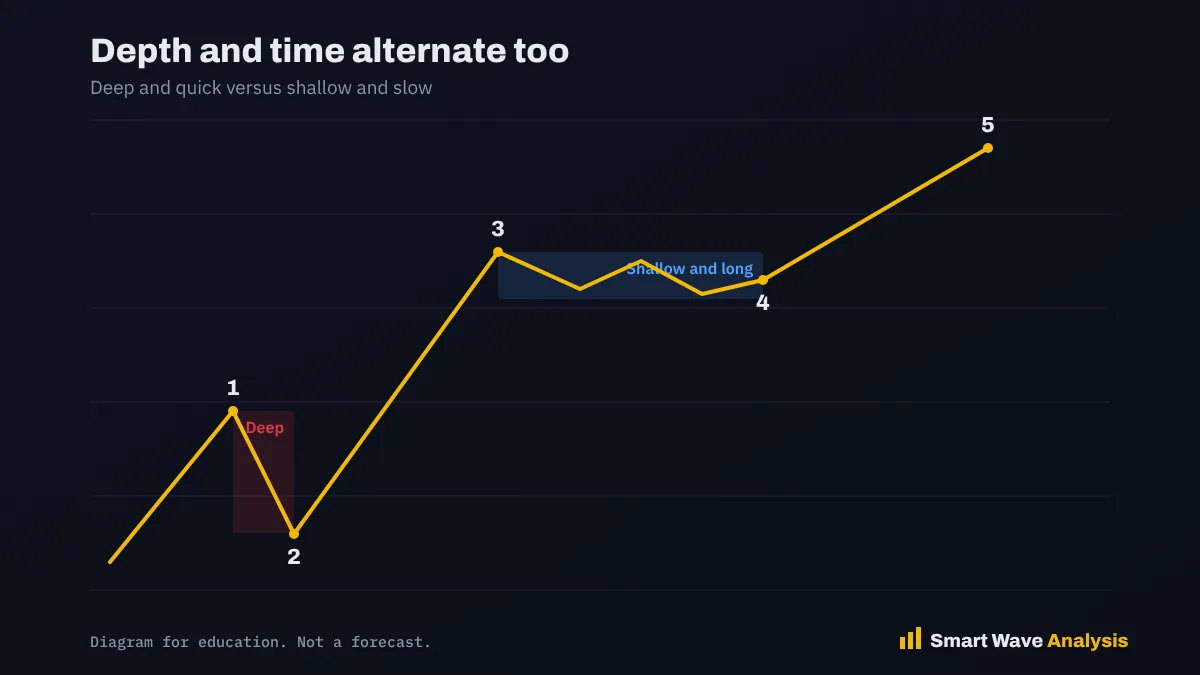
- Depth: wave 2 often retraces deeply, while wave 4 is often shallow.
- Time: one correction is often quick and the other slower.
- Complexity: one may be simple and the other complex, such as a double three.
Alternation in larger patterns
Alternation also appears in corrections. In a double three, the W and Y patterns usually differ. In a flat, a sharp wave A is often followed by a more complex wave B.
How to use it
- After a sharp, deep wave 2, prepare for a slow, sideways wave 4. Avoid expecting a quick bounce.
- After a shallow, sideways wave 2, expect a sharper wave 4.
- Combine alternation with Fibonacci: a shallow wave 4 often ends near the 23.6 to 38.2 percent retracement of wave 3.
Frequently asked questions
What is the guideline of alternation?
The tendency for waves 2 and 4 to differ in shape, depth, time or complexity.
Is alternation a rule?
No. It is a guideline that describes what usually happens, not what must happen.
If wave 2 is a zigzag, what is wave 4 likely to be?
A sideways pattern such as a flat or triangle.
Sources and further reading
- Frost, A. J. and Prechter, R. R., Elliott Wave Principle: Key to Market Behavior (1978) (Wikipedia (author page))
- Elliott wave principle (Wikipedia)
Educational content only. Nothing on this page is financial advice or a recommendation to buy or sell. Trading involves risk and you can lose money. Elliott Wave counts are probabilities, not certainties. Read our full disclaimer and affiliate disclosure.