Wave degree describes the size of a wave in time and price. Elliott defined nine degrees, from the Grand Supercycle, which can span centuries, to the Subminuette, which can last minutes. Each degree has its own labels so you can tell which wave belongs to which.
Why degrees matter
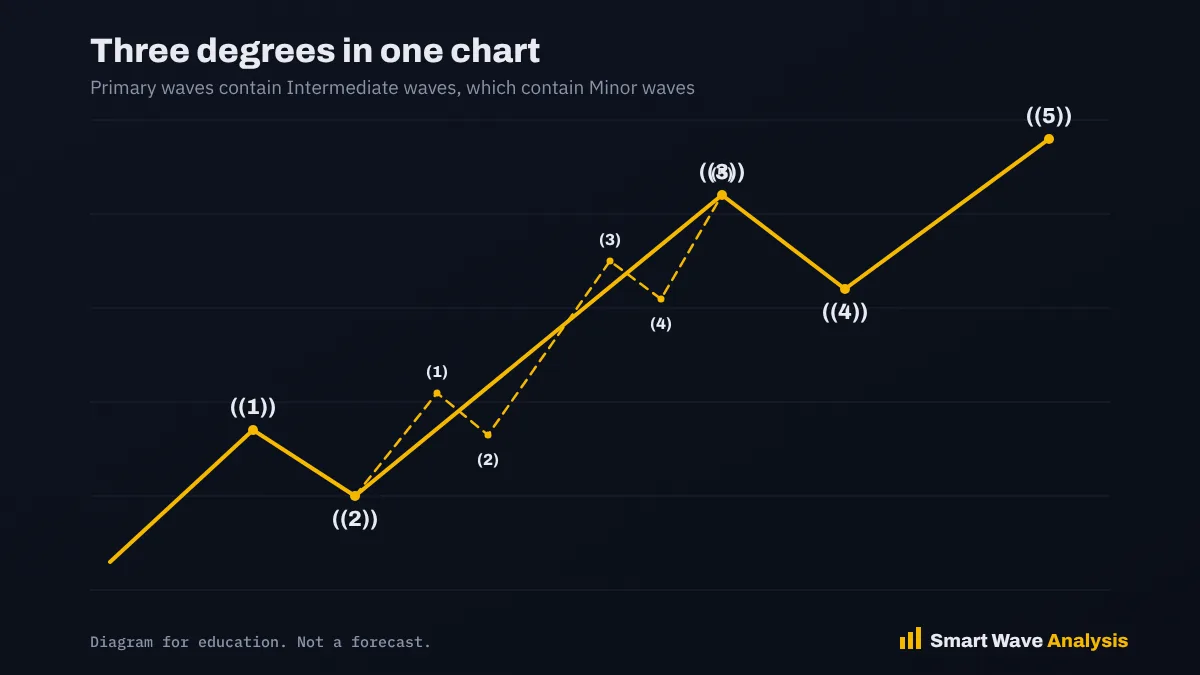
Because waves contain smaller waves, a chart can show several waves labelled “3” at the same time. Without degrees, a count quickly becomes confusing. Degree labels tell you which wave 3 you are talking about: the big one on the monthly chart or the small one inside it on the hourly chart.
The nine degrees
The table below lists the standard degrees and a common labelling style. Exact durations vary from market to market, so treat the time ranges as rough guides.
| Degree | Motive labels | Corrective labels | Typical duration |
|---|---|---|---|
| Grand Supercycle | ((I)) ((II)) ((III)) | ((a)) ((b)) ((c)) | Many decades to centuries |
| Supercycle | (I) (II) (III) | (a) (b) (c) | Several decades |
| Cycle | I II III IV V | a b c | One year to several years |
| Primary | ((1)) ((2)) ((3)) | ((A)) ((B)) ((C)) | Months to a couple of years |
| Intermediate | (1) (2) (3) | (A) (B) (C) | Weeks to months |
| Minor | 1 2 3 4 5 | A B C | Weeks |
| Minute | ((i)) ((ii)) ((iii)) | ((a)) ((b)) ((c)) | Days |
| Minuette | (i) (ii) (iii) | (a) (b) (c) | Hours |
| Subminuette | i ii iii | a b c | Minutes |
How degrees fit together
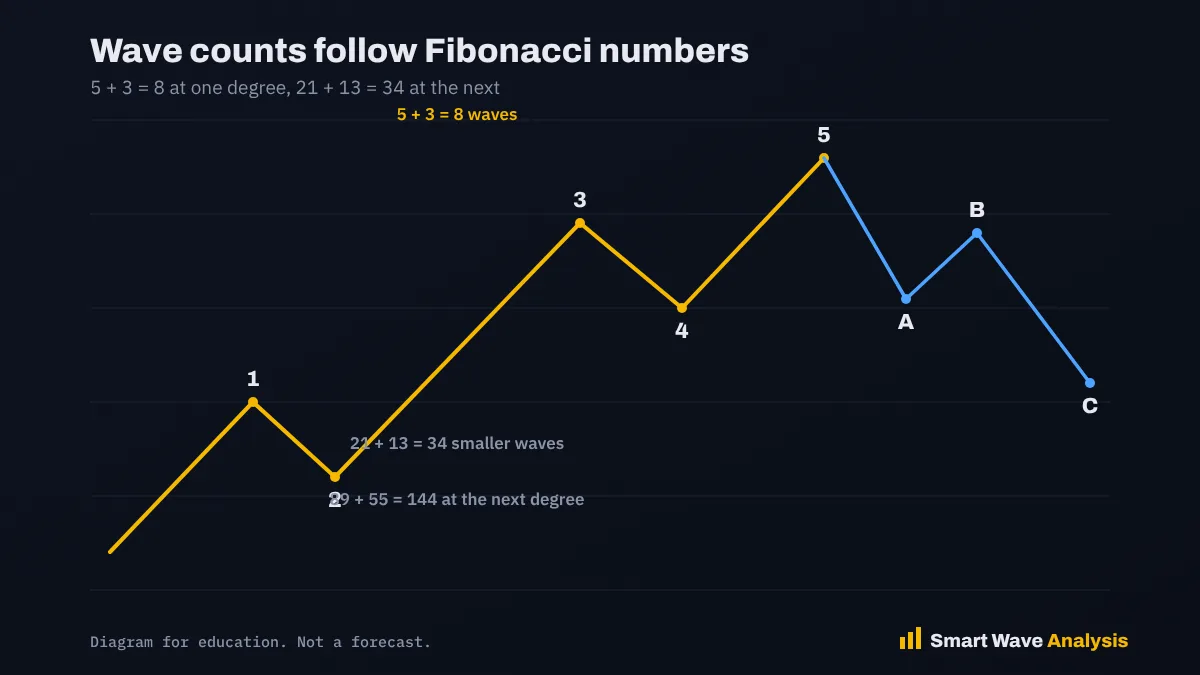
A complete five-wave move at one degree becomes wave 1, 3 or 5 (or wave A or C) of the next higher degree. A three-wave correction becomes wave 2 or 4 (or wave B) of the higher degree. So a full Primary degree cycle of 5 up and 3 down contains 34 Intermediate waves and 144 Minor waves. These are Fibonacci numbers, which is one reason analysts link the Wave Principle to Fibonacci.
Practical tips
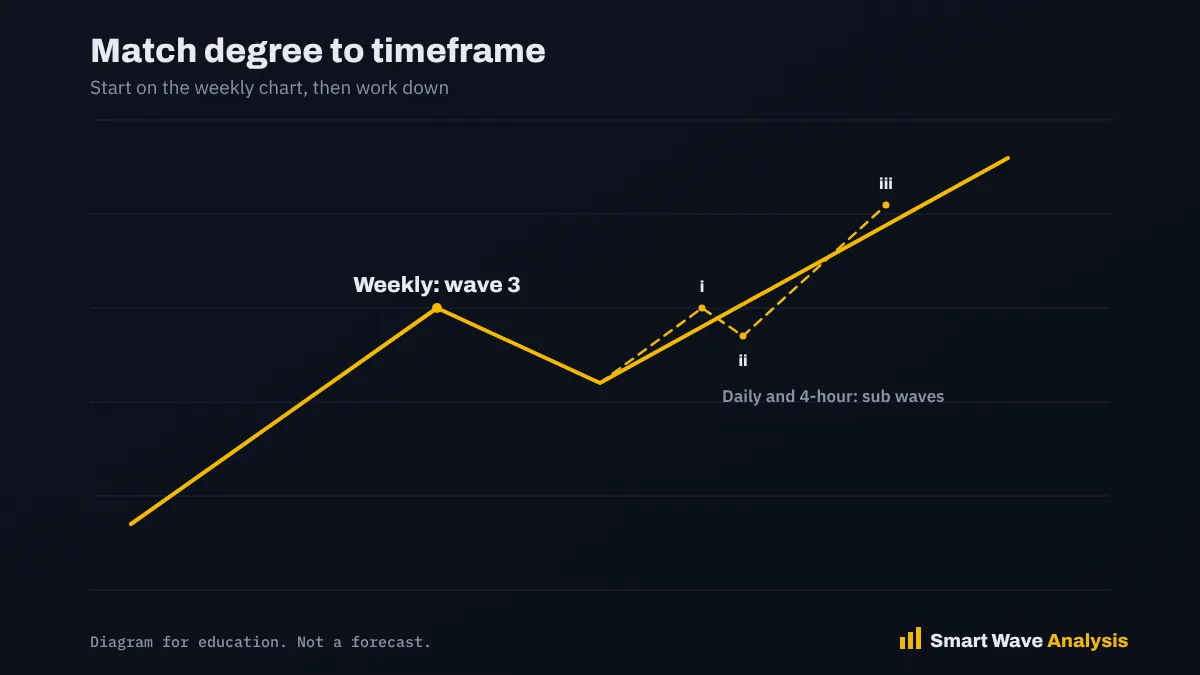
- Start on the highest timeframe you can find and work down. The big picture decides the meaning of smaller waves.
- Use one labelling style and stay consistent. Most charting platforms include Elliott Wave labelling tools with degree options.
- Do not worry about naming the exact degree when you start. What matters is that waves of the same size get labels of the same style.
Frequently asked questions
How many Elliott Wave degrees are there?
Elliott named nine degrees, from Grand Supercycle down to Subminuette. Some analysts add smaller ones for very short timeframes.
Do wave degrees have fixed time lengths?
No. Degree is about the relative size of a wave in the structure. Time ranges are only rough guides.
Which degree should beginners use?
Start with the waves that are clearest on daily and 4-hour charts, which are often Intermediate and Minor degree.
Sources and further reading
- Elliott wave principle (Wikipedia)
- Frost, A. J. and Prechter, R. R., Elliott Wave Principle: Key to Market Behavior (1978) (Wikipedia (author page))
- Fibonacci number (Wikipedia)
Educational content only. Nothing on this page is financial advice or a recommendation to buy or sell. Trading involves risk and you can lose money. Elliott Wave counts are probabilities, not certainties. Read our full disclaimer and affiliate disclosure.