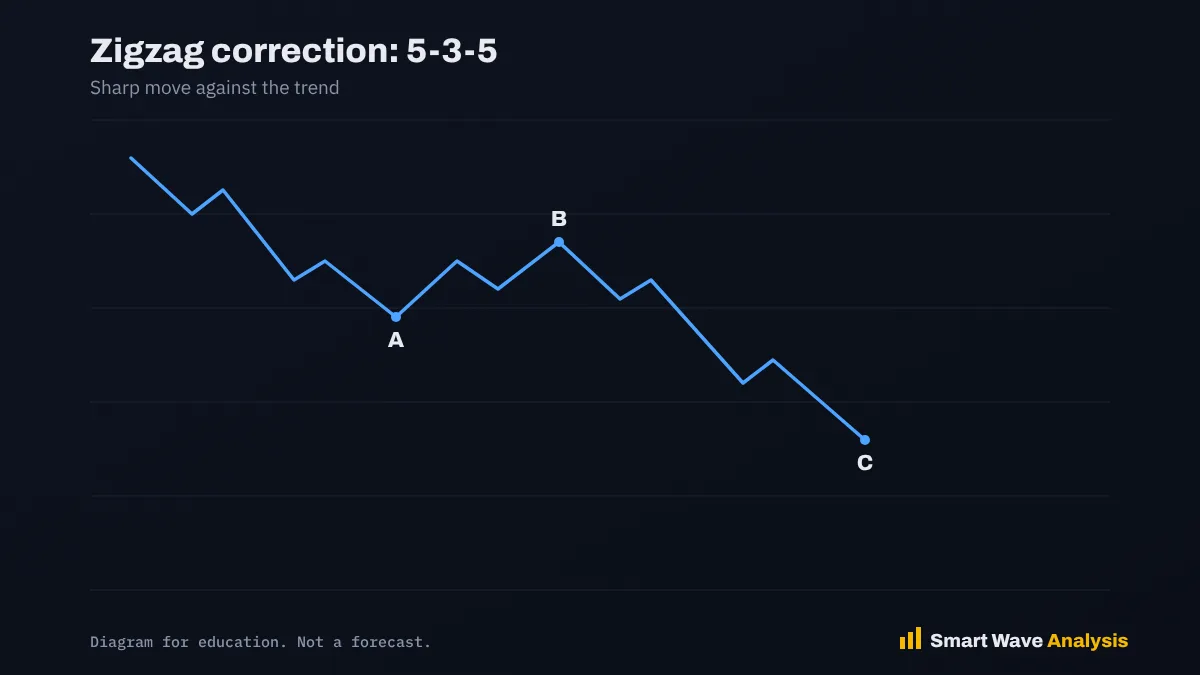
A zigzag is a sharp three-wave correction labelled A-B-C that subdivides 5-3-5. Wave B does not retrace too much of wave A, and wave C moves well beyond the end of wave A. Zigzags often appear in wave 2 positions.
Structure
In a zigzag, wave A is a five-wave impulse or leading diagonal, wave B is a three-wave correction, and wave C is a five-wave impulse or ending diagonal. Wave B usually retraces 38.2 to 78.6 percent of wave A and never goes beyond its start. Wave C then moves beyond the end of wave A.
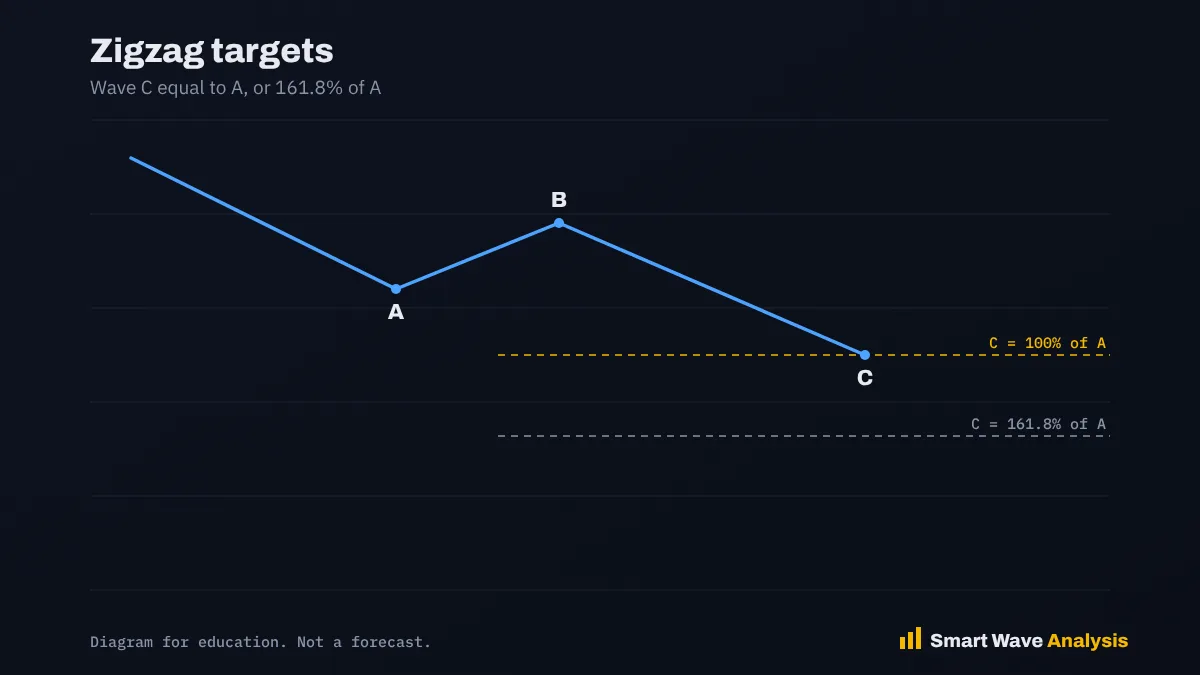
Fibonacci guide for zigzags
- Wave C is often equal to wave A.
- In a stronger correction, wave C can reach 161.8 percent of wave A.
- Wave B commonly retraces 50 to 61.8 percent of wave A.
Where zigzags appear
Zigzags are common in wave 2 of an impulse, because the market makes a deep, sharp test of the new trend. They also appear as wave A of a flat or triangle and as parts of complex corrections.
Double and triple zigzags
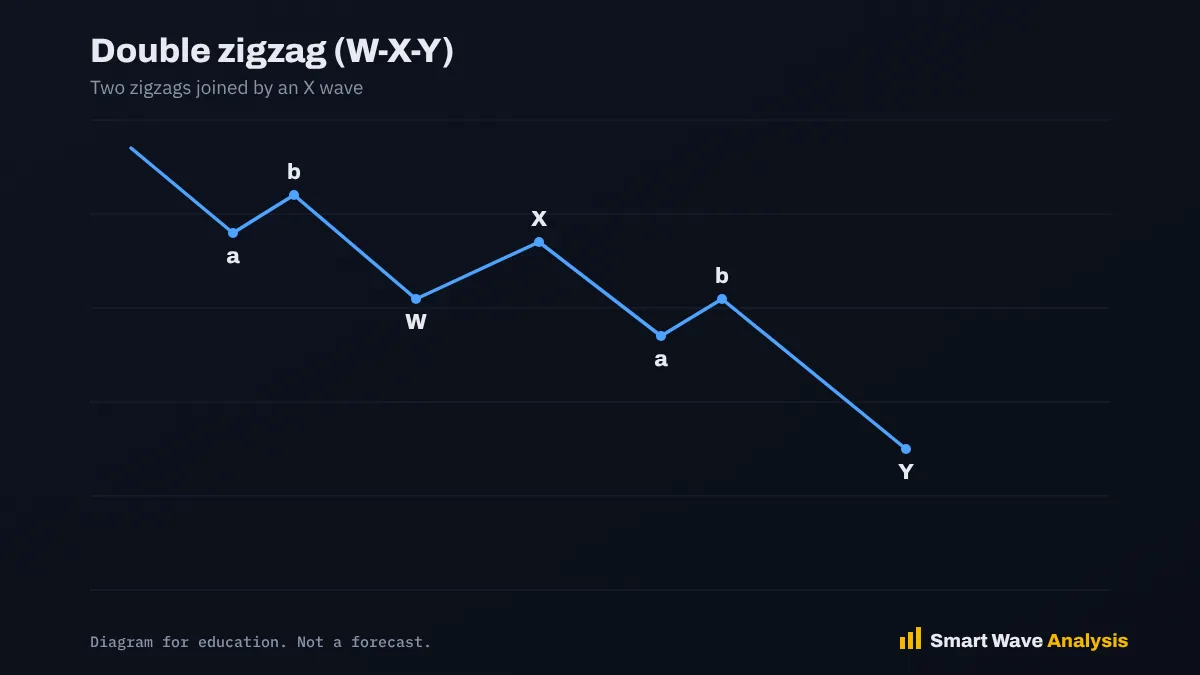
Sometimes one zigzag is not enough to complete a correction. The market adds a second zigzag, joined by a three-wave move labelled X. This is a double zigzag, labelled W-X-Y. Rarely, a third zigzag forms, making a triple zigzag labelled W-X-Y-X-Z. These are steep, deep corrections.
Trading tips
- When a correction falls in five waves (wave A), expect a bounce (wave B) and then another fall (wave C).
- Use wave C equal to wave A as a first target for the end of the correction.
- If wave C ends and the main trend resumes with strength, the zigzag was likely complete.
Frequently asked questions
How does a zigzag subdivide?
5-3-5: wave A has five waves, wave B has three and wave C has five.
How far does wave C go in a zigzag?
Often equal to wave A, and sometimes 161.8 percent of wave A.
What is a double zigzag?
Two zigzags connected by a three-wave X wave, labelled W-X-Y.
Sources and further reading
- Frost, A. J. and Prechter, R. R., Elliott Wave Principle: Key to Market Behavior (1978) (Wikipedia (author page))
- Elliott wave principle (Wikipedia)
- Elliott Wave Theory: What You Need to Know (Investopedia)
Educational content only. Nothing on this page is financial advice or a recommendation to buy or sell. Trading involves risk and you can lose money. Elliott Wave counts are probabilities, not certainties. Read our full disclaimer and affiliate disclosure.