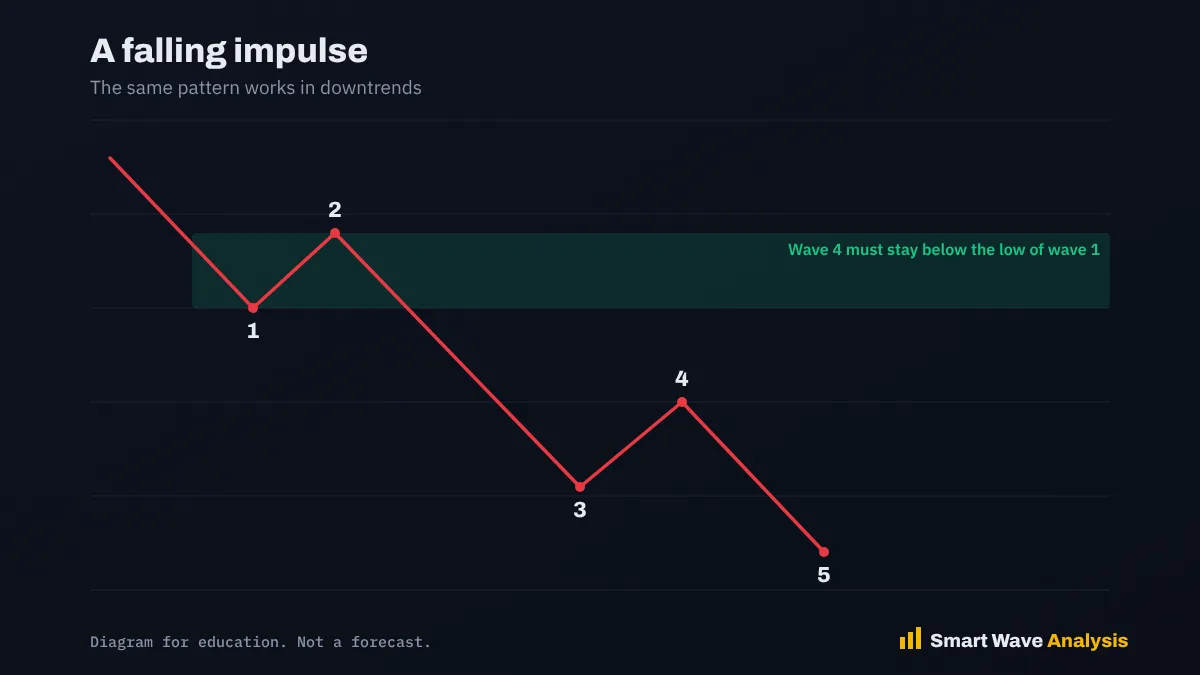
An impulse is a five-wave move in the direction of the larger trend. Waves 1, 3 and 5 are themselves impulses, waves 2 and 4 are corrections, and all three Elliott rules apply. It is the most common motive pattern.
Structure
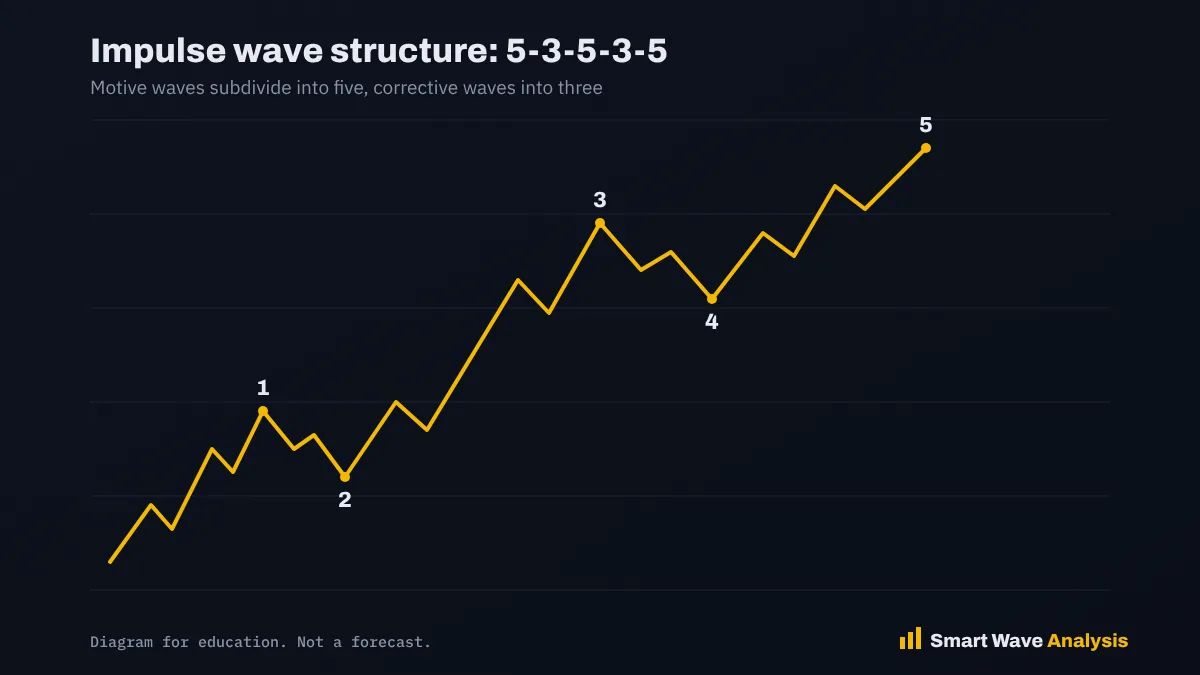
An impulse subdivides 5-3-5-3-5. Waves 1, 3 and 5 are smaller five-wave moves, and waves 2 and 4 are smaller three-wave corrections. This internal structure is what separates a true impulse from a three-wave rally that only looks strong.
Rules that apply
- Wave 2 never moves beyond the start of wave 1.
- Wave 3 is never the shortest of waves 1, 3 and 5.
- Wave 4 never overlaps the price range of wave 1.
Guidelines
- One of the three motive waves is usually extended, most often wave 3.
- Waves 2 and 4 tend to alternate in form: if one is sharp, the other is usually sideways.
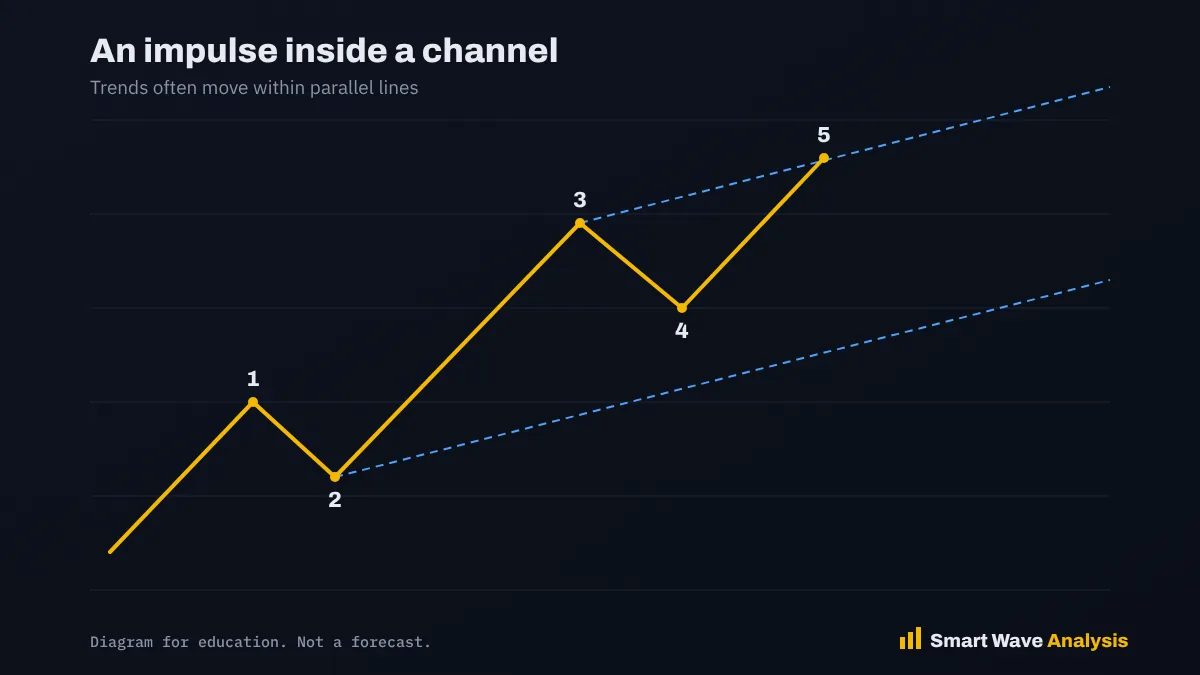
- The whole impulse often fits within a parallel channel.
- Wave 5 often shows momentum divergence.
How to confirm an impulse in real time
You cannot be sure an impulse is complete until it ends, but some signs help. A sharp, broad wave 3 that breaks the end of wave 1 with strength is a good sign. A wave 4 that stays above wave 1 and then a wave 5 that makes a new extreme completes the picture. After five waves, expect a three-wave correction of the same degree.
Where impulses appear
Impulses form waves 1, 3 and 5 of a larger impulse, and waves A and C of a zigzag. They also form wave C of a flat. Spotting an impulse tells you a move has a clear direction.
Example in real markets
Large trends in liquid markets often show clean impulses on daily or weekly charts. Long rallies in the S&P 500, extended moves in Bitcoin and steady trends in EUR/USD all provide practice material. Open any market page and try to find the most recent five-wave move.
Frequently asked questions
What is an impulse wave?
A five-wave move in the direction of the larger trend that follows all three Elliott Wave rules.
How does an impulse subdivide?
It subdivides 5-3-5-3-5: waves 1, 3 and 5 are impulses and waves 2 and 4 are corrections.
What comes after an impulse?
A three-wave correction of the same degree, labelled A, B and C or 2 or 4 depending on position.
Sources and further reading
- Elliott wave principle (Wikipedia)
- Frost, A. J. and Prechter, R. R., Elliott Wave Principle: Key to Market Behavior (1978) (Wikipedia (author page))
- Elliott Wave Theory: What You Need to Know (Investopedia)
Educational content only. Nothing on this page is financial advice or a recommendation to buy or sell. Trading involves risk and you can lose money. Elliott Wave counts are probabilities, not certainties. Read our full disclaimer and affiliate disclosure.