Every five-wave impulse must follow three rules. If a count breaks any of them, it is wrong. Wave 2 never retraces more than 100 percent of wave 1, wave 3 is never the shortest of waves 1, 3 and 5, and wave 4 does not enter the price range of wave 1.
Why rules matter
Elliott Wave analysis has many guidelines, which describe what usually happens. It has only three rules, which describe what must happen. Rules are what make the method testable. A count that breaks a rule must be dropped, and the price level where that happens becomes a natural stop loss.

Rule 1: Wave 2 never retraces more than 100 percent of wave 1
Wave 2 can pull back a lot, often 50 to 61.8 percent of wave 1 and sometimes more. But it can never go beyond the starting point of wave 1. In an uptrend, if price falls below the start of wave 1, the move you labelled as wave 1 was not a wave 1.
How to use it: when you enter near the end of wave 2, place your stop just beyond the start of wave 1. If that level breaks, your count is invalid and you exit with a known loss.
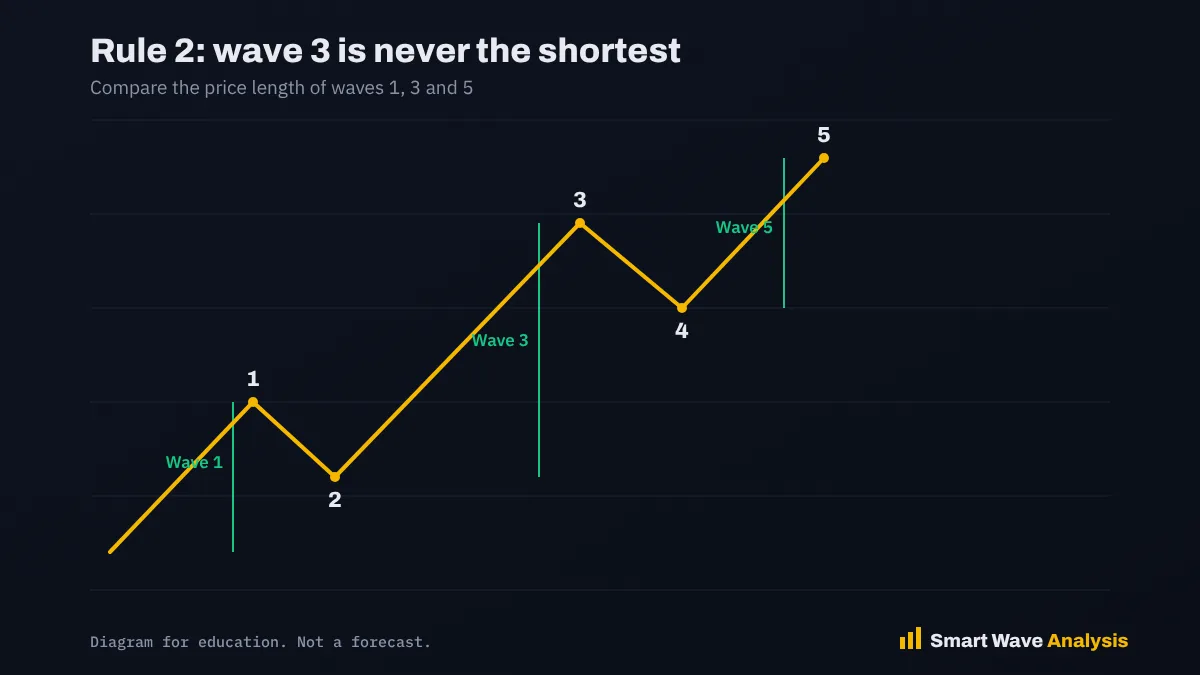
Rule 2: Wave 3 is never the shortest of waves 1, 3 and 5
Wave 3 does not have to be the longest wave, although it often is. It simply cannot be the shortest of the three motive waves. Length is measured in price, from the start to the end of each wave.
How to use it: if wave 3 is shorter than wave 1, then wave 5 must be shorter than wave 3. This puts a cap on how far wave 5 can go and helps you set targets.
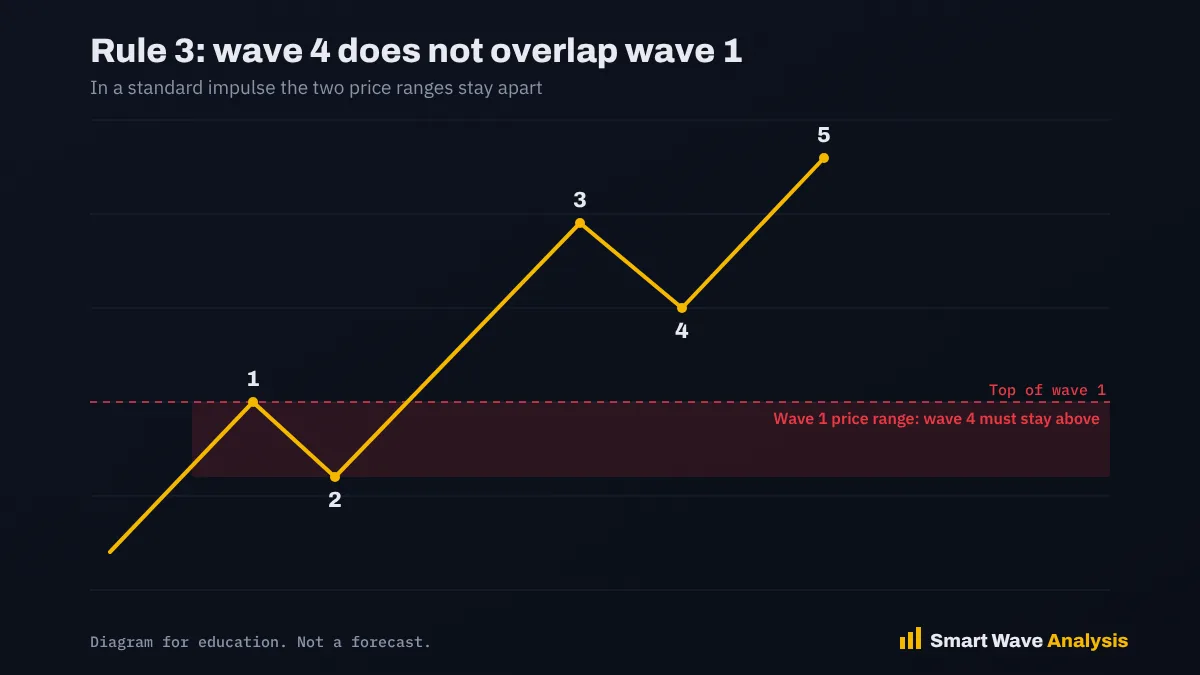
Rule 3: Wave 4 does not enter the price range of wave 1
In a standard impulse, the low of wave 4 in an uptrend must stay above the high of wave 1. The two waves cannot overlap. The only exceptions are diagonal triangles, which appear in the wave 1 or wave 5 position or in wave A or C, and are covered in their own lessons.
How to use it: if price drops into wave 1 territory during what you labelled wave 4, the structure is either a diagonal or a correction, not an impulse. This often warns that the trend is weaker than it looked.
A quick example
Suppose a stock rises from 100 to 120 (wave 1) and pulls back to 108 (wave 2). Rule 1 says wave 2 must stay above 100. It then rises to 150 (wave 3, a 42 point move, longer than wave 1’s 20 points). It pulls back to 135 (wave 4). Rule 3 says wave 4 must stay above 120, the top of wave 1, and 135 is fine. Wave 5 can now go higher, and since wave 3 is the longest so far, there is no cap from Rule 2.
Rules versus guidelines
Guidelines, such as alternation, channeling and Fibonacci ratios, help you choose between possible counts. Rules decide which counts are allowed at all. Always check the rules first.
Frequently asked questions
Can wave 2 go below the start of wave 1?
No. If it does, the move you labelled wave 1 was not the start of an impulse.
Does wave 3 have to be the longest wave?
No. It only cannot be the shortest of waves 1, 3 and 5. In most markets, though, it is the longest.
When can wave 4 overlap wave 1?
Only in diagonal triangles, which form in the wave 1 or wave 5 position of an impulse or the A or C position of a zigzag.
Sources and further reading
- Elliott wave principle (Wikipedia)
- Frost, A. J. and Prechter, R. R., Elliott Wave Principle: Key to Market Behavior (1978) (Wikipedia (author page))
- Elliott Wave Theory: What You Need to Know (Investopedia)
Educational content only. Nothing on this page is financial advice or a recommendation to buy or sell. Trading involves risk and you can lose money. Elliott Wave counts are probabilities, not certainties. Read our full disclaimer and affiliate disclosure.