A triangle is a sideways correction of five overlapping waves labelled A-B-C-D-E, each made of three waves. Triangles appear just before the final move of a larger pattern, so they are most common in wave 4, wave B and the last part of complex corrections.
Structure
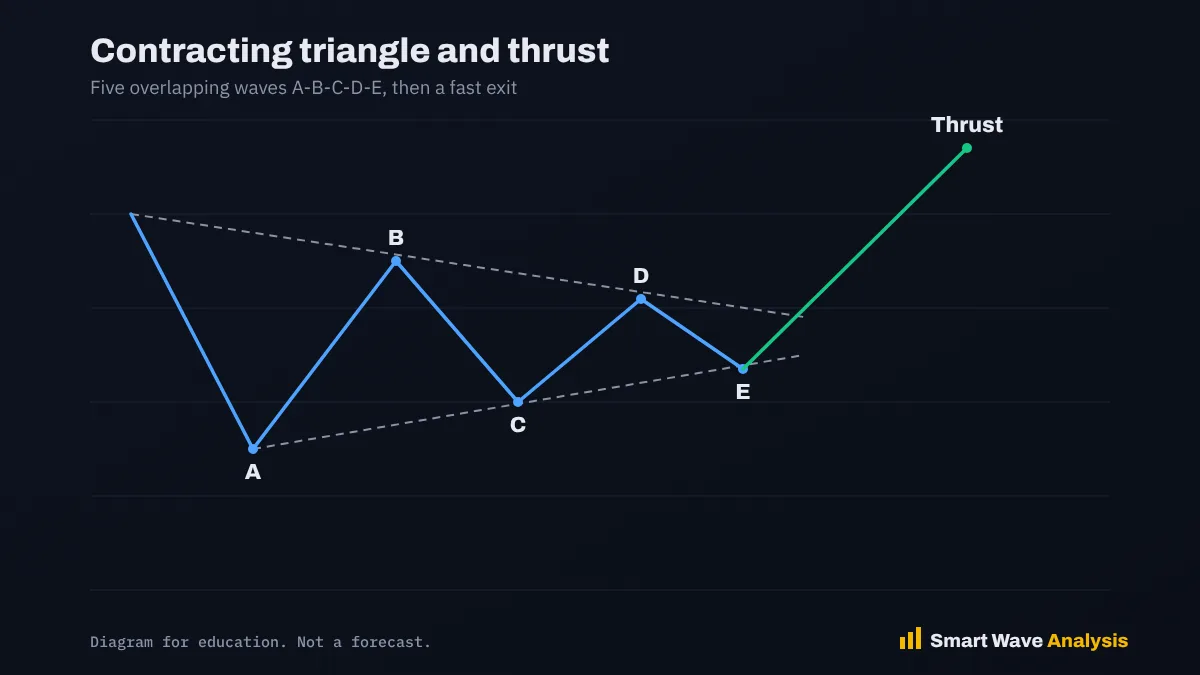
A triangle subdivides 3-3-3-3-3. Its waves move between two trend lines: one connecting the ends of waves A and C, and one connecting the ends of waves B and D. Wave E often stops short of the A-C line.
Types of triangles
- Contracting: the trend lines converge. This is by far the most common. It can be symmetrical, ascending or descending.
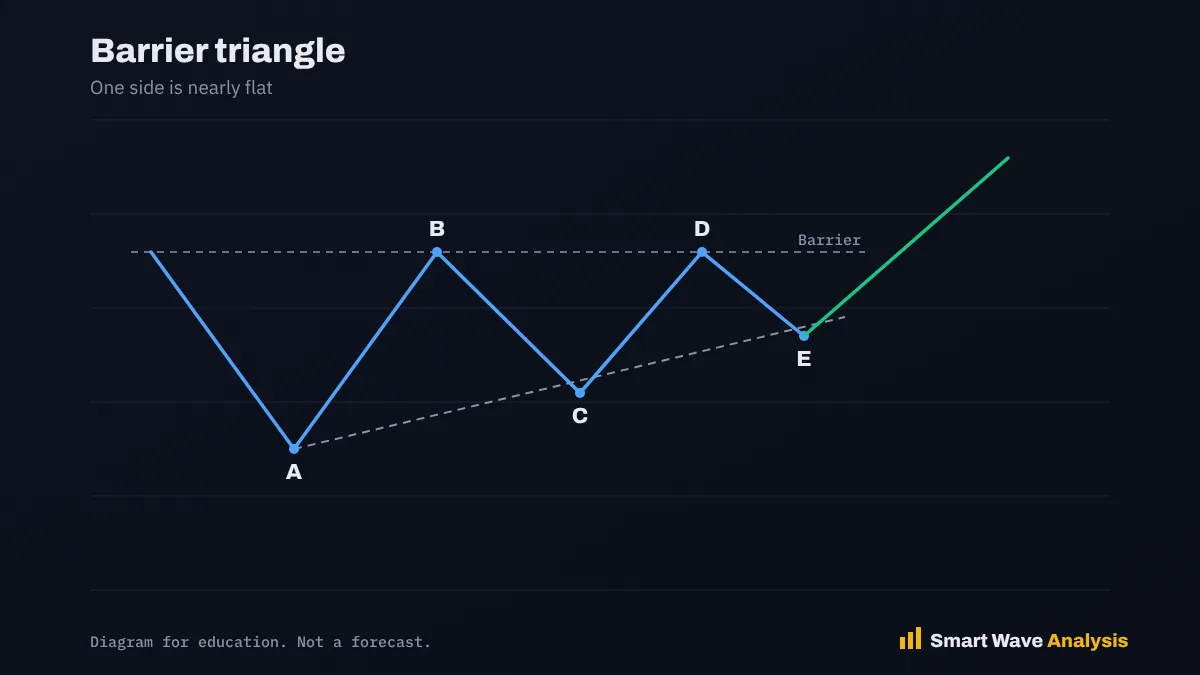
- Barrier: one trend line is nearly flat, like a ceiling or floor.
- Expanding: the trend lines diverge. This form is rare.
Where triangles appear
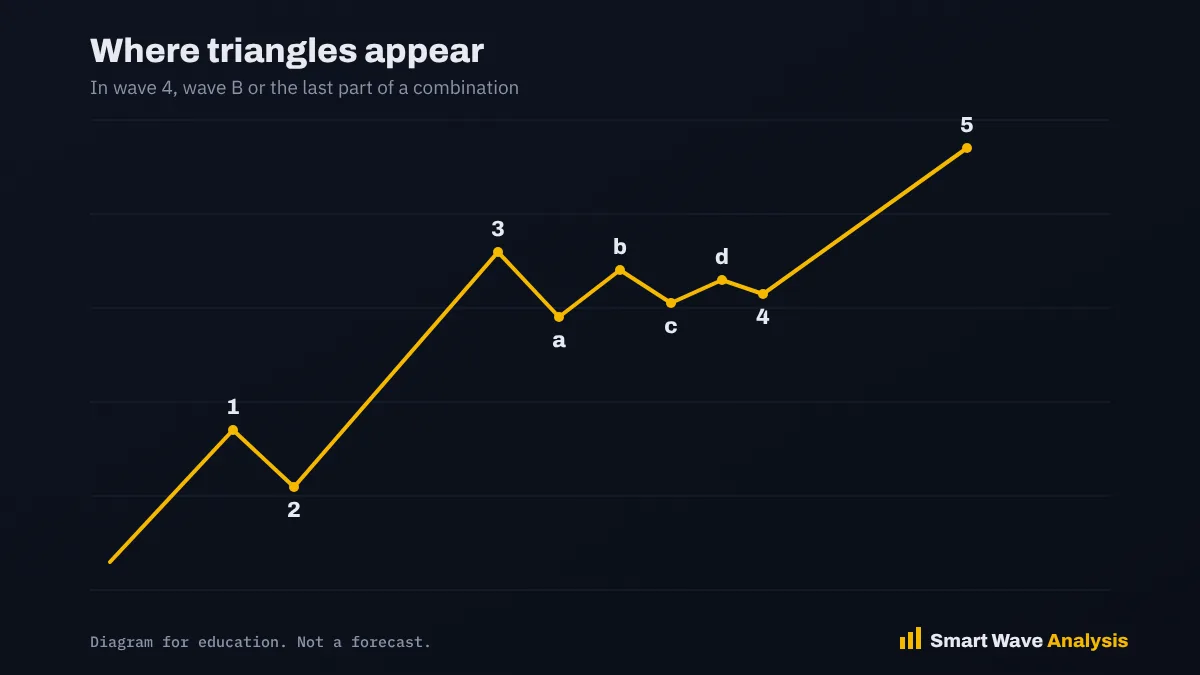
Triangles come before the final move in a pattern. You will find them in:
- Wave 4 of an impulse, just before wave 5.
- Wave B of a zigzag, just before wave C.
- The last part (Y or Z) of a double or triple three.
Triangles do not appear in wave 2 of an impulse.
The thrust after a triangle
When a triangle ends, the market moves out of it with a fast move called the thrust. In a wave 4 triangle, the thrust is wave 5. A useful guide is that the thrust often travels about the widest part of the triangle, measured from the start of wave A.
Trading tips
- Avoid trading inside a triangle. The waves overlap and are hard to time.
- Wait for the break of the B-D line after wave E ends.
- Remember the thrust is a final move. Plan to take profit, not to hold for a long new trend.
Frequently asked questions
How many waves does a triangle have?
Five waves, labelled A, B, C, D and E, each made of three smaller waves.
Where do triangles appear?
In wave 4, wave B and the last part of complex corrections, just before the final move.
What is a triangle thrust?
The fast move out of a triangle when it ends, often about the width of the triangle's widest part.
Sources and further reading
- Frost, A. J. and Prechter, R. R., Elliott Wave Principle: Key to Market Behavior (1978) (Wikipedia (author page))
- Elliott wave principle (Wikipedia)
Educational content only. Nothing on this page is financial advice or a recommendation to buy or sell. Trading involves risk and you can lose money. Elliott Wave counts are probabilities, not certainties. Read our full disclaimer and affiliate disclosure.