An extension is an elongated motive wave whose smaller waves are almost as large as the other main waves. Most impulses have one extended wave, and in stocks and many other markets it is usually wave 3.
What an extension looks like
In an extended wave, the five smaller waves inside it are so large that the whole impulse can look like nine waves instead of five. For example, if wave 3 is extended, its sub-waves (i), (ii), (iii), (iv) and (v) are all clearly visible and similar in size to waves 1, 2, 4 and 5.
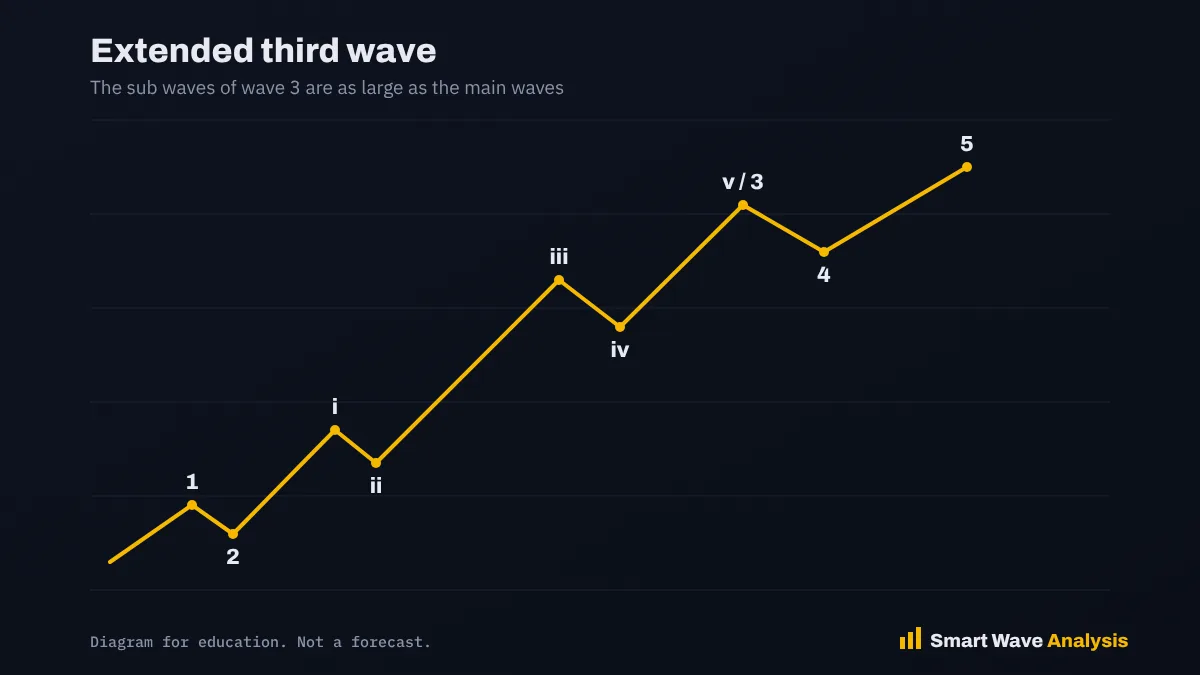
Which wave extends?
- Wave 3: the most common in stock indices and currencies. It often reaches 161.8% or 261.8% of wave 1.
- Wave 5: common in commodities and crypto, where late stage speculation can drive the final wave very far.
- Wave 1: the least common. If wave 1 is extended, waves 3 and 5 tend to be shorter.
Useful guideline: only one extension
Usually only one of the three motive waves extends. If waves 1 and 3 are about equal in length, wave 5 is likely to extend. If wave 3 is extended, waves 1 and 5 often tend toward equality in size.
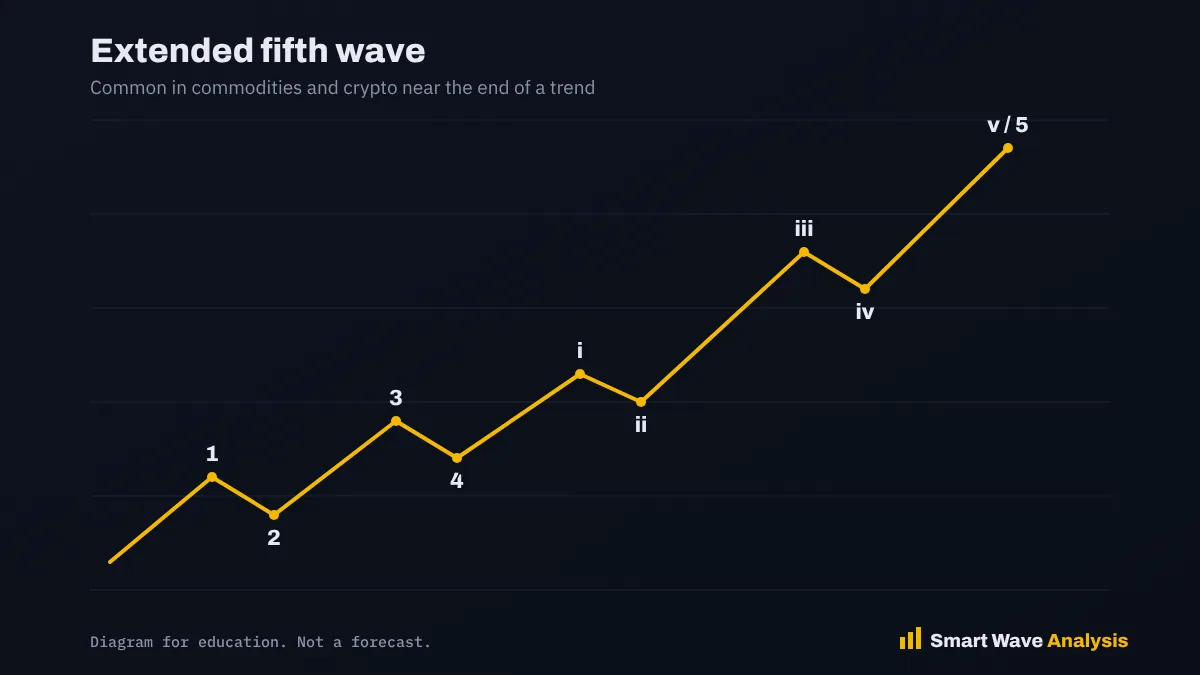
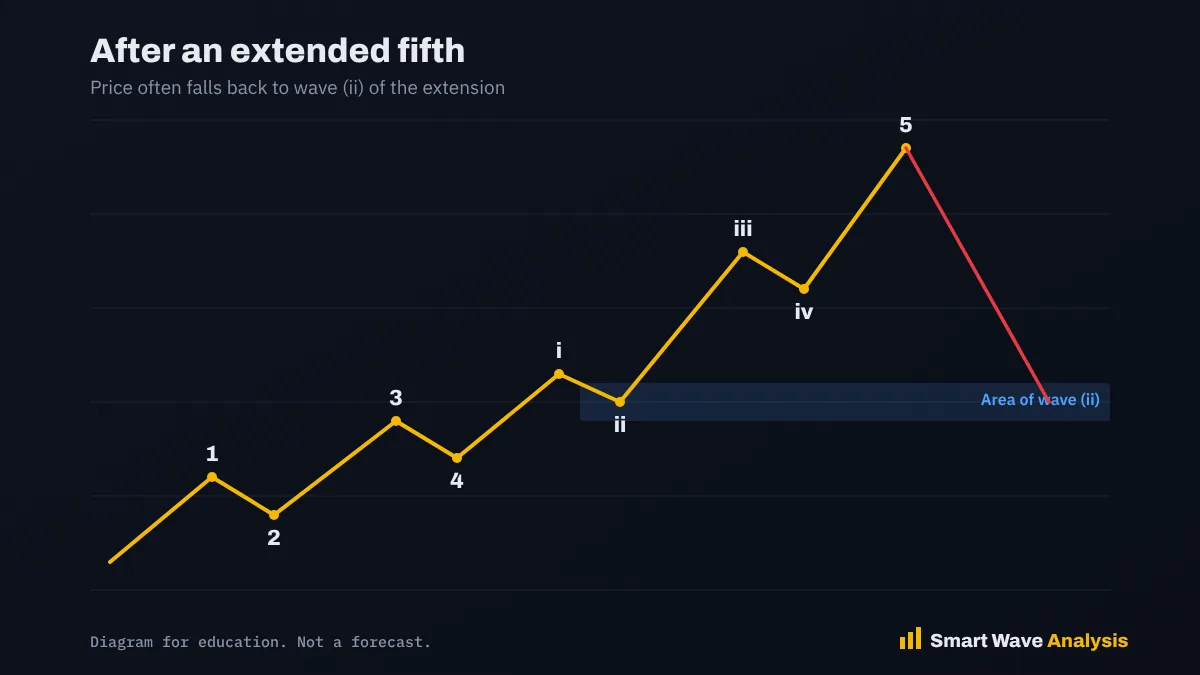
What happens after an extension
When wave 5 is extended, the correction that follows often retraces sharply back to the area of wave (ii) inside the extension. This is called a double retracement and is common after blow-off moves.
Trading tips
- Do not exit too early in an extended wave 3. Trail your stop below the previous smaller wave (iv).
- Watch for wave (v) of 3 to show momentum loss before expecting wave 4.
- In crypto and commodities, keep an extended wave 5 in mind when waves 1 and 3 are similar in size.
Frequently asked questions
Which Elliott wave extends most often?
Wave 3, especially in stock indices and currencies.
Can more than one wave extend?
It is rare. Usually only one of waves 1, 3 and 5 extends.
What happens after an extended fifth wave?
The market often retraces quickly to the area of wave (ii) inside the extension.
Sources and further reading
- Frost, A. J. and Prechter, R. R., Elliott Wave Principle: Key to Market Behavior (1978) (Wikipedia (author page))
- Elliott wave principle (Wikipedia)
Educational content only. Nothing on this page is financial advice or a recommendation to buy or sell. Trading involves risk and you can lose money. Elliott Wave counts are probabilities, not certainties. Read our full disclaimer and affiliate disclosure.