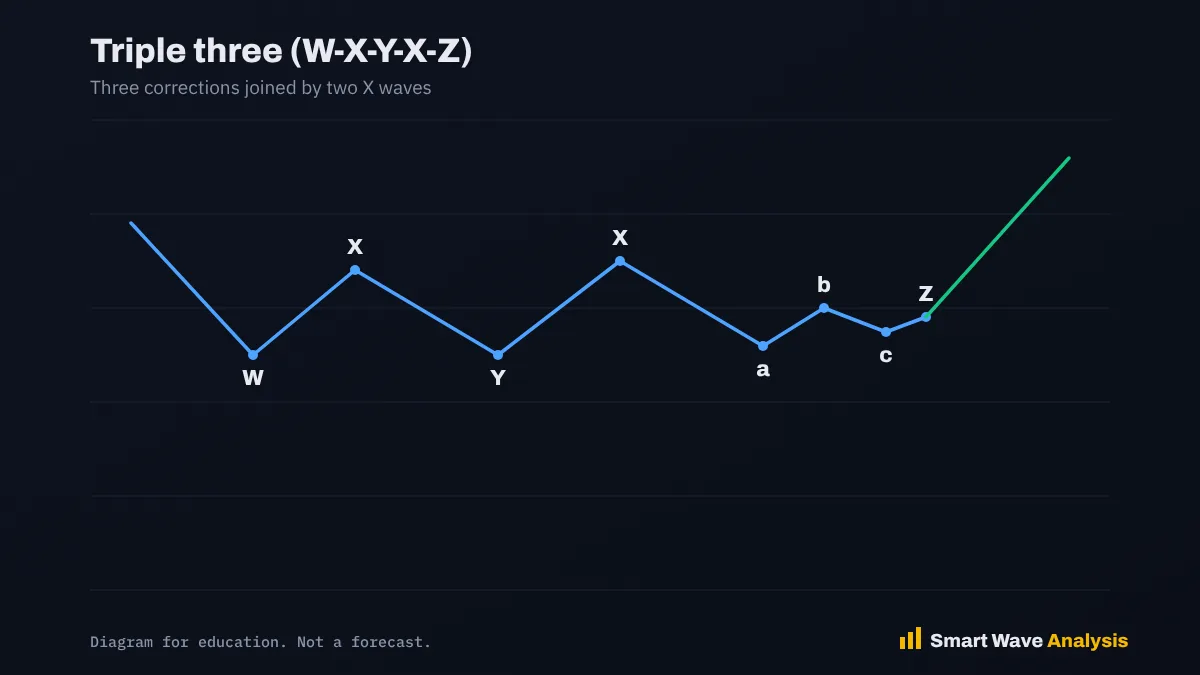
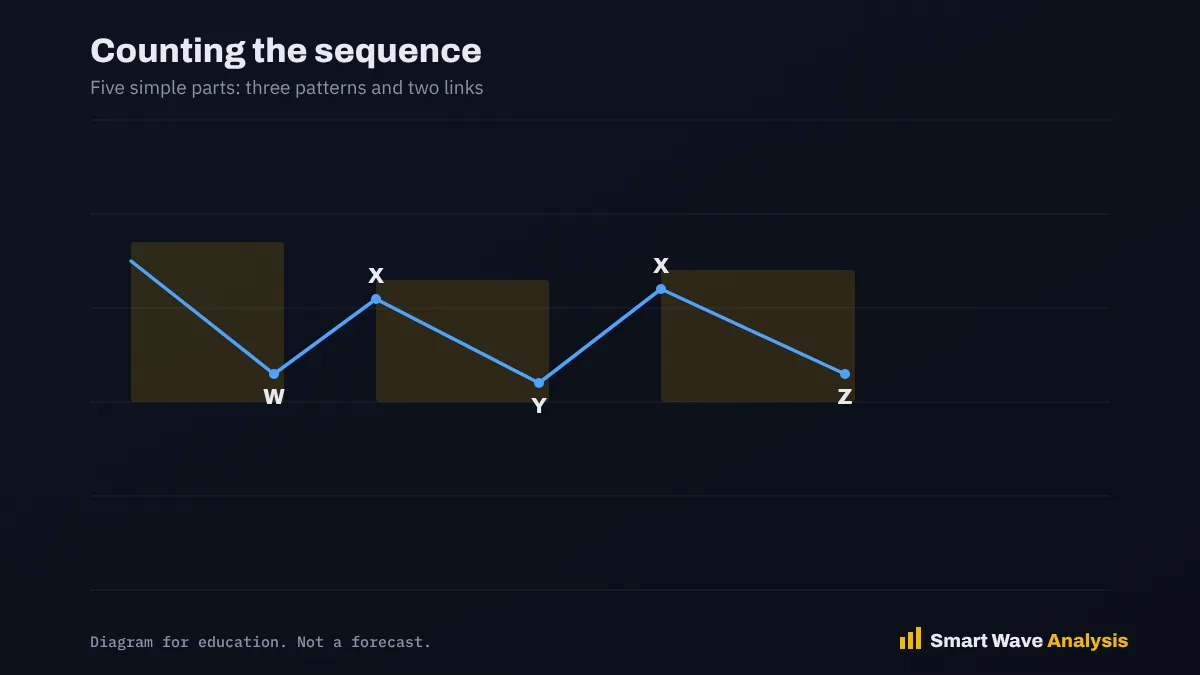
A triple three is a rare complex correction made of three simple patterns, labelled W, Y and Z, joined by two X waves. It extends a sideways correction even further in time than a double three.
Structure
A triple three follows the form W-X-Y-X-Z. Each of W, Y and Z is a zigzag, flat or triangle, and each X is a three-wave move. As with the double three, the overall shape is sideways.
How rare is it?
Triple threes are uncommon. Most complex corrections end as double threes. Analysts should consider a triple three only when a sideways market continues well after a double three appears complete.
Where triple threes appear
They appear mainly in wave 4, wave B and wave X positions, where the market is waiting for the next major move. They can also appear in markets with low news flow and thin participation.
Trading tips
- When a market keeps moving sideways, reduce trading size and wait.
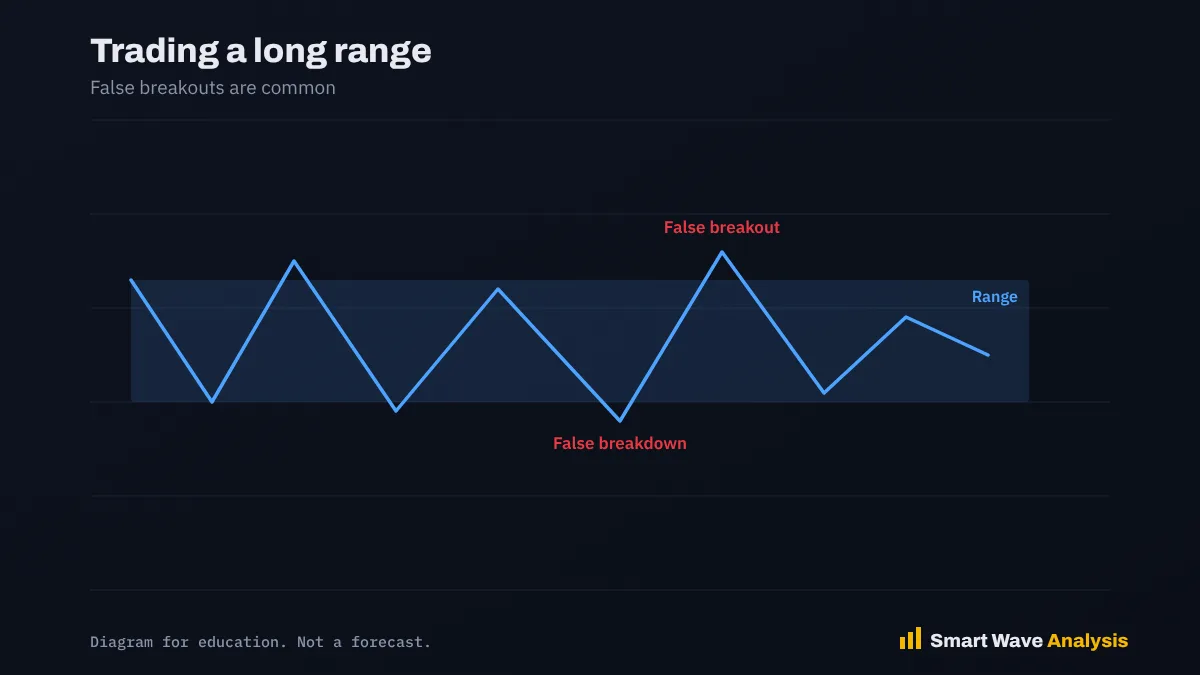
- Range trading may work, but expect false breakouts.
- A triangle as the Z wave often signals the end of the pattern.
Frequently asked questions
What is a triple three?
A complex correction of three simple patterns, W, Y and Z, joined by two X waves.
How common are triple threes?
They are rare. Most complex corrections end as double threes.
What signals the end of a triple three?
Often a triangle in the Z position followed by a strong move out of the range.
Sources and further reading
- Frost, A. J. and Prechter, R. R., Elliott Wave Principle: Key to Market Behavior (1978) (Wikipedia (author page))
- Elliott wave principle (Wikipedia)
Educational content only. Nothing on this page is financial advice or a recommendation to buy or sell. Trading involves risk and you can lose money. Elliott Wave counts are probabilities, not certainties. Read our full disclaimer and affiliate disclosure.