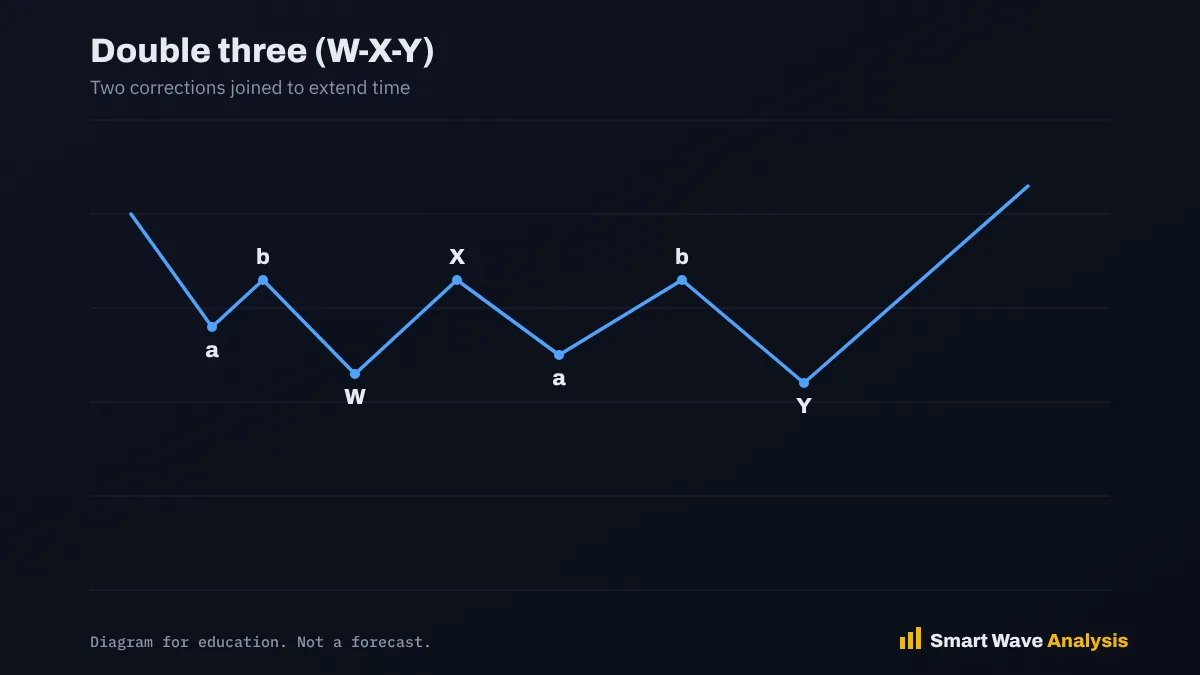
A double three is a sideways correction made of two simple corrective patterns, labelled W and Y, joined by a three-wave connecting move labelled X. It is used by the market to extend a correction in time.
Structure
A double three combines two corrective patterns. The first, W, is often a zigzag or flat. The second, Y, is often a flat or triangle. The X wave between them is a correction in the opposite direction, usually a zigzag.
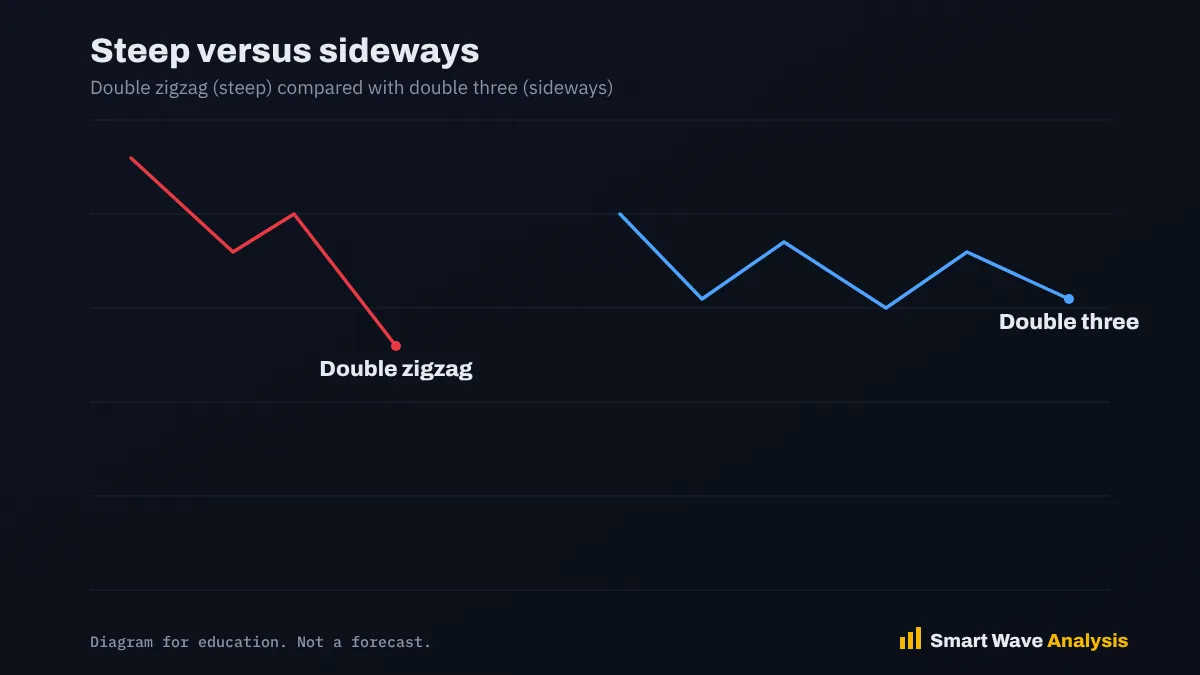
Unlike a double zigzag, which is steep, a double three is mostly sideways. Its goal is to use up time rather than to retrace a lot of price.
Common combinations
- Zigzag, X, flat.
- Flat, X, flat.
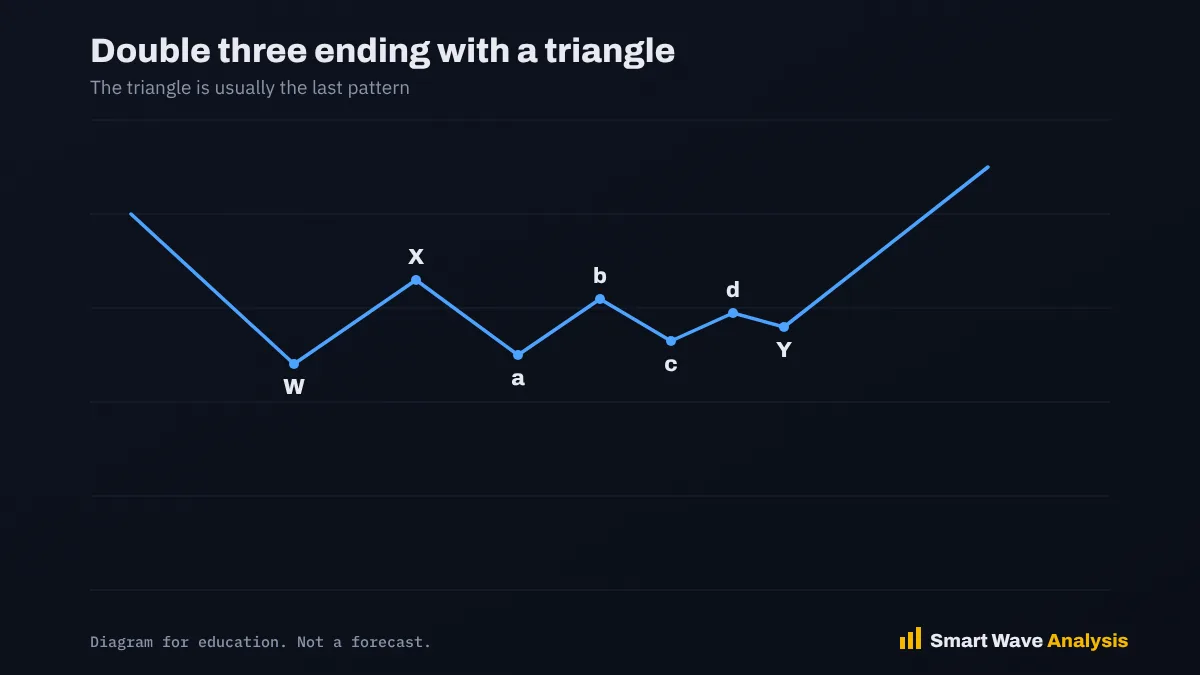
- Zigzag, X, triangle.
- Flat, X, triangle.
Usually only one zigzag and one triangle appear in a combination, and a triangle, if present, is the last pattern.
How to spot one
A double three often begins when a correction looks complete, but the trend does not resume with strength. Instead, the market moves sideways again. If the move after the first pattern is a three-wave move rather than an impulse, it may be wave X.
Trading tips
- Be patient. Double threes can last much longer than expected.
- Do not label every bounce in a sideways market as a new trend.
- Look for a triangle or flat as the final Y wave before the trend resumes.
Frequently asked questions
What is a double three?
A sideways correction of two simple patterns, W and Y, joined by an X wave.
How is a double three different from a double zigzag?
A double zigzag is steep and deep. A double three is mostly sideways and extends a correction in time.
Which patterns can make up a double three?
Usually a mix of zigzags, flats and triangles, with any triangle coming last.
Sources and further reading
- Frost, A. J. and Prechter, R. R., Elliott Wave Principle: Key to Market Behavior (1978) (Wikipedia (author page))
- Elliott wave principle (Wikipedia)
Educational content only. Nothing on this page is financial advice or a recommendation to buy or sell. Trading involves risk and you can lose money. Elliott Wave counts are probabilities, not certainties. Read our full disclaimer and affiliate disclosure.