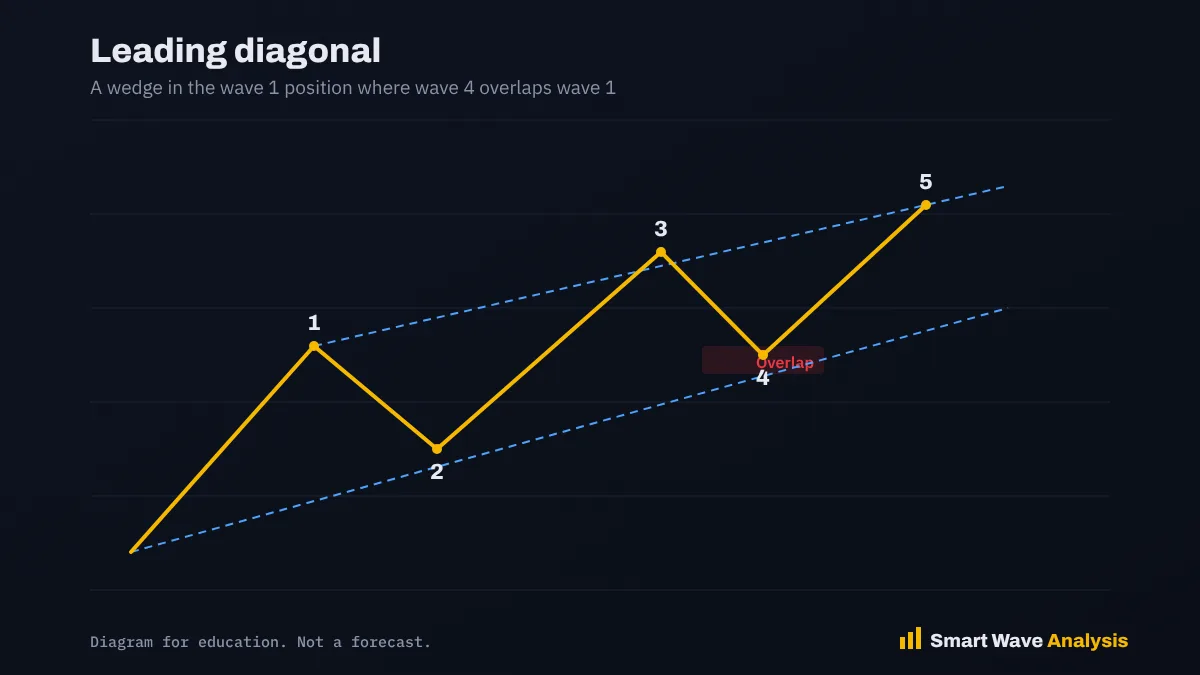
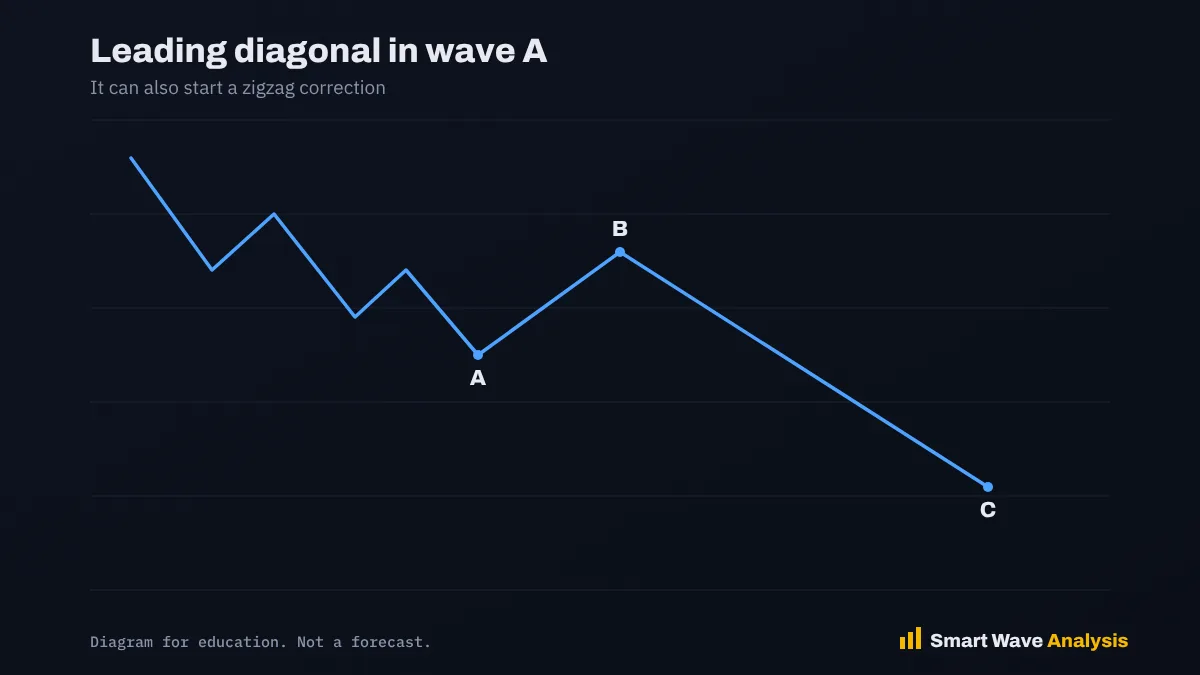
A leading diagonal is a wedge-shaped motive pattern that appears in the wave 1 position of an impulse or the wave A position of a zigzag. It usually subdivides 5-3-5-3-5, and wave 4 typically overlaps wave 1.
Structure
A leading diagonal has five waves inside converging or, more rarely, expanding trend lines. Most often its waves subdivide 5-3-5-3-5, though a 3-3-3-3-3 version is also recognized by some analysts. The key difference from a normal impulse is that wave 4 usually overlaps the price range of wave 1.
Where it appears
- Wave 1 of an impulse.
- Wave A of a zigzag.
What it tells you
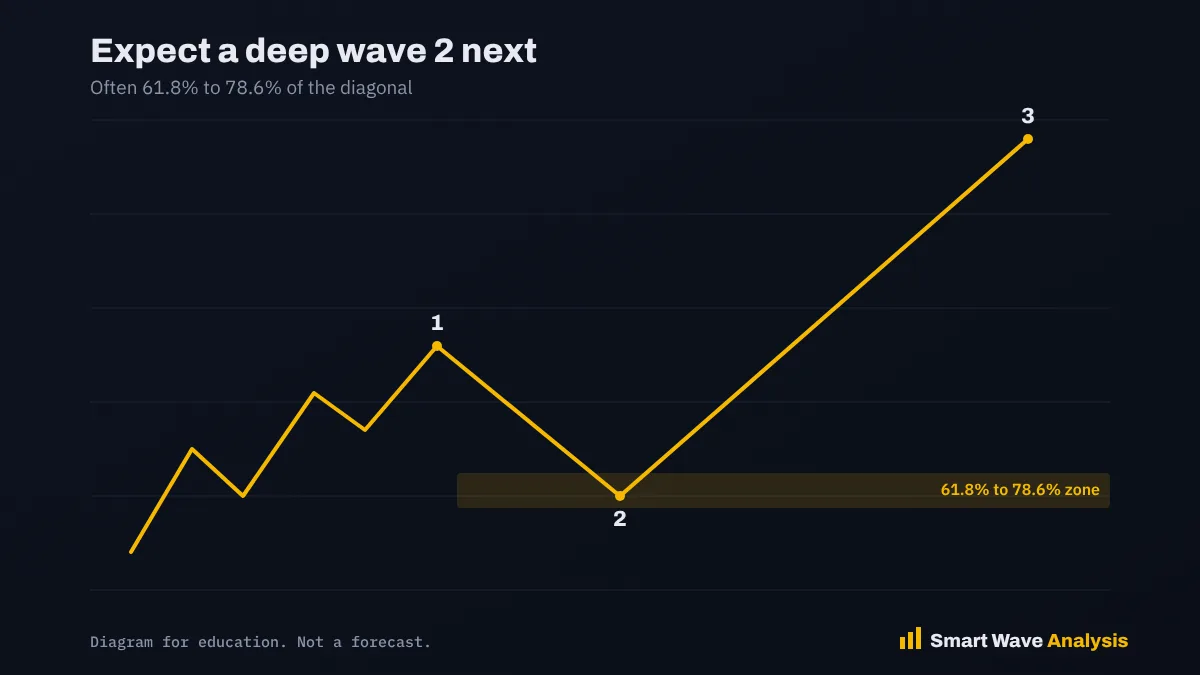
A leading diagonal shows that a new trend is starting, but with hesitation. After it ends, the following wave 2 or wave B often retraces deeply, frequently 61.8 to 78.6 percent of the diagonal. That deep pullback sets up a strong wave 3.
Trading tips
- Do not reject a count just because wave 4 overlaps wave 1 in the first wave of a new trend. Check for a diagonal.
- Expect a deep wave 2 after a leading diagonal, and look for entries near the 61.8 to 78.6 percent retracement.
- Place stops beyond the start of the diagonal.
Frequently asked questions
Where do leading diagonals form?
In the wave 1 position of an impulse or the wave A position of a zigzag.
Can wave 4 overlap wave 1 in a leading diagonal?
Yes. Overlap is normal in diagonals and is the main difference from a standard impulse.
What follows a leading diagonal?
Usually a deep wave 2 or wave B retracement, often 61.8 to 78.6 percent.
Sources and further reading
- Frost, A. J. and Prechter, R. R., Elliott Wave Principle: Key to Market Behavior (1978) (Wikipedia (author page))
- Elliott wave principle (Wikipedia)
Educational content only. Nothing on this page is financial advice or a recommendation to buy or sell. Trading involves risk and you can lose money. Elliott Wave counts are probabilities, not certainties. Read our full disclaimer and affiliate disclosure.