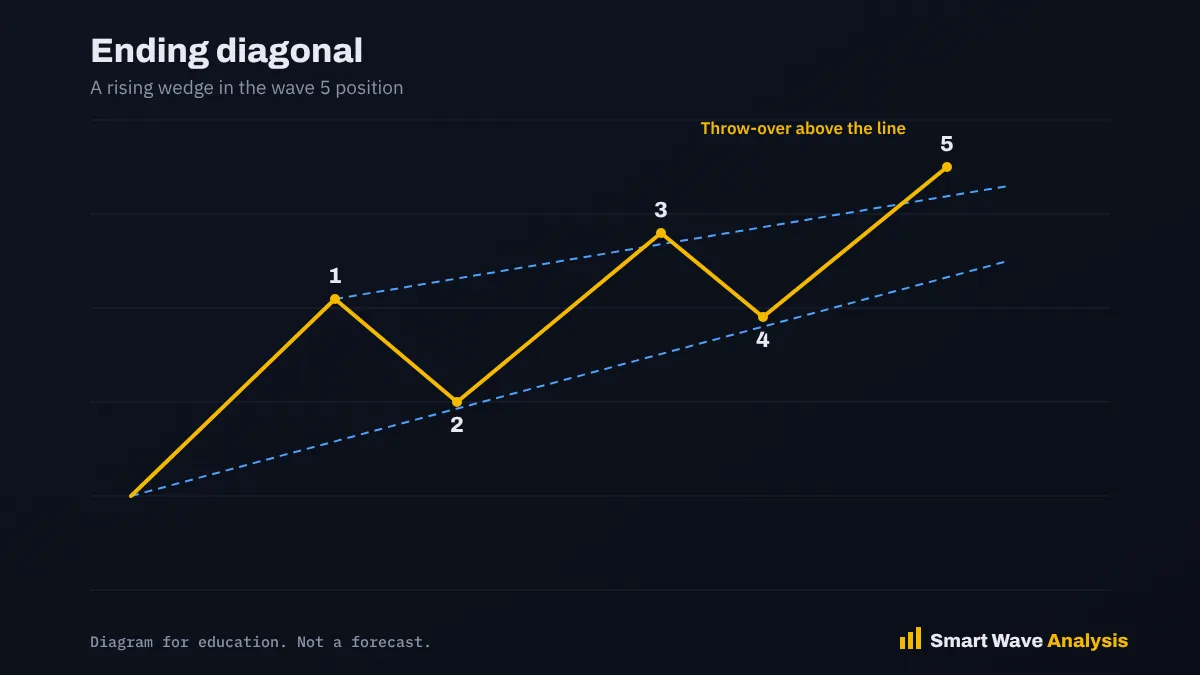
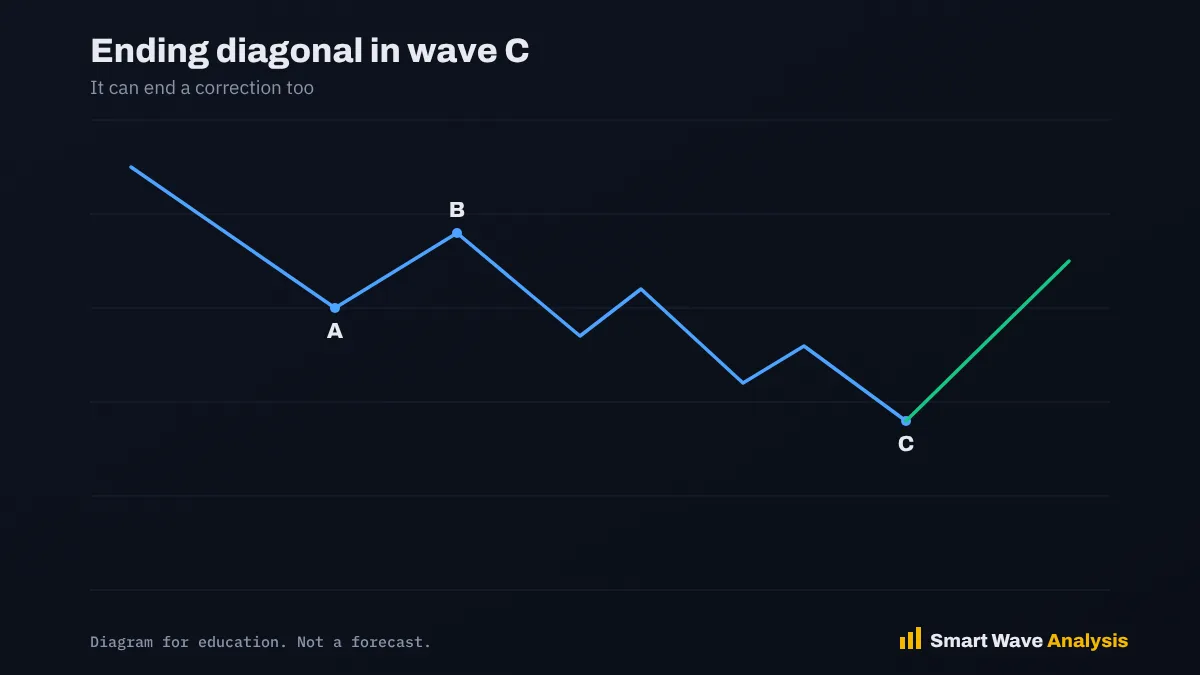
An ending diagonal is a wedge-shaped pattern that appears in the wave 5 position of an impulse or the wave C position of a correction. All five of its waves subdivide into three waves, 3-3-3-3-3, and it signals that the larger move is close to its end.
Structure
An ending diagonal has five waves inside two converging trend lines, forming a wedge. Each of its waves is a three-wave move, so it subdivides 3-3-3-3-3. Wave 4 almost always overlaps wave 1. In a contracting ending diagonal, wave 3 is shorter than wave 1, and wave 5 is shorter than wave 3.
Where it appears
- Wave 5 of an impulse, often after a wave 3 that moved too far, too fast.
- Wave C of a zigzag or flat.
The throw-over
Wave 5 of an ending diagonal often pokes briefly beyond the upper trend line in an uptrend, or below the lower line in a downtrend. This is called a throw-over. It frequently comes with a spike in volume and is followed by a fast reversal.
What happens next
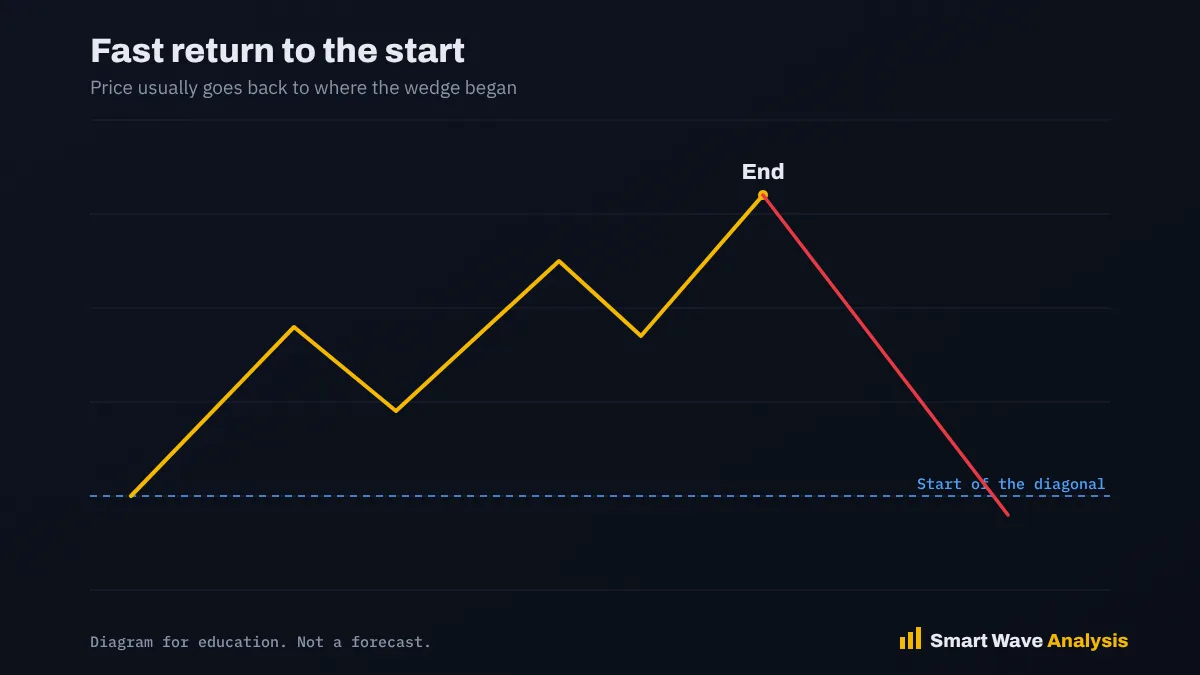
After an ending diagonal, the market usually reverses sharply and returns at least to the starting point of the diagonal, often in a short time. This makes ending diagonals one of the most useful reversal signals in Elliott Wave analysis.
Trading tips
- Avoid buying the final push of a rising wedge after a long rally.
- Look for a break of the lower trend line to confirm the pattern is complete.
- Use the start of the diagonal as a first target for the reversal.
Frequently asked questions
How does an ending diagonal subdivide?
All five waves are three-wave moves, so it subdivides 3-3-3-3-3.
What is a throw-over?
A brief move of wave 5 beyond the diagonal's trend line, often just before a sharp reversal.
How far does price fall after an ending diagonal?
It often returns at least to where the diagonal began, and usually quickly.
Sources and further reading
- Frost, A. J. and Prechter, R. R., Elliott Wave Principle: Key to Market Behavior (1978) (Wikipedia (author page))
- Elliott wave principle (Wikipedia)
Educational content only. Nothing on this page is financial advice or a recommendation to buy or sell. Trading involves risk and you can lose money. Elliott Wave counts are probabilities, not certainties. Read our full disclaimer and affiliate disclosure.