By the Smart Wave Analysis team. Published November 3, 2026. Prices as of 06:40 UTC.
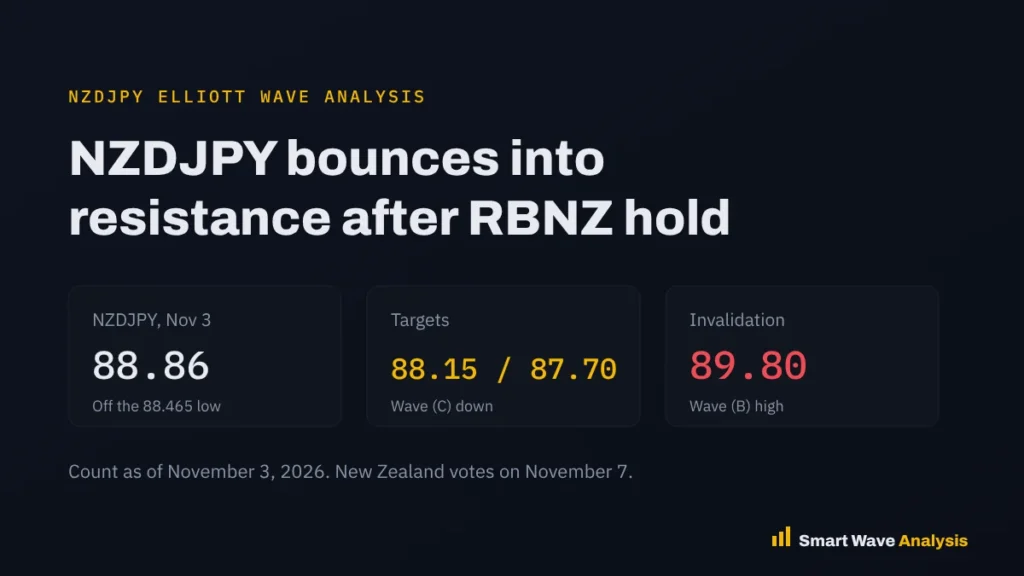
NZDJPY trades near 88.86 on November 3, 2026, after bouncing from a low of 88.465 earlier in the day. The bounce has reached resistance at 88.90 to 89.00. Our count reads the fall from the October high near 90.33 as an A-B-C decline, now in wave (C). The targets are 88.15 and 87.70, and the count stays valid while price holds below 89.80. Count date: November 3, 2026.
Key takeaways
- Kiwi side: the Reserve Bank of New Zealand held its cash rate at 2.75% on October 28 when markets expected a hike.
- Yen side: the Bank of Japan held at 1.25% but said underlying inflation has reached 2% and left a December hike open.
- Wave count: NZDJPY is in wave (C) of an A-B-C decline from the October high, with targets at 88.15 and 87.70.
- Risk line: a move above 89.80 cancels the count. The New Zealand election on November 7 adds event risk.
NZDJPY combines two currencies that are moving on central bank news this month. This post explains both sides, then sets out the wave count and the levels to watch. You can follow the daily count on our NZD/JPY analysis page.
RBNZ surprise hold weighs on the kiwi
The Reserve Bank of New Zealand kept its official cash rate at 2.75% on October 28, 2026, ending a run of two hikes, according to the Reserve Bank of New Zealand cash rate page. The vote was 4 to 3, with three members wanting a rise to 3%. Inflation eased to 3.7% in the September quarter, below the bank’s forecast, though the bank expects it to rise to 4.4% by year end because of fuel prices.
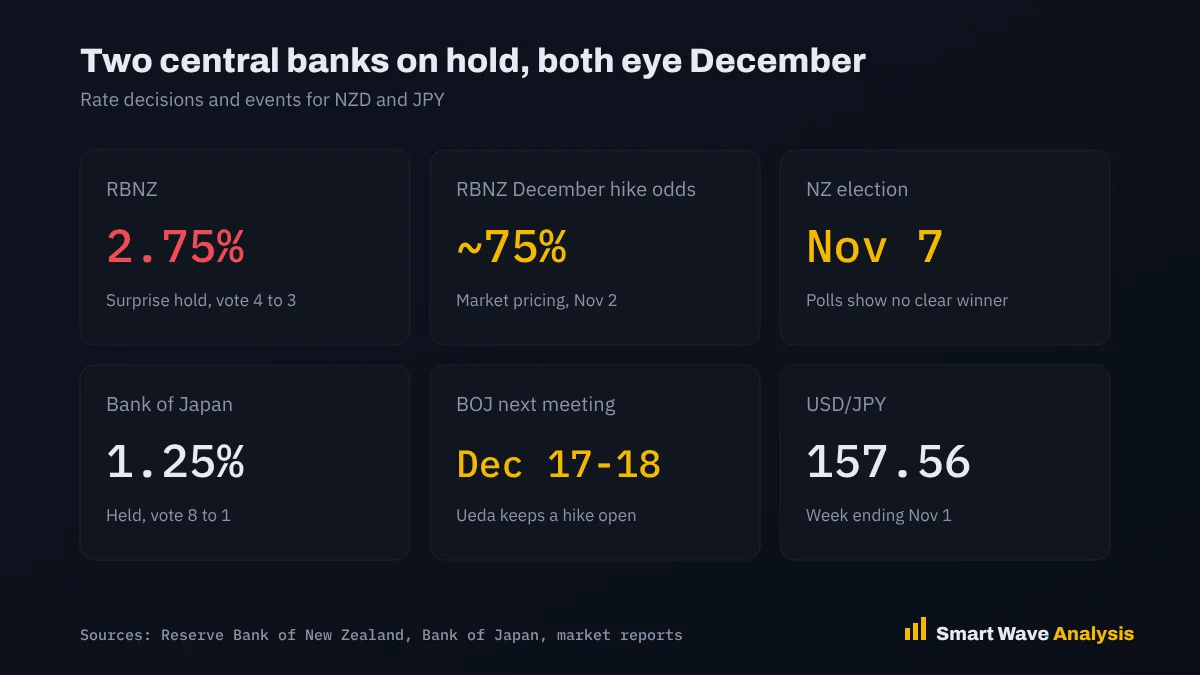
The kiwi led losses among major currencies that week, and NZD/USD fell to about 0.560 on November 2, its weakest level in nearly three weeks. Governor Anna Breman said the chance of a December hike is high, and markets priced it at about 75%. Investors are also waiting for the third quarter jobs report and the general election on Saturday, November 7, where polls show no clear winner.
Bank of Japan keeps a December hike in play
The Bank of Japan held its rate at 1.25% on October 30, with an 8 to 1 vote, based on the Bank of Japan policy statements. Governor Kazuo Ueda said underlying inflation has reached the 2% target and that “the policy phase is changing.” He said decisions will be made at each meeting, including the next one on December 17 and 18. That supports the yen against higher yielding currencies like the kiwi. See our USD/JPY wave count for the yen side.
NZDJPY Elliott Wave count
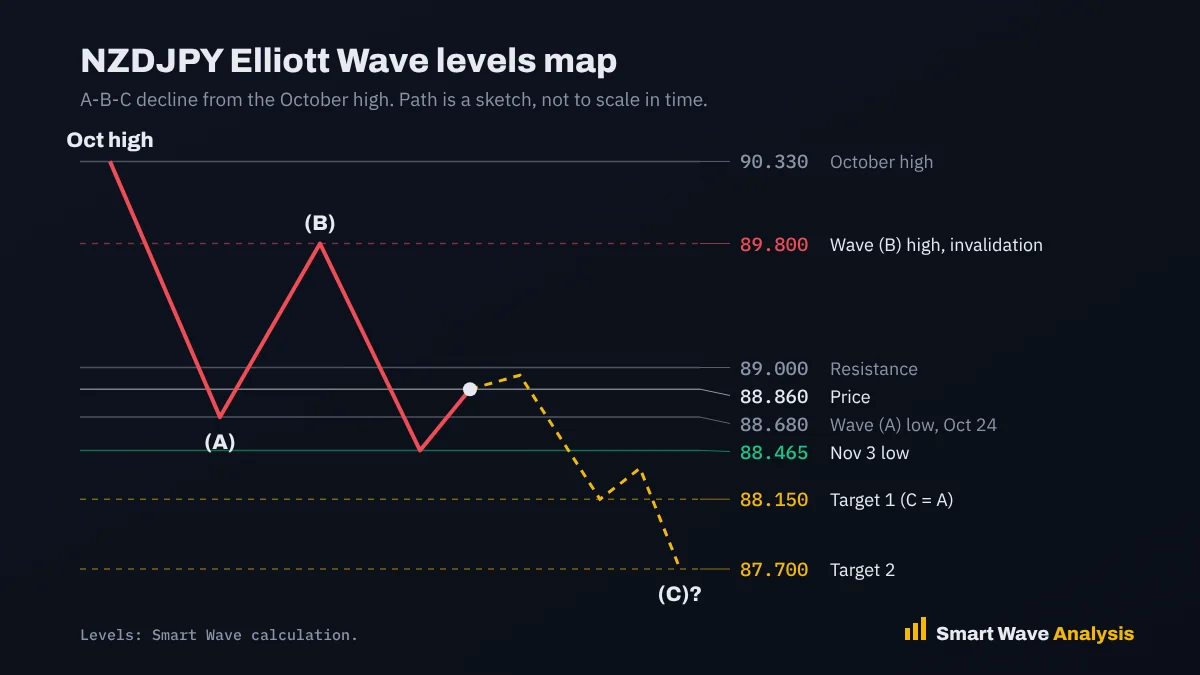
NZDJPY peaked near 90.33 in late October. We read the move since then as an A-B-C decline, the pattern known as a zigzag:
- Wave (A): the drop from about 90.33 to about 88.68 in late October.
- Wave (B): the bounce to about 89.80, which failed well below the high.
- Wave (C): the decline from 89.80 that is now in progress. It has already broken below the wave (A) low, reaching 88.465 on November 3.

Today’s bounce from 88.465 to 88.90 looks like a small pause inside wave (C), not a new uptrend. If wave (C) equals wave (A), which measured about 1.65 yen, it points to about 88.15. A longer wave (C) at 127.2% of wave (A) points to about 87.70. Read more about this pattern in our zigzag correction lesson.
| Level | NZDJPY | Why it matters |
|---|---|---|
| October high | 90.33 | Start of the decline |
| Invalidation | 89.80 | Wave (B) high. A move above cancels the count |
| Resistance | 88.90 to 89.00 | Today’s bounce high and the 89 round number |
| Price | 88.86 | November 3, 2026 |
| Trigger | 88.465 | A break below resumes wave (C) |
| Target 1 | 88.15 | Wave (C) equals wave (A) |
| Target 2 | 87.70 | Wave (C) at 127.2% of wave (A) |
How we built this count
We start from the daily chart to mark the October high and the swings since then, then use the 1-minute chart to time the current bounce. Price data comes from the OANDA NZD/JPY feed on TradingView. Targets use standard Fibonacci ratios between wave (A) and wave (C), and every count has one invalidation level. Keep our economic calendar open for the New Zealand jobs data.
Trade plan
- Bearish viewSell near 88.90 to 89.00, with a stop above 89.20. The wider stop for a swing trade sits above 89.80.
- Targets88.465 first, then 88.15 and 87.70. Take some profit at each step.
- Event riskThe New Zealand jobs report and the November 7 election can move the kiwi sharply. Keep positions small around them.
- RiskSize each trade so a stop costs only 1% to 2% of your account. Our position size calculator does the math.
Want the next NZDJPY count before the move?
Get professional Elliott Wave analysis with updated charts, clear targets and invalidation levels for forex, stocks, indices, commodities and crypto.
- Daily chart updates
- Entry and stop levels
- Several timeframes
Frequently asked questions
Why did NZDJPY fall in late October 2026?
The Reserve Bank of New Zealand surprised markets by holding its cash rate at 2.75% on October 28 when a hike was expected. The New Zealand dollar fell, while the yen found support after the Bank of Japan said underlying inflation has reached its 2% target.
What is the NZDJPY Elliott Wave target?
Our count shows an A-B-C decline from the October high near 90.33. Wave (C) targets 88.15, where it equals wave (A), and then 87.70. A move above 89.80 would cancel the count.
When are the next RBNZ and BOJ decisions?
The Bank of Japan meets on December 17 and 18, 2026. The Reserve Bank of New Zealand also decides in December, and markets priced about a 75% chance of a hike.
What events could move NZDJPY this week?
New Zealand’s third quarter jobs report and the New Zealand general election on Saturday, November 7, 2026. Polls show no clear winner, which adds risk for the kiwi.
Sources
This analysis is for education and is not financial advice. Elliott Wave counts are probabilities, not certainties. Read our risk disclaimer.
Free Elliott Wave e-books
 FREE
Elliott Wave Forecasting Guide
A clear introduction to forecasting markets with the Elliott Wave Principle.
Get the free e-book FREE
Elliott Wave Trading Strategies
Practical setups for entries, stops and exits using wave structure.
Get the free e-book FREE
Beginner's Guide to Forex Trading
Forex basics for new traders: pairs, pips, lots, sessions and risk.
Get the free e-book FREE
Guide to Trading Stocks and ETFs
How stock and ETF markets work and how to read them with wave analysis.
Get the free e-bookFree download after a short sign-up with the publisher.
Educational content only. Nothing on this page is financial advice or a recommendation to buy or sell. Trading involves risk and you can lose money. Elliott Wave counts are probabilities, not certainties. Read our full disclaimer and affiliate disclosure.