By the Smart Wave Analysis team. Published November 5, 2026. Results as of the morning of November 5.
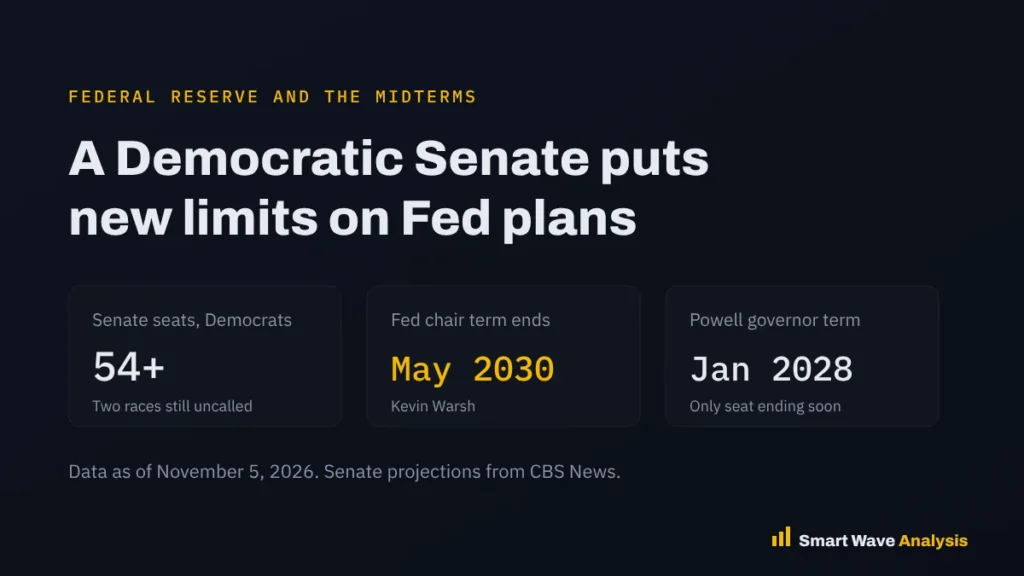
Democrats won control of the US Senate in the November 3, 2026 midterms, with at least 54 seats secured, according to CBS News projections. Because the Senate confirms Federal Reserve governors, the result makes it much harder for President Trump to place allies on the Fed board. Fed Chair Kevin Warsh stays in place until May 2030, and the next scheduled board vacancy is Jerome Powell’s governor seat in January 2028. The new Senate takes office on January 3, 2027.
Key takeaways
- Senate control: Democrats flipped at least seven seats and hold at least 54, with Alaska and Mississippi still uncalled.
- The Fed: any new Fed governor now needs support from a Democratic Senate, which limits the White House’s ability to reshape the board.
- Lisa Cook: even if the president removes Governor Cook, analysts say a replacement would struggle to win confirmation.
- Markets: traders still price a high chance of a Fed rate hike in December, so the election changes who sits at the Fed more than what the Fed does next.
The 2026 midterms were widely seen as a vote on prices and the war with Iran. This post sets out the results that matter for markets, explains why the Senate is the key check on the Federal Reserve, and shows what traders should watch next. Keep our economic calendar open for the Fed’s December meeting.
The Senate results
CBS News projected Democratic control of the Senate on November 4. By the morning of November 5, Democrats had secured at least 54 seats. Two races, Alaska and Mississippi, were still too close to call, with CBS rating both as toss-ups.
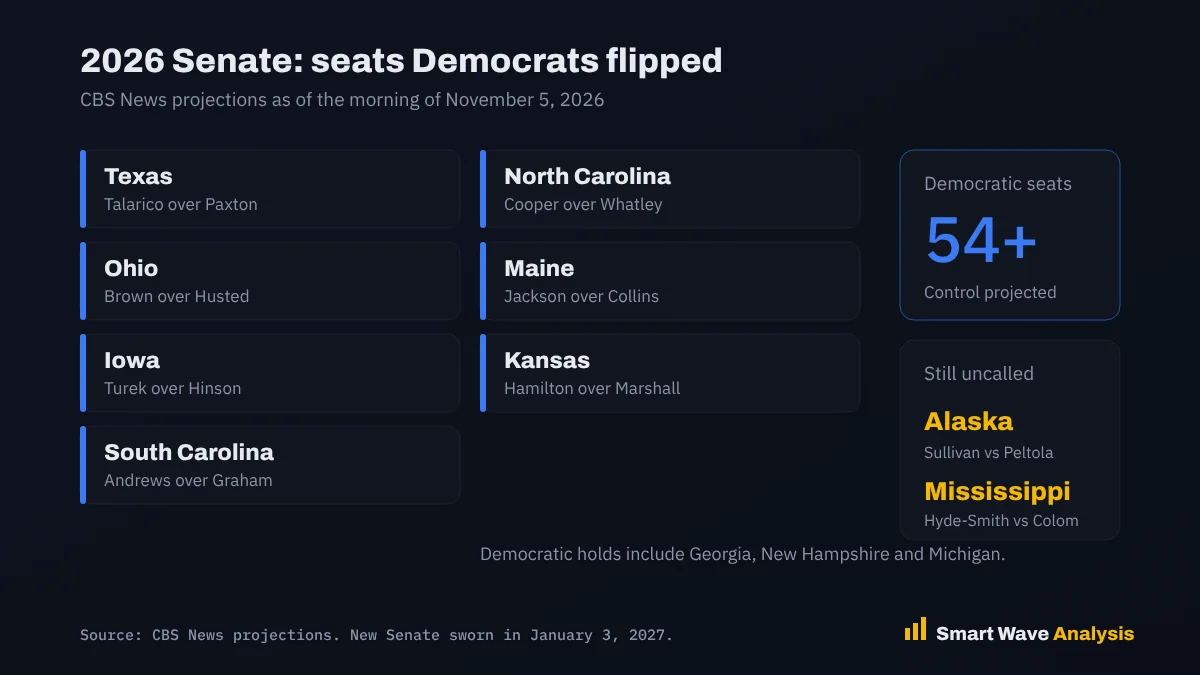
| State | Winner (projected) | Defeated | Result |
|---|---|---|---|
| Texas | James Talarico (D) | Ken Paxton (R) | D flip |
| North Carolina | Roy Cooper (D) | Michael Whatley (R) | D flip |
| Ohio | Sherrod Brown (D) | Jon Husted (R) | D flip |
| Maine | Troy Jackson (D) | Susan Collins (R) | D flip |
| Iowa | Josh Turek (D) | Ashley Hinson (R) | D flip |
| Kansas | Adam Hamilton (D) | Roger Marshall (R) | D flip |
| South Carolina | Annie Andrews (D) | Darline Graham (R) | D flip |
| Michigan | Abdul El-Sayed (D) | Mike Rogers (R) | D hold |
| Alaska | Dan Sullivan (R) vs Mary Peltola (D) | Uncalled | |
| Mississippi | Cindy Hyde-Smith (R) vs Scott Colom (D) | Uncalled | |
Senate Democratic Leader Chuck Schumer said Democrats would use investigations, court cases and “legislative razor wire” to push back when they believe the president is going beyond the law.
Michigan: Abdul El-Sayed wins an open seat
The Associated Press called Michigan’s Senate race for Democrat Abdul El-Sayed. With about 98% of the vote counted as of 6:12 p.m. EST on November 4, he led Republican Mike Rogers by 52.5% to 45.5%. El-Sayed replaces Democratic Sen. Gary Peters, who did not seek a third term, and becomes the first Muslim elected to the US Senate.
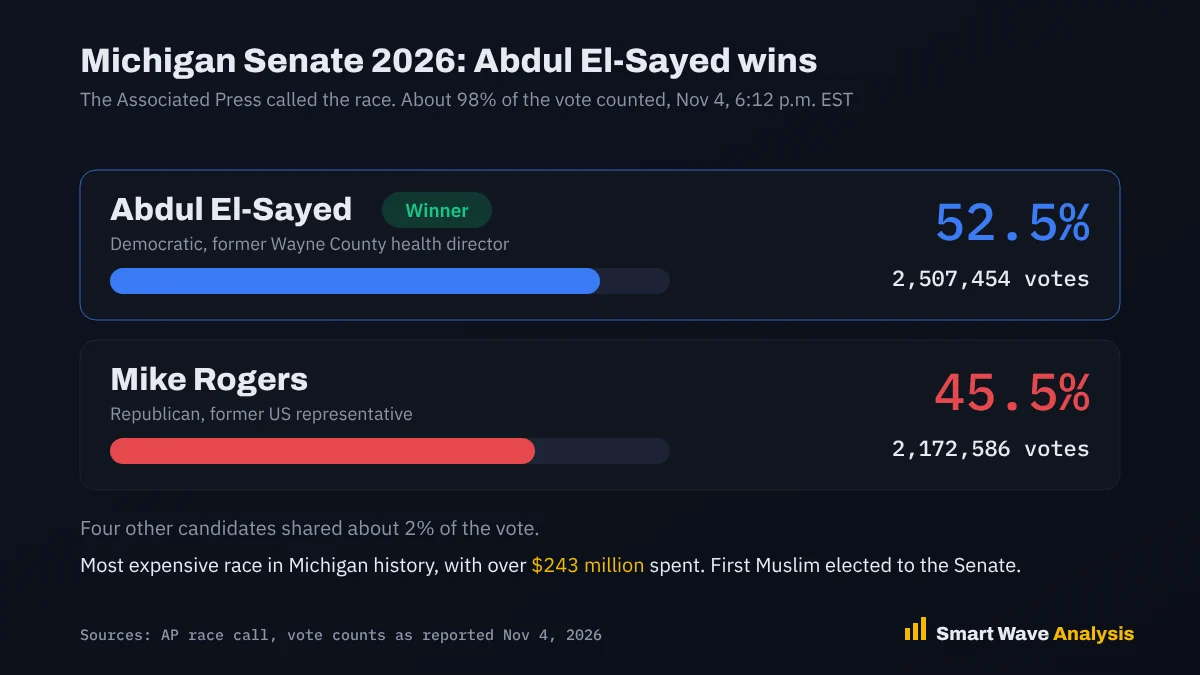
The result stands out for three reasons. It was the only open Democratic-held Senate seat in a state that Donald Trump won in 2024, so Republicans saw it as their best pickup chance. It was also the most expensive election in Michigan history, with more than $243 million spent. And El-Sayed, the former Wayne County health director, had never held elected office. He won a close Democratic primary on August 4 with 48.5% of the vote, ahead of Rep. Haley Stevens, while Rogers, the 2024 Republican nominee, ran unopposed in his primary.
| Candidate | Party | Votes | Share |
|---|---|---|---|
| Abdul El-Sayed | Democratic | 2,507,454 | 52.5% |
| Mike Rogers | Republican | 2,172,586 | 45.5% |
| Lydia Christensen | Libertarian | 49,484 | 1% |
| Tim Long | US Taxpayers | 26,417 | 1% |
| Douglas P. Marsh | Green | 12,510 | Under 1% |
| Walter P. Kristy | Natural Law | 7,232 | Under 1% |
Vote counts as reported on November 4 with about 98% of the vote counted. Counting was not complete, so the final numbers may change. Rogers said in a statement that he remains “hopeful that Michigan’s best days are ahead.”
Why the Senate matters for the Federal Reserve
The Fed board has seven governors, each serving a 14-year term, and every one of them needs Senate confirmation. You can see the current members on the Federal Reserve Board page. With Democrats in charge, any new nominee will need to win over a majority that is wary of political pressure on the central bank.
- Kevin Warsh: the president’s pick for Fed chair stays in the job until May 2030. Analysts say he will need to work with the new Congress if he wants a second term as chair.
- Jerome Powell: the former chair remains a governor. His term ends in January 2028, the only governor seat set to open in the next two years.
- Philip Jefferson: his term as vice chair ends in September 2027, but he can stay on the board as a governor.
- Banking Committee: Sen. Elizabeth Warren, a critic of Warsh, is likely to take over as chair from Sen. Tim Scott. The committee handles all Fed nominations, as described on the Senate Banking Committee website.
What happens to the Lisa Cook case
The president moved to fire Governor Lisa Cook in August 2025 over alleged errors on mortgage documents from before she joined the Fed. Cook, a Biden appointee, denies wrongdoing and sued. The Supreme Court has already ruled against the administration once, and in October 2026 the White House set up a committee to decide whether there is legal “cause” to remove her.
Analysts say the Senate result changes the math. JPMorgan economist Michael Feroli said even a successful removal would not give the president a seat for an ally, because a Democratic Senate would not confirm one. Jaret Seiberg of TD Cowen said that may make a firing less likely. Former Cleveland Fed President Loretta Mester said the effort may continue anyway.
Both sides of the debate
The president has called the current Fed board “hostile” and “partisan,” and his supporters argue that an elected administration should have more say over a central bank that sets borrowing costs for the whole economy. Supporters of Fed independence argue that keeping politics out of rate decisions helps keep inflation in check. Mark Spindel of Pilot Wave Holdings noted that Fed independence “has always depended in part on Congress.” Voters and investors will judge which approach serves the economy better.
What it means for rates and markets
The election changes who can join the Fed, not the Fed’s next move. The Fed held rates at 3.75% to 4.00% on October 28, and markets still price a high chance of a hike in December because inflation remains above target. The bigger market moves this week came from war and trade expectations: oil fell more than 8% on Iran peace hopes, as we explain in our oil price update, and gold rose back above $4,000.
- Fed meetingThe December decision is the next big test. Watch whether Warsh signals a hike despite the new political mood.
- Lame-duck periodThe current Senate sits until January 3, 2027. Any Fed nomination pushed before then could become a flashpoint.
- Uncalled racesAlaska and Mississippi will set the final size of the Democratic majority.
- MarketsFollow the S&P 500 and gold wave counts for how investors price the new Congress.
Want to trade the next big market move?
Get professional Elliott Wave analysis with updated charts, clear targets and invalidation levels for stocks, indices, forex, commodities and crypto.
- Daily chart updates
- Entry and stop levels
- Several timeframes
Frequently asked questions
Who controls the Senate after the 2026 midterms?
CBS News projected that Democrats will control the Senate, with at least 54 seats secured as of November 5, 2026. Races in Alaska and Mississippi were still uncalled at that time.
Who won the Michigan Senate race?
The Associated Press called the race for Democrat Abdul El-Sayed. With about 98% of the vote counted, he had 2,507,454 votes (52.5%) to 2,172,586 (45.5%) for Republican Mike Rogers. He is the first Muslim elected to the US Senate.
How does a Democratic Senate affect the Federal Reserve?
The Senate confirms Fed governors. A Democratic majority can block nominees it sees as too close to the White House, which makes it much harder for the president to add allies to the Fed board.
When does the new Senate take office?
The new Congress is sworn in on January 3, 2027. Until then, the current Republican-led Senate remains in place.
Sources
- Federal Reserve: Board of Governors members
- US Senate Committee on Banking, Housing, and Urban Affairs
This article is for information and education. It is not financial or political advice. Election results are as reported at the time of writing and may change as counting finishes. Read our risk disclaimer.
Free Elliott Wave e-books
 FREE
Elliott Wave Forecasting Guide
A clear introduction to forecasting markets with the Elliott Wave Principle.
Get the free e-book FREE
Elliott Wave Trading Strategies
Practical setups for entries, stops and exits using wave structure.
Get the free e-book FREE
Beginner's Guide to Forex Trading
Forex basics for new traders: pairs, pips, lots, sessions and risk.
Get the free e-book FREE
Guide to Trading Stocks and ETFs
How stock and ETF markets work and how to read them with wave analysis.
Get the free e-bookFree download after a short sign-up with the publisher.
Educational content only. Nothing on this page is financial advice or a recommendation to buy or sell. Trading involves risk and you can lose money. Elliott Wave counts are probabilities, not certainties. Read our full disclaimer and affiliate disclosure.