By the Smart Wave Analysis team. Published November 9, 2026.
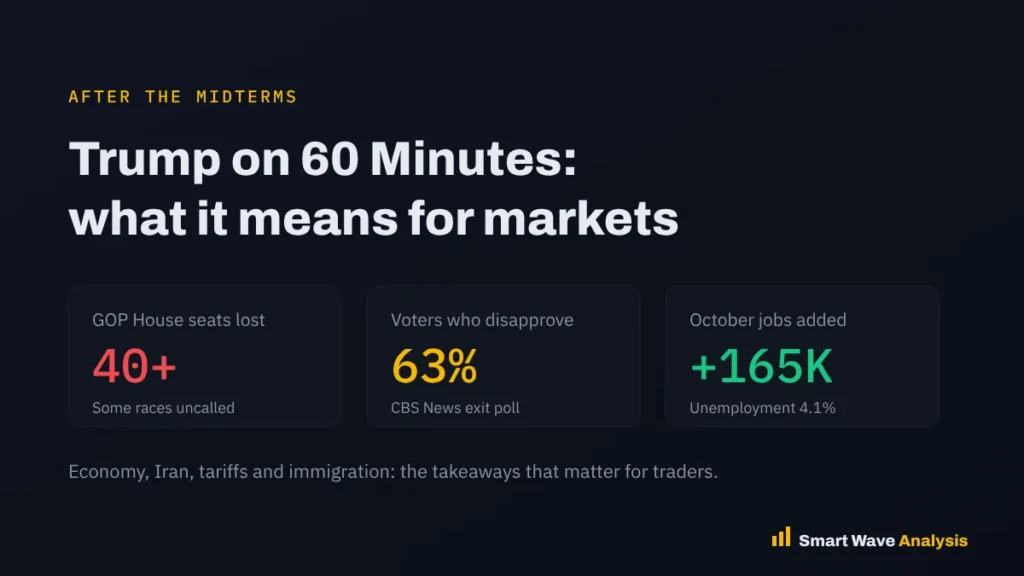
In a 60 Minutes interview that aired on November 8, 2026, President Trump said the economy is “phenomenal” but admitted to “bad messaging” after Republicans lost more than 40 House seats. He said he is “not looking to” escalate the Iran war, called his deportation push “too tough” in some cases, and hinted at staff changes. Soon after, he named Stephen Miller to replace Susie Wiles as White House chief of staff. For markets, the main points are oil and Iran, tariffs and prices, and the Fed’s next move.
Key takeaways
- Economy: Trump defended his record but said the message did not reach voters, who mostly rated the economy as weak.
- Iran: he said he does not plan to escalate the war, while Qatar leads peace talks.
- Immigration: he said some deportations were “too tough,” then picked an immigration hardliner as chief of staff.
- Markets: traders will watch oil, tariffs and the Fed’s December meeting more than the political headlines.
The interview came five days after the November 3 midterms, which handed Democrats control of the Senate. We explained what that means for the central bank in our Democratic Senate and Fed independence analysis. Here are the eight takeaways that matter most, with the numbers behind them.
1. Why Republicans lost, in the voters’ words
Republicans lost more than 40 House seats and at least seven Senate seats, with some races still uncalled. Some losses came in districts Trump won by double digits in 2024. CBS News exit polling shows why voters were unhappy.
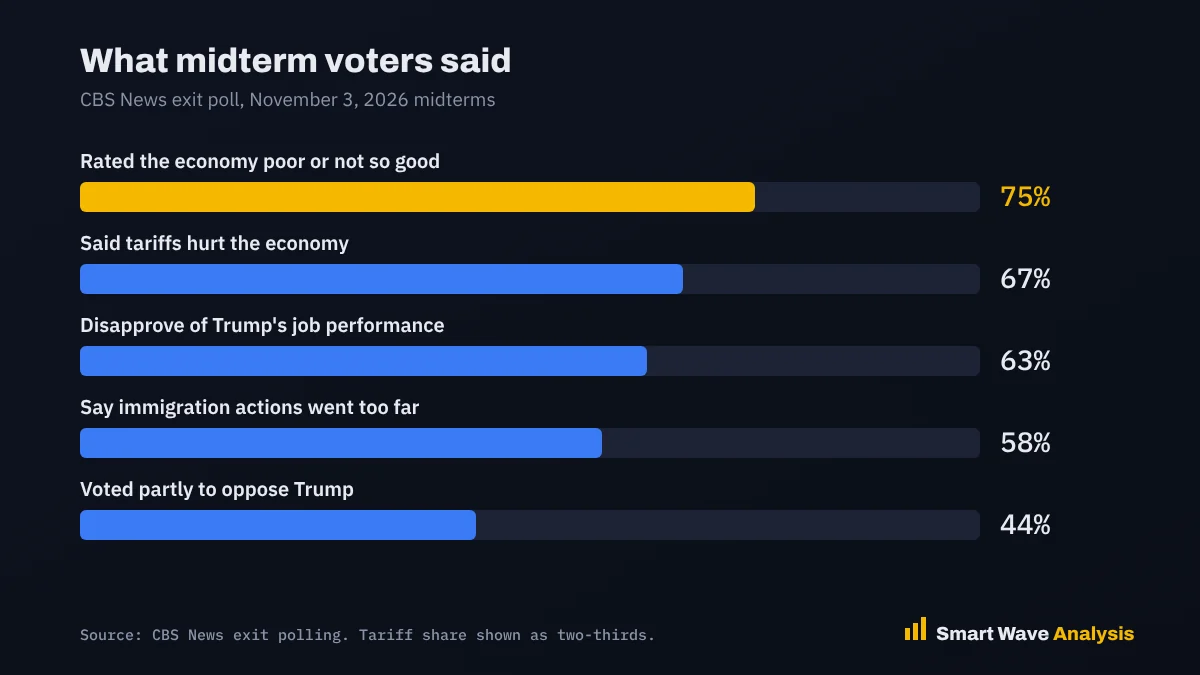
| Exit poll question | Share of voters |
|---|---|
| Rated the economy poor or not so good | About 75% |
| Said Trump’s tariffs hurt the economy | About 67% |
| Disapprove of Trump’s job performance | About 63% |
| Say immigration actions have gone too far | 58% |
| Voted partly to oppose Trump | 44% |
Among voters who called the economy weak, about 70% backed Democratic House candidates. They pointed most often to the cost of gas, food, utilities and health care.
2. Trump: the economy is strong, the message was weak
Trump called the economic numbers “phenomenal” and pointed to record stock prices and 401(k) balances. “I think it was bad messaging, maybe by me,” he said, adding, “We couldn’t get the word across.” When asked about Americans without large retirement accounts, he answered, “But a lot of people do.”
The interview followed a stronger than expected jobs report. The Bureau of Labor Statistics said the economy added 165,000 jobs in October, and the unemployment rate edged down to 4.1%.
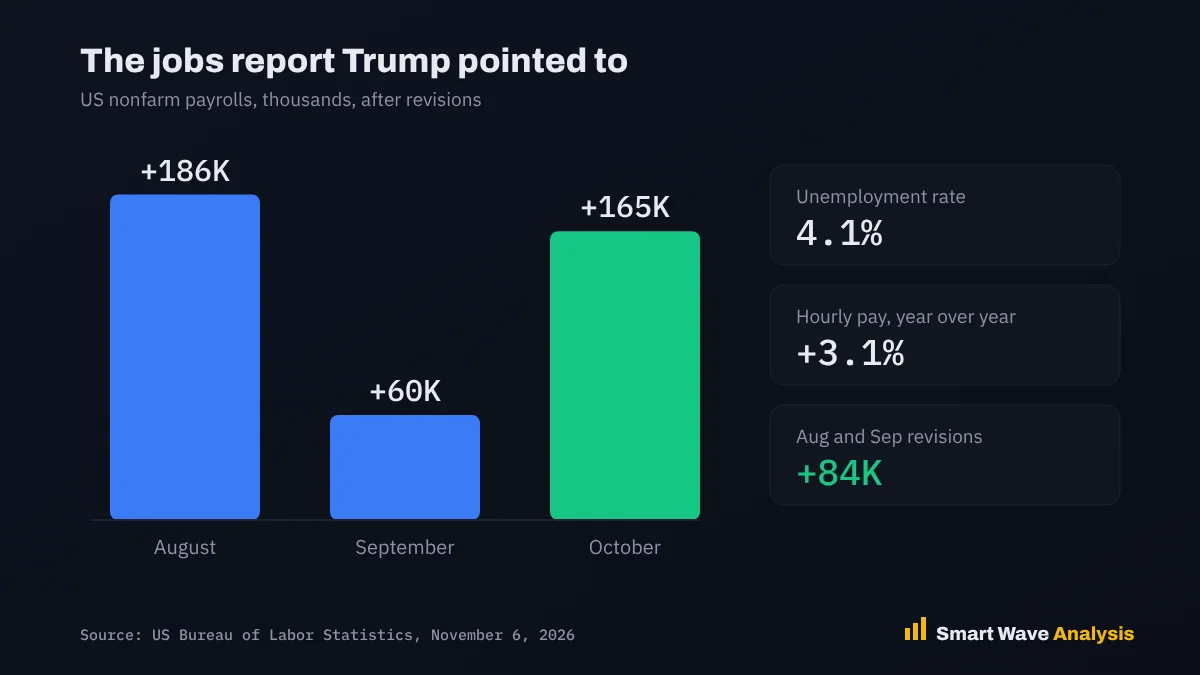
The gap between the data and voters’ mood comes down to prices. Hourly pay rose 3.1% from a year earlier, which is not much faster than prices for many households. That is why “affordability” mattered more at the ballot box than job growth.
3. Tariffs remain a weak spot with voters
Two in three voters said tariffs hurt the economy. Tariffs raise costs for importers, and some of that cost reaches store shelves. Trump did not signal a change in his trade policy during the interview. For traders, any move to ease tariffs would be a big story for stocks and inflation, so follow the S&P 500 wave count for how the market reacts to trade news.
4. Iran: “I’m not looking to” escalate
Vice President JD Vance posted after the election that the unpopular Iran war was “the real reason we lost.” Trump said he did not fully disagree, but said his answer to doing it again is an “emphatic yes,” because Iran’s military and nuclear program were set back. He said history will judge the war better than voters do today.
Asked whether he would escalate now that the midterms are over, he said, “Well, I’m not looking to. I don’t think there’s any reason to.” The two sides have mostly avoided major attacks since September, though the US carried out limited defensive strikes last week. Qatar is leading talks, and Trump said Iran is close to a deal. This matters for oil. Peace hopes already pushed crude lower, as we covered in our oil price update.
5. Immigration: “I think it was too tough”
Trump said immigration “both helped and hurt.” He gave himself high marks for border security, but said removing workers who held steady jobs and broke only immigration law hurt his party. “I think it was too tough,” he said. Many Latino voters in states like Texas moved back toward Democrats this year over this issue.
At the same time, Trump named Stephen Miller as his new chief of staff. Miller is widely seen as the architect of the administration’s strict enforcement policy. Labor markets in farming, hotels and construction rely heavily on immigrant workers, so any change in deportation policy can affect wages and hiring in those sectors.
6. Staff changes: Wiles out, Miller in
Asked whether anyone would be fired, Trump said, “I do, yeah. Little bit,” and added he would make “maybe a few changes.” Susie Wiles resigned as chief of staff, and Trump announced Miller as her replacement shortly after the interview. Trump also said he has confidence in Defense Secretary Pete Hegseth and called Democratic calls to impeach him “very unfair.”
7. Net worth and business interests
Trump is the wealthiest person to hold the office, and his fortune has grown partly through family cryptocurrency ventures. Asked about reports that his net worth soared, he said, “So did everyone,” and added, “I devote almost no time to my net worth.” He said his stocks sit in broad index funds and his sons run the family company. Critics argue that conflicts of interest remain a concern, and polls show many voters share that worry.
8. The 2028 race and pardons
Trump said he will “probably” endorse a 2028 candidate, “but not necessarily.” He named Vance and Secretary of State Marco Rubio as part of a “tremendous bench.” He also said he plans “tremendous numbers of pardons” before leaving office and called a self-pardon “certainly not unreasonable,” though he said he does not expect to try it. The rules of the next race may also change, as we explain in our guide to the National Popular Vote compact.
Trump also said military pilots have told him “very strange” things about unexplained objects in the sky, and when asked whether he could forgive his political enemies, he said, “I want to be honest, no.”
Both sides of the debate
Trump’s supporters point to a record stock market, steady job growth and a weaker Iran as proof his policies are working, and say the problem was communication. His critics point to the exit polls, saying voters felt higher prices from tariffs and disliked the war and the scale of deportations. Both views will shape the next two years, especially with a Democratic Senate that can block nominees and slow new laws.
What it means for markets
The interview had no direct policy announcement, but it gave traders a few signals. A softer tone on Iran supports the case for lower oil. A tougher chief of staff suggests little change on immigration. And the strong jobs report keeps pressure on the Fed, which held rates at 3.75% to 4.00% in October. The next decision comes at the December meeting, listed on the Federal Reserve’s FOMC calendar.
- OilWatch for news from the Qatar talks. A deal could push crude lower, while new strikes could reverse the drop.
- FedStrong hiring and pay growth make a December rate hike more likely. Check our economic calendar for the next inflation report.
- GoldLower war risk can cool safe-haven demand. Follow our gold analysis for the key levels.
- TariffsAny sign of trade relief would be the biggest upside surprise for stocks.
Want to trade the next big market move?
Get professional Elliott Wave analysis with updated charts, clear targets and invalidation levels for stocks, indices, forex, commodities and crypto.
- Daily chart updates
- Entry and stop levels
- Several timeframes
Frequently asked questions
When did Trump’s 60 Minutes interview air?
The interview with correspondent Ross Douthat aired on Sunday, November 8, 2026, five days after the midterm elections.
What did Trump say about why Republicans lost the midterms?
He said the economy is strong but blamed “bad messaging, maybe by me.” He also said immigration enforcement was “too tough” in some cases, and he partly agreed with JD Vance that the Iran war hurt Republicans.
Will Trump escalate the war with Iran?
Trump said, “I’m not looking to. I don’t think there’s any reason to.” He also said Iran is close to a deal, with Qatar mediating talks.
Who replaced Susie Wiles as White House chief of staff?
Trump named Stephen Miller, his longtime adviser on immigration policy, to replace Susie Wiles.
How many jobs did the US add in October 2026?
The Bureau of Labor Statistics reported 165,000 new jobs in October, with the unemployment rate at 4.1%. August and September were revised up by a combined 84,000 jobs.
Sources
- US Bureau of Labor Statistics: The Employment Situation, October 2026
- Federal Reserve: FOMC meeting calendar
This article is for information and education. It is not financial or political advice, and it does not support any party or candidate. Quotes are from the interview as aired and may be shortened. Read our risk disclaimer.
Free Elliott Wave e-books
 FREE
Elliott Wave Forecasting Guide
A clear introduction to forecasting markets with the Elliott Wave Principle.
Get the free e-book FREE
Elliott Wave Trading Strategies
Practical setups for entries, stops and exits using wave structure.
Get the free e-book FREE
Beginner's Guide to Forex Trading
Forex basics for new traders: pairs, pips, lots, sessions and risk.
Get the free e-book FREE
Guide to Trading Stocks and ETFs
How stock and ETF markets work and how to read them with wave analysis.
Get the free e-bookFree download after a short sign-up with the publisher. Affiliate links: we may earn a commission at no cost to you.
Educational content only. Nothing on this page is financial advice or a recommendation to buy or sell. Trading involves risk and you can lose money. Elliott Wave counts are probabilities, not certainties. Read our full disclaimer and affiliate disclosure.