By the Smart Wave Analysis team. Published November 7, 2026.
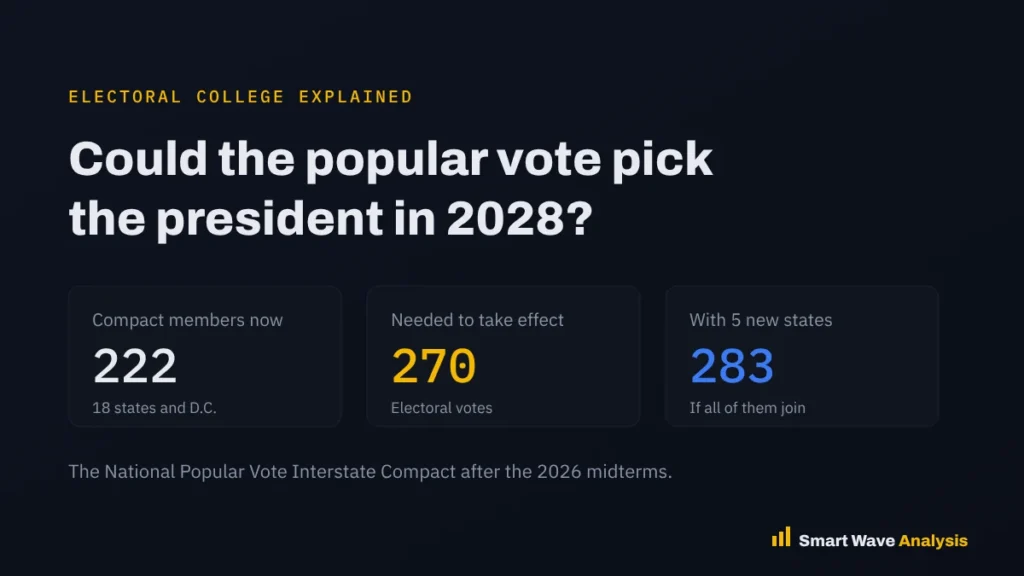
The National Popular Vote Interstate Compact is a deal between states to give their electoral votes to the candidate who wins the most votes nationwide. It has 222 of the 270 electoral votes it needs. After the 2026 midterms, Democrats are reported to hold new trifectas in Pennsylvania, Michigan, Wisconsin, Nevada and Arizona. Those five states have 61 electoral votes. If at least four of them join, including Pennsylvania and Michigan, the compact would pass 270. It would still face court challenges.
Key takeaways
- The goal: the compact would make the national vote winner president without changing the Constitution.
- The gap: members hold 222 electoral votes, so the compact is 48 short of the 270 it needs to start.
- The midterm shift: new one-party control in five swing states gives backers their best chance yet to close the gap.
- The fight ahead: critics argue the compact needs approval from Congress, and lawsuits are almost certain if it ever takes effect.
The 2026 midterms changed more than Congress. As we covered in our look at the Democratic Senate and the Fed, voters reshaped power in Washington. They also reshaped power in several state capitals, and that matters for a long-running plan to change how the country picks its president.
How the Electoral College works today
Americans do not vote for president directly. Each state gets electors equal to its seats in Congress, and a candidate needs 270 of the 538 electoral votes to win. The National Archives explains the process step by step. Nearly every state gives all of its electors to whoever wins that state, even by a single vote. Maine and Nebraska are the only exceptions.
Because of this winner-take-all rule, a candidate can win the White House while losing the national vote. That has happened five times: in 1824, 1876, 1888, 2000 and 2016.
| Year | Won the Electoral College | Won the popular vote |
|---|---|---|
| 1824 | John Quincy Adams | Andrew Jackson |
| 1876 | Rutherford B. Hayes | Samuel Tilden |
| 1888 | Benjamin Harrison | Grover Cleveland |
| 2000 | George W. Bush | Al Gore |
| 2016 | Donald Trump | Hillary Clinton |
In 1824 no candidate won a majority of electors, so the House of Representatives chose the president. In the other four elections, the Electoral College winner took office.
What the National Popular Vote compact does
The compact was first proposed in 2006 by computer scientist John Koza. Maryland became the first state to join on April 10, 2007. Each member state promises to give all of its electors to the winner of the national popular vote, no matter who wins inside that state.
The key detail is that the deal only starts once member states hold a majority of electoral votes, which is 270. At that point the national vote winner would be guaranteed a win in the Electoral College. Under the compact’s text, it applies to an election only if it has reached 270 by July 20 of that election year. That means states would need to act by July 20, 2028 for the next presidential race.
Today 18 states and the District of Columbia have joined, with 222 electoral votes. Virginia was the most recent, joining in 2026 with 13 electoral votes. Most members are states that Democrats usually win, such as California, New York and Illinois.
Why the midterms matter for the compact
To join, a state usually needs its House, its Senate and its governor to agree. That is why one-party control, known as a trifecta, matters so much. After the 2026 midterms, Democrats are reported to have new trifectas in five swing states. In Arizona, PBS reported it is the party’s first trifecta since 1966, with Gov. Katie Hobbs re-elected.
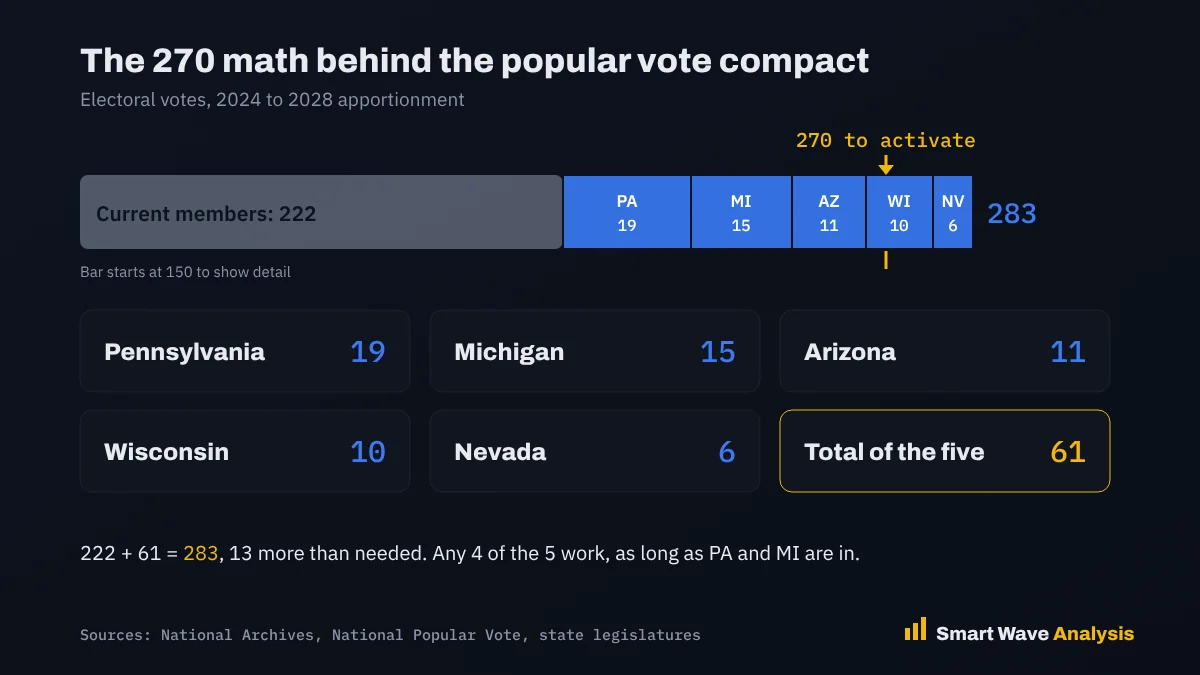
| State | Electoral votes | Past action on the compact | Status |
|---|---|---|---|
| Pennsylvania | 19 | Has not passed either chamber | Not a member |
| Michigan | 15 | Passed the House 65 to 36 in 2008 | Not a member |
| Arizona | 11 | Passed the House 40 to 16 in 2016 | Not a member |
| Wisconsin | 10 | Has not passed either chamber | Not a member |
| Nevada | 6 | Bill vetoed by Gov. Steve Sisolak in 2019 | Not a member |
| Total | 61 | 222 + 61 = 283 | |
The math is tighter than it looks. Pennsylvania and Michigan are both must-haves, because without either one the remaining states fall short. Any four of the five work as long as those two are included. Nevada shows that party control is no guarantee: a Democratic governor vetoed the bill in 2019, and a later effort to change the state constitution passed in 2023 but did not pass again in 2025.
New legislatures are sworn in starting in January 2027. That gives lawmakers about 18 months before the July 20, 2028 cutoff. Bills often take more than one session to pass, so the window is real but short.
The legal fight it would face
The biggest question is the Compact Clause of the Constitution. It says states cannot enter agreements with each other without the consent of Congress. Supporters argue the Constitution lets each state choose how to appoint its electors. The text of Article II, Section 1 says each state shall appoint electors “in such Manner as the Legislature thereof may direct.”
Opponents argue that a deal changing how the whole country elects its president needs approval from Congress. A 2019 report from the Congressional Research Service noted that courts have not settled this question. Election law scholar Derek Muller has also raised concerns about how states would verify each other’s vote totals, since there is no official national count today. Backers point to Chiafalo v. Washington (2020), where the Supreme Court ruled that states can require electors to follow the state’s choice, as a sign that states have wide power over electors.
Both sides of the debate
Supporters say every vote should count the same no matter where a voter lives. They argue that today’s system pushes candidates to focus on a few swing states and ignore the rest. Polls show public support for a national vote: Pew Research found 63% of Americans favored it in 2022, and Gallup found 61% in 2020.
Critics say the Electoral College protects smaller states and forces candidates to build broad, coast-to-coast coalitions. Many Republican leaders call the compact an attempt to get around the Constitution without a proper amendment. Some also worry that a very close national race could trigger recounts in every state at once. Both sides agree on one point: if the compact reaches 270, the Supreme Court will likely have the final word.
What it means for markets
The compact will not change the Fed’s next rate decision or this quarter’s earnings. Still, the rules of a presidential race shape where campaigns spend money and which issues get attention, and political uncertainty tends to show up in volatility. If state bills start moving in 2027, expect more headlines about the 2028 race. Keep our economic calendar handy for the events that move prices first.
- January 2027New state legislatures take office. Watch for compact bills in Pennsylvania and Michigan.
- 2027 sessionsCommittee votes will show whether the new majorities make this a priority.
- Court filingsAny state that joins could face a lawsuit over the Compact Clause.
- July 20, 2028The cutoff for the compact to apply to the 2028 election.
Want to trade the next big market move?
Get professional Elliott Wave analysis with updated charts, clear targets and invalidation levels for stocks, indices, forex, commodities and crypto.
- Daily chart updates
- Entry and stop levels
- Several timeframes
Frequently asked questions
What is the National Popular Vote Interstate Compact?
It is an agreement between states to give all of their electoral votes to the candidate who wins the most votes nationwide. It only takes effect once member states hold at least 270 electoral votes.
How many states have joined the compact?
Eighteen states and the District of Columbia have joined, with a combined 222 electoral votes. Virginia joined most recently, in 2026.
Could the popular vote decide the 2028 election?
Only if states with at least 48 more electoral votes join by July 20, 2028, and the compact survives legal challenges. New Democratic trifectas in five swing states make that possible, but not certain.
Does the compact abolish the Electoral College?
No. The Electoral College would still exist. Member states would simply give their electors to the national vote winner, which would guarantee that candidate at least 270 electoral votes.
Is the National Popular Vote compact constitutional?
Courts have not decided. Supporters say states have the power to choose how they appoint electors. Opponents say the compact needs approval from Congress under the Compact Clause.
Sources
- National Archives: The Electoral College
- Constitution Annotated (Congress.gov): Article II, Section 1
This article is for information and education. It is not financial or political advice, and it does not support any party or candidate. Election results and state control are as reported at the time of writing and may change. Read our risk disclaimer.
Free Elliott Wave e-books
 FREE
Elliott Wave Forecasting Guide
A clear introduction to forecasting markets with the Elliott Wave Principle.
Get the free e-book FREE
Elliott Wave Trading Strategies
Practical setups for entries, stops and exits using wave structure.
Get the free e-book FREE
Beginner's Guide to Forex Trading
Forex basics for new traders: pairs, pips, lots, sessions and risk.
Get the free e-book FREE
Guide to Trading Stocks and ETFs
How stock and ETF markets work and how to read them with wave analysis.
Get the free e-bookFree download after a short sign-up with the publisher. Affiliate links: we may earn a commission at no cost to you.
Educational content only. Nothing on this page is financial advice or a recommendation to buy or sell. Trading involves risk and you can lose money. Elliott Wave counts are probabilities, not certainties. Read our full disclaimer and affiliate disclosure.