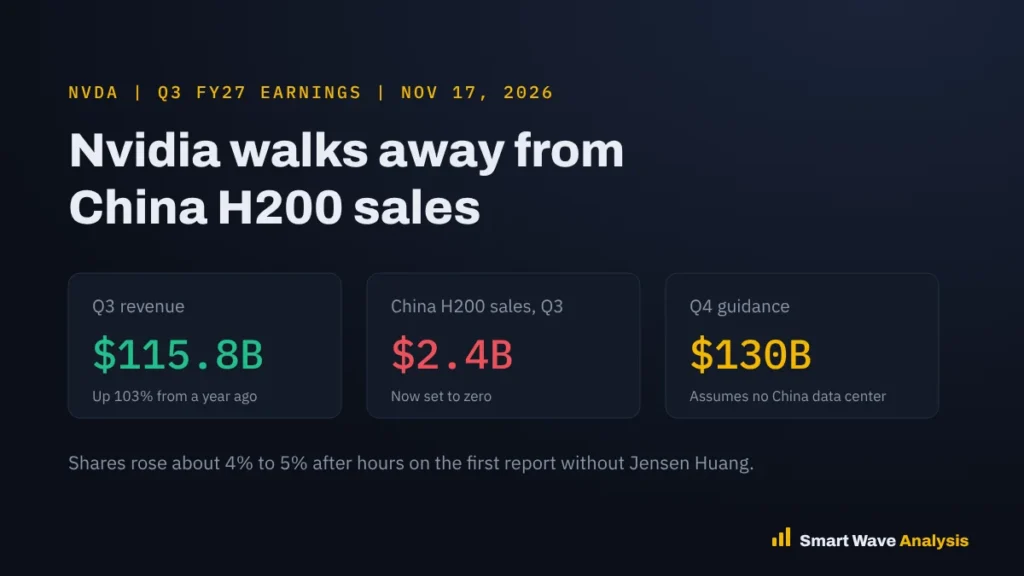
Nvidia will stop selling its H200 AI chips in China, interim CEO Colette Kress said on November 17, in the first earnings call since Jensen Huang’s exit. Those sales brought in $2.4 billion last quarter, about 2% of data center revenue. Total revenue hit a record $115.8 billion, well above forecasts, and Nvidia guided to $130 billion next quarter with no China data center sales included. Shares rose about 4% to 5% after hours. The bigger risk now is a new US rule that limits chip sales to data centers in Southeast Asia.
Key takeaways
- China exit: Nvidia is ending H200 sales in China, a deal that was arranged by Huang and the White House with a 25% fee to the US government.
- Small direct hit: China H200 sales were only $2.4 billion out of $107.6 billion in data center revenue.
- Bigger indirect risk: a new US rule makes data centers in five countries prove they are not serving Chinese firms, and analysts see tens of billions of dollars at risk next year.
- Strong demand elsewhere: Kress pointed to “demand far exceeding supply” and said the new Vera Rubin chips are off to an “explosive start,” which can fill the gap.
Last week we looked at what Huang’s resignation meant for the stock in our Nvidia CEO change analysis. One of the questions we raised was what would happen to China sales. We now have the answer.
Nvidia’s first quarter without Jensen Huang
Nvidia’s third fiscal quarter, which ended October 25, was its biggest yet. Revenue doubled from a year earlier, and data center sales rose 110%. Analysts had expected about $109 billion in revenue, according to FactSet. The full numbers are in Nvidia’s earnings release filed with the SEC.
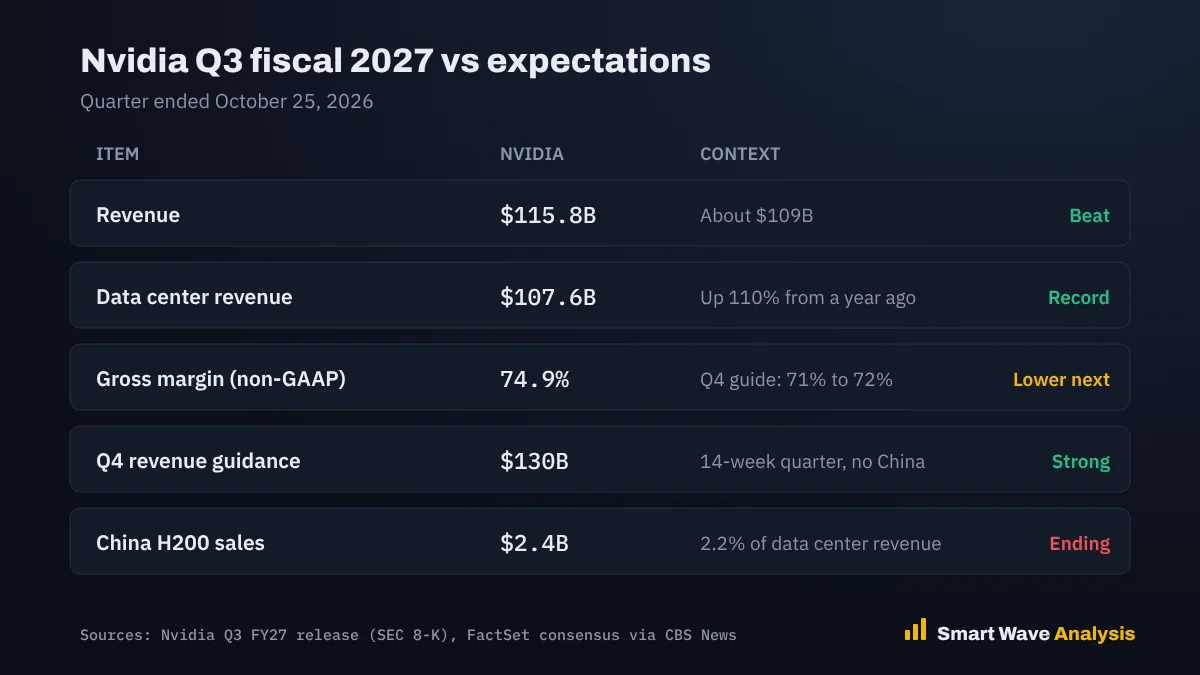
| Item | Q3 fiscal 2027 | Note |
|---|---|---|
| Revenue | $115.8B | Beat Up 103% from $57B a year ago |
| Data center revenue | $107.6B | Up 110% from a year ago |
| Net income | $65.3B | Up 105% from a year ago |
| Gross margin (non-GAAP) | 74.9% | Watch Q4 guide is 71% to 72% |
| Q4 revenue guidance | $130B | A 14-week quarter, with no China data center sales |
Board chair Harvey Jones also ended talk of a comeback, saying the board “does not intend to reinstate Jensen as CEO.” Kress raised Nvidia’s growth forecast for next fiscal year to about 75%, up from about 70%.
Why Nvidia is leaving the China market
The H200 deal let Nvidia sell an older but still powerful chip to Chinese buyers, as long as the chips passed through the US and the government collected a 25% fee. Huang personally pushed for it. In practice, China largely refused to accept the deliveries, because Beijing wants to build demand for Chinese-made chips. So the sales were smaller than expected.
With Huang gone and a spy scandal in the news, Nvidia’s new leaders chose a clean break. The board also set up a new committee to oversee national security, export rules and trade risk. Analysts on the call did not ask about China or Singapore, even though those are the questions investors care about most.
The new US chip rule matters more than China
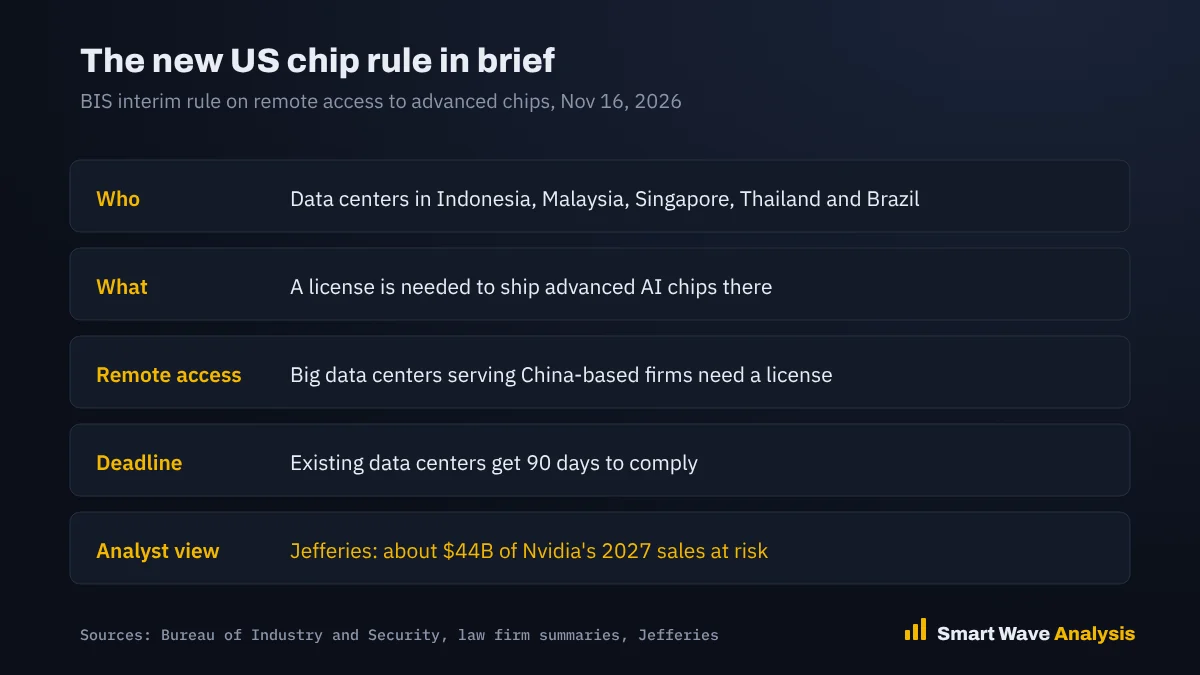
On November 16, the Commerce Department’s Bureau of Industry and Security issued a rule aimed at Chinese companies that rent computing power from data centers in other countries. Shipping advanced chips to data centers in Indonesia, Malaysia, Singapore, Thailand and Brazil now needs a license. Large data centers that serve China-based firms also need one, and existing sites have 90 days to comply. Beijing called the rule “economic coercion,” while Malaysia told its data centers to follow it.
This is where the real money is. In mid-2025, Nvidia billed 22% of its revenue, $10.2 billion in one quarter, through Singapore, though much of that was for chips shipped elsewhere. Jefferies estimates about $44 billion of Nvidia’s 2027 chip sales could be affected. UBS sees roughly a 10% hit to demand, mostly over the long term, because Nvidia can sell the chips to other customers in the short term.
Both sides for investors
The bullish case: China was already a tiny share of sales, and Nvidia still beat forecasts by about $7 billion. Demand from US cloud giants, AI labs and governments is larger than supply. Leaving China removes a political risk that has hung over the stock all year, and it may help Nvidia’s standing in Washington.
The bearish case: China-linked demand through Southeast Asia could be much bigger than the $2.4 billion in direct sales. Margins are expected to slip next quarter. The company still has no permanent CEO, and the board’s review of the spy allegations is not finished. Rivals such as AMD could win customers who want to avoid US export headaches.
Nvidia closed at $166.19 on November 12, the day Huang resigned, and drifted lower into earnings. After the report, shares rose to about $161 to $163 in after-hours trading. That is still below where they stood before the scandal, so the market has not fully forgiven the leadership shock. Our Nasdaq 100 analysis shows how much the tech index depends on Nvidia’s next move.
What to watch next
- Nov 19The new chip rule takes effect when published in the Federal Register.
- Next 90 daysData centers in Southeast Asia must get licenses. Watch for customers who switch suppliers.
- CEO searchA strong permanent pick would likely help the stock.
- BeijingChina has threatened countermeasures but has not named any yet.
We will publish an updated Elliott Wave count on Nvidia once the after-hours move settles into a few regular sessions. New to wave analysis? Start with our Elliott Wave theory guide.
Want to trade the next big market move?
Get professional Elliott Wave analysis with updated charts, clear targets and invalidation levels for stocks, indices, forex, commodities and crypto.
- Daily chart updates
- Entry and stop levels
- Several timeframes
Frequently asked questions
Is Nvidia leaving China?
Nvidia said on November 17, 2026, that it will stop selling its H200 AI chips in China. Its outlook for next quarter assumes no data center computing revenue from China.
How much revenue does Nvidia get from China?
Sales of licensed H200 chips to China were $2.4 billion in the quarter ended October 25, 2026, about 2.2% of Nvidia’s $107.6 billion in data center revenue.
How did Nvidia stock react to earnings?
Nvidia shares rose about 4% to 5% in after-hours trading on November 17, 2026, to around $161 to $163, after revenue of $115.8 billion beat forecasts.
What is the new US chip export rule?
A November 16, 2026 rule requires licenses to ship advanced AI chips to data centers in Indonesia, Malaysia, Singapore, Thailand and Brazil, and to large data centers that serve China-based companies.
Sources
- SEC: Nvidia Q3 fiscal 2027 results (Form 8-K)
- US Commerce Department: Bureau of Industry and Security
This article is for information and education and is not financial advice. Details are as of November 18, 2026. Read our risk disclaimer.
Free Elliott Wave e-books
 FREE
Elliott Wave Forecasting Guide
A clear introduction to forecasting markets with the Elliott Wave Principle.
Get the free e-book FREE
Elliott Wave Trading Strategies
Practical setups for entries, stops and exits using wave structure.
Get the free e-book FREE
Beginner's Guide to Forex Trading
Forex basics for new traders: pairs, pips, lots, sessions and risk.
Get the free e-book FREE
Guide to Trading Stocks and ETFs
How stock and ETF markets work and how to read them with wave analysis.
Get the free e-bookFree download after a short sign-up with the publisher. Affiliate links: we may earn a commission at no cost to you.
Educational content only. Nothing on this page is financial advice or a recommendation to buy or sell. Trading involves risk and you can lose money. Elliott Wave counts are probabilities, not certainties. Read our full disclaimer and affiliate disclosure.