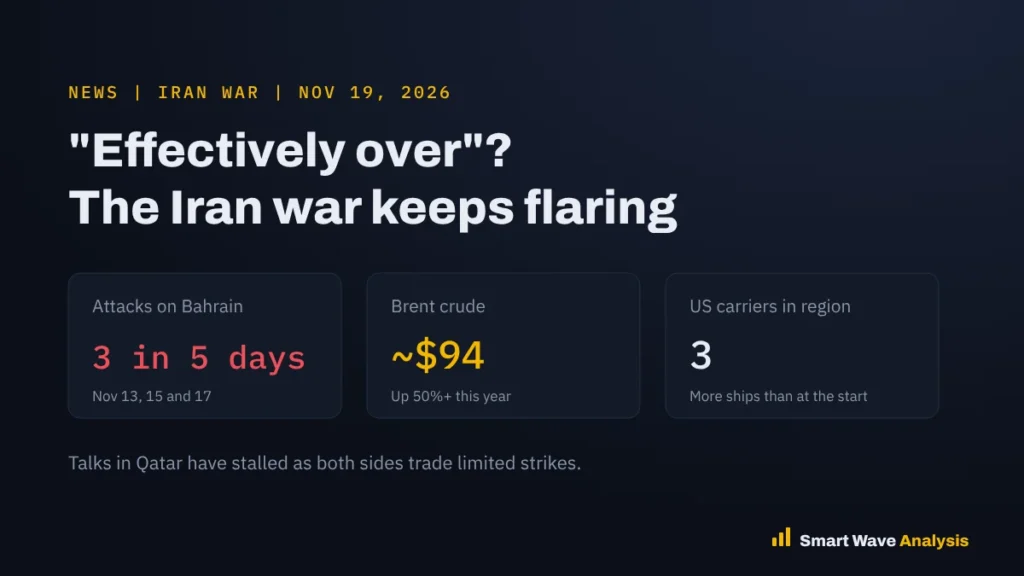
No, the Iran war is not fully over. President Trump said on November 9 that it was “effectively over” militarily, but Iran then fired at US military sites in Bahrain three times in five days, and US jets struck an Iranian missile site on Qeshm Island on November 17. Peace talks through Qatar have stalled, the US naval blockade of Iran is still in place, and Brent crude has climbed back toward $94 a barrel.
Key takeaways
- Mixed messages: Trump calls new US attacks “highly unlikely,” yet he has sent a third aircraft carrier and thousands more troops to the region.
- Small strikes, big signal: the Bahrain attacks caused little or no damage, but they ended a roughly two-month lull.
- Talks are stuck: the main dispute is who moves first, the US on sanctions and the blockade or Iran on its nuclear program.
- Oil is the scorecard: crude fell after the midterms on peace hopes and is now rising again on the new strikes.
The war has been one of the biggest drivers of markets this year. We first looked at Trump’s comments in our 60 Minutes interview takeaways, where he said he was “not looking to” escalate. Ten days later, the fighting is back in the headlines.
How the Iran war got here
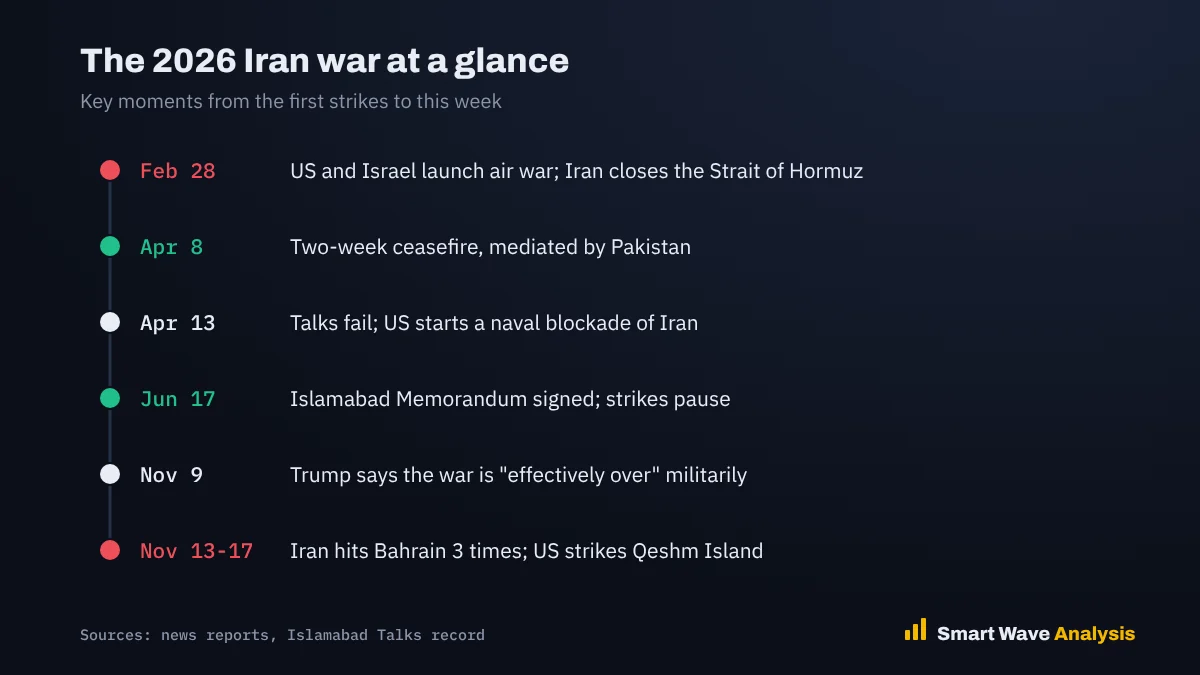
The war began on February 28, when the US and Israel launched air strikes on Iran. Iran answered with missile and drone attacks across the region and closed the Strait of Hormuz, the narrow waterway that normally carries about a fifth of the world’s oil. A ceasefire in April and a broader deal signed in June, known as the Islamabad Memorandum, promised to reopen the strait, end the blockade and pause strikes.
That deal did not hold. By the fall the US naval blockade of Iranian ports was back in force, and the two sides had largely held off from major attacks since September. The US Energy Information Administration explains why the strait matters so much in its guide to world oil transit chokepoints.
What happened this week
| Date | Event |
|---|---|
| Nov 9 | Trump says the war is “effectively over” but US forces stay “locked and loaded” |
| Nov 13 | Iran targets a US early warning radar site in Bahrain |
| Nov 15 | Iran fires at a radar system at a US helicopter base in Bahrain |
| Nov 17 | Iran sends drones at another US radar site in Bahrain; hours later a US jet strikes a Revolutionary Guard missile site on Qeshm Island |
Bahrain, home to the US Navy’s Fifth Fleet, said its air defenses stopped the attacks, and the US military reported no damage or injuries. Iran said it was responding to US strikes on its communications towers and to ongoing US drone flights. An Iranian official said the strike on Qeshm caused no damage to homes, businesses or key infrastructure. US Central Command posts official updates on its news page.
Where the peace talks stand
Qatar is the main go-between, and its prime minister met Trump to press for more time for diplomacy. Qatar warned that any escalation posed an “extremely grave danger” to a deal. Iranian officials describe the situation as “no war, no peace.”
- What Iran wants: an end to the blockade, relief from oil and gas sanctions, and access to frozen money abroad. It says Hormuz could be fully reopened within two days if those are met. It refuses to send its enriched uranium abroad.
- What the US wants: nuclear limits written into any deal from the start. Secretary of State Marco Rubio called Iran’s conditions “outrageous and ridiculous and really not realistic.”
- The sticking point: mediators are working on a seven-point plan, but the two sides disagree on who should act first.
Vice President JD Vance, who blamed the war for Republican losses in the midterms, said Iran will not become a “forever war.” The new Democratic majority in Congress is also pushing for more oversight, as we covered in our report on the Hegseth impeachment vote.
What it means for oil and markets
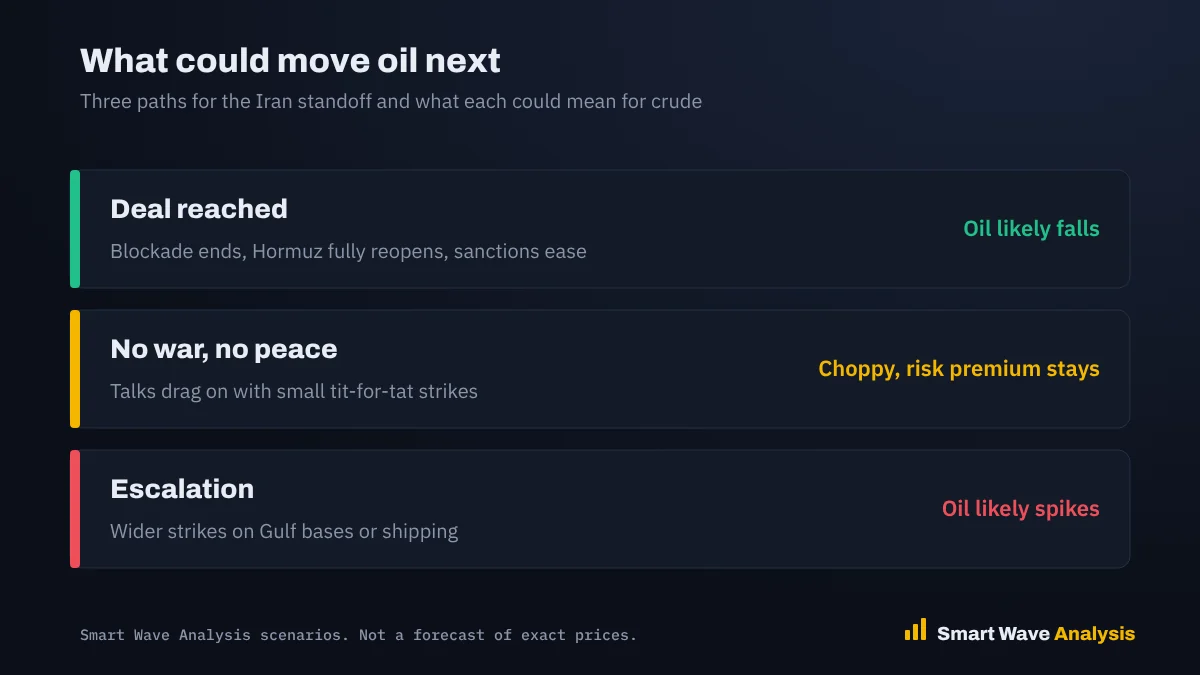
Brent crude dropped after the midterms as traders bet on a peace deal, then rose back toward $94 a barrel after the new strikes. It is still up more than 50% this year. US-protected tankers have brought Gulf oil shipments back close to prewar levels, which limits how high prices can go for now. But Iran keeps attacking ships that try to cross the strait, so the risk premium is not going away.
For traders, every headline from Doha or the Gulf can move crude by a few dollars in a day. Our latest oil price Elliott Wave update lays out the key levels, and you can follow Brent crude and gold for the safe-haven side of the story.
Supporters of the president say military pressure and the blockade have weakened Iran and forced it to the table, and that a deal is close. Critics say the US has no clear exit plan, that the war has cost American lives and pushed up fuel prices, and that voters punished Republicans for it in the midterms.
What to watch next
- Qatar talksAny sign of a first-step deal on the blockade or sanctions would likely push oil lower.
- More attacksA strike that causes US casualties would raise the odds of a wider US response.
- Hormuz trafficWatch tanker attacks and mine reports in the strait.
- CongressThe new Democratic majority could use hearings and budget votes to limit military action.
Want to trade the next big market move?
Get professional Elliott Wave analysis with updated charts, clear targets and invalidation levels for stocks, indices, forex, commodities and crypto.
- Daily chart updates
- Entry and stop levels
- Several timeframes
Frequently asked questions
Is the Iran war over?
Not fully. Trump said on November 9, 2026, that it was effectively over militarily, but Iran attacked US sites in Bahrain three times between November 13 and 17, and the US struck back on Qeshm Island.
When did the 2026 Iran war start?
The war began on February 28, 2026, when the US and Israel launched air strikes on Iran. Iran responded with missile and drone attacks and closed the Strait of Hormuz.
Are the US and Iran negotiating?
Yes, indirectly. Qatar is mediating, but talks have stalled over whether the US should first ease sanctions and the blockade or Iran should first accept nuclear limits.
How is the Iran war affecting oil prices?
Brent crude is near $94 a barrel and up more than 50% this year. Prices fell on peace hopes after the midterms and rose again after the new strikes in mid-November.
Sources
This article is for information only and is not financial or political advice. It does not support any party or government. Details are as reported on November 19, 2026. Read our risk disclaimer.
Free Elliott Wave e-books
 FREE
Elliott Wave Forecasting Guide
A clear introduction to forecasting markets with the Elliott Wave Principle.
Get the free e-book FREE
Elliott Wave Trading Strategies
Practical setups for entries, stops and exits using wave structure.
Get the free e-book FREE
Beginner's Guide to Forex Trading
Forex basics for new traders: pairs, pips, lots, sessions and risk.
Get the free e-book FREE
Guide to Trading Stocks and ETFs
How stock and ETF markets work and how to read them with wave analysis.
Get the free e-bookFree download after a short sign-up with the publisher. Affiliate links: we may earn a commission at no cost to you.
Educational content only. Nothing on this page is financial advice or a recommendation to buy or sell. Trading involves risk and you can lose money. Elliott Wave counts are probabilities, not certainties. Read our full disclaimer and affiliate disclosure.