By the Smart Wave Analysis team. Published November 13, 2026.
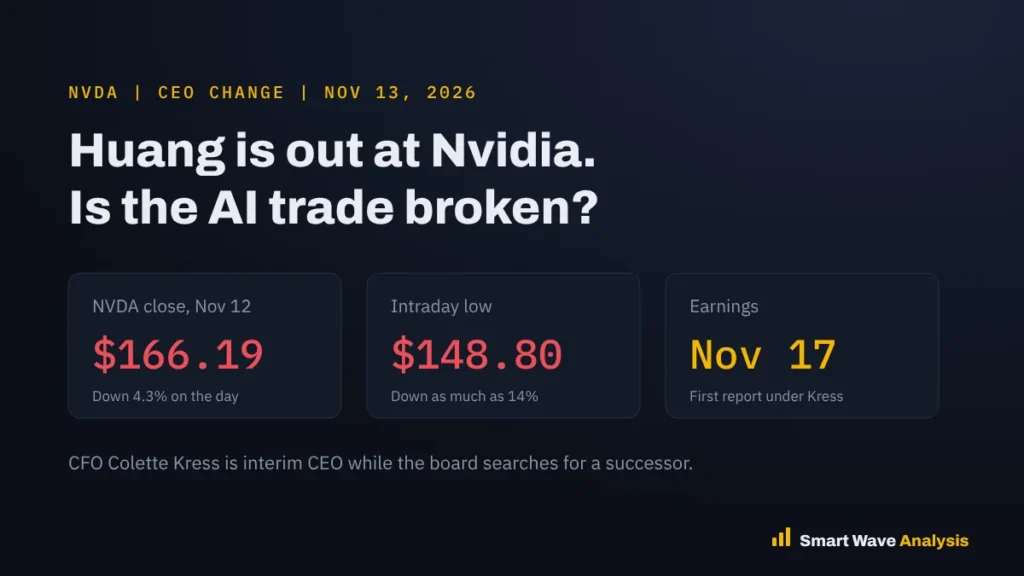
Jensen Huang resigned as Nvidia’s CEO and left its board on November 12, 2026, after reports about his personal relationships, including one with a woman US intelligence officials reportedly suspect of spying for China. CFO Colette Kress is interim CEO. Nvidia stock fell as much as 14% to $148.80 before closing down 4.3% at $166.19. The leadership shock is real, but the chips, customers and orders have not changed. The next test is earnings on November 17.
Key takeaways
- A sudden exit: Nvidia’s co-founder left after 33 years as CEO, with no named successor and no chief operating officer.
- The market blinked, then steadied: buyers cut a 14% drop to 4.3% by the close, a sign that many investors see a people problem, not a product problem.
- Washington is the wild card: the spy allegations give lawmakers new reasons to tighten chip sales to China.
- The AI trade may broaden: rivals such as AMD and Broadcom could gain if customers spread their bets.
Nvidia is one of the largest weights in the major US stock indexes, so its swings move the whole market. Our Nasdaq 100 Elliott Wave analysis tracks how the tech index is holding up.
Why Jensen Huang resigned
The story moved fast. On Sunday, November 8, Huang publicly admitted he had been unfaithful to his wife, and Nvidia’s board opened an independent review of reports that a foreign intelligence service had targeted him. On Wednesday, a report described a separate relationship with a senior Nvidia executive who reported to him. On Thursday, Nvidia announced that Huang had stepped down as president, CEO and director, effective immediately. The company gave no reason in its announcement.
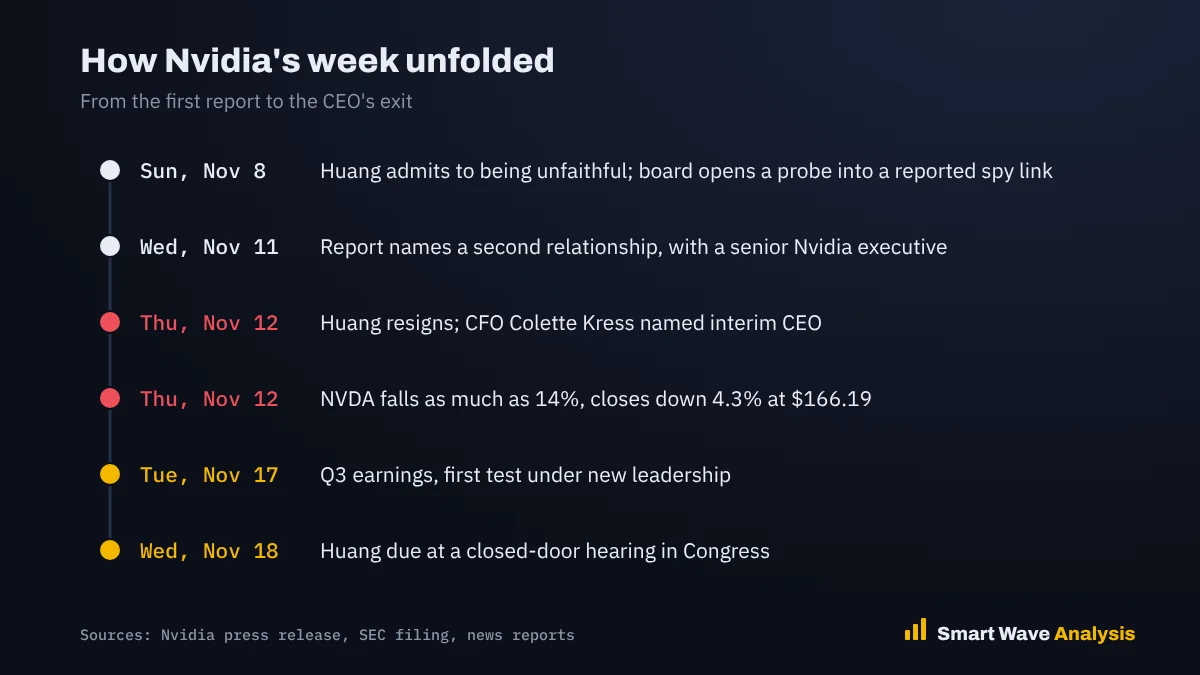
The board says it has “no reason to believe that either national security or NVIDIA secrets were compromised,” but its review is ongoing. There is no public evidence that Huang knowingly helped Beijing. President Trump has defended him, calling him an “honorable man.”
The board also named Harvey Jones, a director since 1993 and former Synopsys CEO, as its first-ever chair. Nvidia’s 8-K filing with the SEC confirms the leadership changes.
Who is Colette Kress?
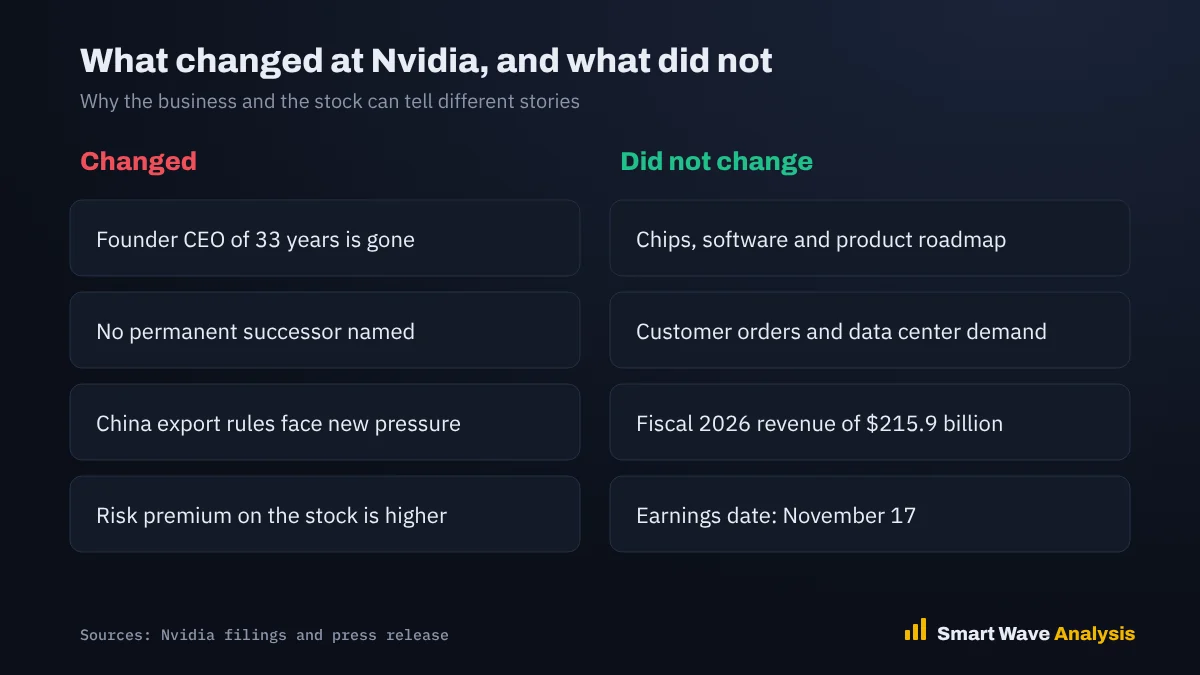
Kress has been Nvidia’s chief financial officer since 2013 and will keep that role while serving as interim CEO. During her time as CFO, Nvidia’s yearly revenue grew from about $4.1 billion to $215.9 billion in fiscal 2026. Before Nvidia, she held senior finance jobs at Cisco, Microsoft and Texas Instruments. “Our focus remains on serving our customers, partners, developers and shareholders,” she said.
How Nvidia stock reacted
NVDA opened sharply lower on Thursday and hit $148.80, down about 14%, on heavy volume. Dip buyers stepped in within the first hour, and the stock closed at $166.19, down 4.3%. That recovery matters. A stock that closes far above its low on the worst news of the year often shows that long-term holders are not rushing for the exit. Bernstein cut its rating to market perform with a $200 target, while Raymond James kept a strong buy.
The selloff also spilled into chip suppliers in Asia, including Korean memory makers that depend on Nvidia orders. In the US, Nvidia’s slide pulled the S&P 500 and Nasdaq lower on the day.
The case for hidden upside in the AI trade
A scandal at the top of the most important AI company sounds like pure bad news. There are four reasons it may not be.
- The business is intact. Data center demand comes from cloud giants with multi-year spending plans. Those plans were not built around one person. If earnings confirm strong orders, the gap between Nvidia’s results and its lower share price could attract buyers.
- Better governance. Huang ran a flat company with about 60 direct reports. A board chair, a CEO search and a clearer succession plan can lower the “key person” risk that investors have long worried about.
- A broader AI trade. If big customers hedge by buying more chips from AMD or designing their own with Broadcom, AI spending spreads across more stocks. That can make the whole trade less fragile. Follow our AMD analysis and Broadcom analysis for those charts.
- Clearer China rules. Uncertainty over chip sales to China has hung over Nvidia all year. Tighter rules would hurt some sales, but a firm line from Washington could remove a risk that markets cannot price today.
Critics say Nvidia’s culture and strategy were built around Huang, and no interim leader can replace that quickly. One analyst called it a “reset” that opens the door for rivals, pointing to reports that a major AI lab moved some work from Nvidia’s software to AMD hardware in days. If lawmakers also block more China sales, Nvidia could lose growth at the same time it loses its leader.
What Washington could do next
Huang has agreed to appear at a closed-door hearing with House lawmakers on November 18, the day after earnings. Members of both parties are pushing bills to tighten export controls on advanced AI chips, add location checks for exported chips and limit chip-making equipment. The Commerce Department’s Bureau of Industry and Security sets the export rules that would change.
Nvidia received approval in December 2025 to sell its H200 chips to China, subject to inspections, limits and a 25% tariff. Chinese buyers reportedly ordered more than two million of them. Any rollback would cut into those sales.
What to watch
- Nov 17Q3 earnings at 2 p.m. Pacific. Watch guidance, data center orders and any comment on China sales.
- Nov 18Huang’s closed-door session with House lawmakers.
- $148.80Thursday’s low. A break below it would show sellers are back in control.
- CEO searchAn experienced outside hire or a strong internal pick would likely calm investors.
We will update our Elliott Wave count on Nvidia after earnings, when the market has digested both the leadership change and the numbers. New to wave analysis? Start with our Elliott Wave theory guide, and keep the economic calendar open for the week’s data.
Want to trade the next big market move?
Get professional Elliott Wave analysis with updated charts, clear targets and invalidation levels for stocks, indices, forex, commodities and crypto.
- Daily chart updates
- Entry and stop levels
- Several timeframes
Frequently asked questions
Why did Jensen Huang resign from Nvidia?
Huang resigned on November 12, 2026, after reports about his personal relationships, including one with a woman US intelligence officials reportedly suspect of spying for China. Nvidia did not give a reason in its announcement.
Who is Nvidia’s new CEO?
CFO Colette Kress is interim CEO and will also stay on as CFO. The board is searching for a permanent CEO and will consider internal and external candidates.
How much did Nvidia stock fall after Huang resigned?
Nvidia fell as much as 14% to $148.80 on November 12, 2026, then recovered to close down 4.3% at $166.19.
When does Nvidia report earnings?
Nvidia reports third-quarter fiscal 2027 results on Tuesday, November 17, 2026, with a call at 2 p.m. Pacific time.
Sources
This article is for information and education and is not financial advice. The allegations described are reported claims, and the board’s review is ongoing. Details are as of November 13, 2026. Read our risk disclaimer.
Free Elliott Wave e-books
 FREE
Elliott Wave Forecasting Guide
A clear introduction to forecasting markets with the Elliott Wave Principle.
Get the free e-book FREE
Elliott Wave Trading Strategies
Practical setups for entries, stops and exits using wave structure.
Get the free e-book FREE
Beginner's Guide to Forex Trading
Forex basics for new traders: pairs, pips, lots, sessions and risk.
Get the free e-book FREE
Guide to Trading Stocks and ETFs
How stock and ETF markets work and how to read them with wave analysis.
Get the free e-bookFree download after a short sign-up with the publisher. Affiliate links: we may earn a commission at no cost to you.
Educational content only. Nothing on this page is financial advice or a recommendation to buy or sell. Trading involves risk and you can lose money. Elliott Wave counts are probabilities, not certainties. Read our full disclaimer and affiliate disclosure.