

Quick answer: Strategy CEO Phong Le says selling roughly 6,900 BTC near $62,000 between June and August, then buying 4,603 BTC back at $80,318 last week, were both correct calls. Neither move was a bet on Bitcoin’s price — both were funding decisions tied to STRC, Strategy’s preferred stock, which fell below its $100 par value in June and forced the company to find cash elsewhere.
Key Takeaways
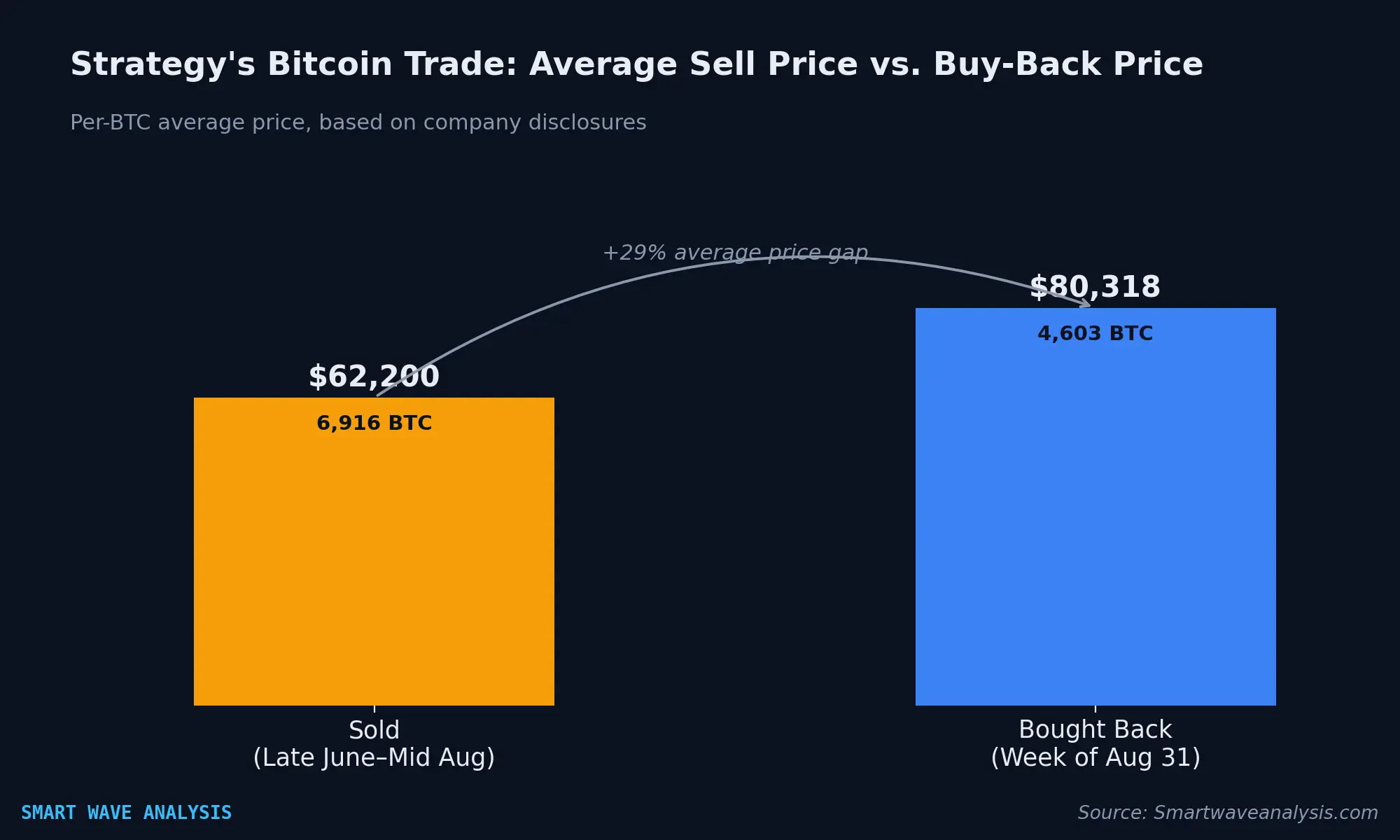
- Strategy sold 6,916 BTC in four tranches (late June–mid-August) at a weighted average of about $62,200, raising roughly $430 million
- It bought back 4,603 BTC last week for about $369.7 million, at an average price of $80,318
- CEO Phong Le says the sale funded STRC preferred-stock dividends after STRC dropped below its $100 stated value in June, cutting off a cheaper source of financing
- Strategy now holds 845,050 BTC (worth roughly $65 billion) — the sale represented less than 1% of total holdings
- The company is rebranding its approach as a “two-way capital management company” rather than a pure accumulator
- MSTR stock is down about 22% year-to-date, and Bernstein just cut its price target from $450 to $350
Strategy — the company formerly known as MicroStrategy — is the largest corporate Bitcoin treasury on earth, and its every move gets treated as a referendum on institutional Bitcoin adoption more broadly. So when the company most associated with aggressive Bitcoin accumulation started selling instead of buying, the reaction was immediate. Here’s what actually happened, and why Strategy’s Bitcoin treasury strategy looks less erratic once you understand the mechanics behind it.
What Actually Happened
Between June 29 and August 23, Strategy went quiet on new Bitcoin acquisition for the first extended stretch since it began its Bitcoin treasury strategy in 2020. Instead of buying, it sold. Across four separate tranches, the company offloaded 6,916 BTC at a weighted average price of roughly $62,200, bringing in about $430 million.
Then, in the week ending August 31, Strategy reversed course and resumed Bitcoin purchases, buying 4,603 BTC at an average price of $80,318 — a purchase of roughly $369.7 million, financed through equity issuance of new MSTR shares. MSTR Bitcoin holdings, in other words, kept climbing even through a stretch that looked from the outside like retreat.
On the surface, that reads like the textbook definition of a bad trade: sell low, buy high. CEO Phong Le addressed the optics directly in a Bloomberg Television interview this week, arguing that both decisions were “the right trade at the time” — just not for the reason most people assume.

Why Phong Le Says the Trade Was Right
Le’s central argument is that Strategy’s Bitcoin purchases and sales aren’t driven by where Bitcoin’s price sits on any given day. “We don’t really make decisions on Bitcoin specific to Bitcoin price,” he said. Instead, he described the moves as a capital allocation calculation built around cost of capital — essentially, whichever financing option carries the lowest financing costs at the time wins, whether that means equity issuance, issuing preferred shares, or selling a small slice of the company’s Bitcoin holdings.
By that logic, the two-month pause wasn’t really about halting Bitcoin accumulation — it was about repair work. Le said the company used the period to cut net debt from roughly $7 billion to zero and build up about $7 billion in a USD reserve, pushing total assets to around $72 billion. A cleaner balance sheet, in turn, lowered Strategy’s cost of capital and made it cheaper to issue new MSTR shares once the MSTR premium to net asset value returned — which is exactly what funded last week’s buyback.
Le has also pushed back on the idea that the sale represents any change in conviction. The 6,916 BTC sold amounts to less than 1% of Strategy’s Bitcoin holdings, which have grown 25–30% this year despite the sale. Strategy Bitcoin holdings now stand at 845,050 BTC, worth roughly $65 billion at current prices, making it by far the largest corporate Bitcoin treasury company in the world — well ahead of every other publicly traded firm pursuing a Bitcoin treasury strategy.
What Is STRC, and Why Did It Force Strategy to Sell Bitcoin?
This is the part most coverage of this story glosses over, and it’s the actual mechanism behind the trade.
STRC (nicknamed “Stretch”) is a variable-rate perpetual preferred stock that Strategy issued to raise capital without diluting common MSTR shareholders as heavily as issuing more common stock would. Like most preferred shares, STRC has a stated — or “par” — value, which for STRC is $100. Strategy adjusts STRC’s dividend rate up or down specifically to keep the shares trading close to that $100 mark, since preferred stock only stays attractive to income-focused investors when it trades near par.
In June, STRC slipped below its $100 par value. That mattered for one specific reason: when a preferred share trades below par, issuing more of it to raise cash becomes less capital-efficient — investors demand a bigger discount, which raises financing costs. With that route effectively closed, Strategy needed another capital allocation lever to cover its STRC dividend obligations without waiting for the shares to recover. Selling a small portion of its Bitcoin holdings was the fastest, cleanest option.
In other words: the Bitcoin sale wasn’t a market call. It was the byproduct of a preferred-stock mechanic falling out of balance. As of this week, STRC still hasn’t fully repegged to its $100 par value — which is worth watching, since it’s the same pressure point that triggered the original sale.
Strategy’s 2026 Bitcoin Playbook, Step by Step
The sell-then-buy sequence looks less erratic once it’s placed on a timeline:
| Month | What Happened |
|---|---|
| February 2026 | Strategy accelerates Bitcoin buying even as its holdings sit underwater and questions mount over its debt and preferred-share financing |
| May 2026 | The company formally abandons its “never sell” stance, pledging instead to operate as a net buyer rather than an absolute one |
| June 2026 | STRC falls below its $100 par value, closing off a key cheap-financing route |
| June 29–Aug 23, 2026 | Strategy pauses Bitcoin buying entirely; sells 6,916 BTC across four tranches to fund STRC dividends and repair the balance sheet |
| Aug 31, 2026 | Strategy resumes buying, purchasing 4,603 BTC at an average of $80,318 |
| Sept 1–2, 2026 | Phong Le defends both moves publicly on Bloomberg Television |
Read this way, the story isn’t really about Bitcoin’s price at all — it’s about a company managing a preferred-stock obligation and communicating that decision to a market that was primed to read it as a loss of conviction.
Is This a New Strategy, or the Same Playbook With a New Name?
Le has started describing Strategy as a “two-way capital management company” — a deliberate break from the “one-way accumulator” identity the company built its reputation on. Under this framing, selling Bitcoin isn’t a departure from the treasury strategy; it’s a feature of it. A company that can buy and sell Bitcoin, buy and sell its own equity, and buy and sell preferred shares has more tools to manage its balance sheet than one that only ever accumulates.
Le has said he doesn’t expect the company to sell Bitcoin again as markets move into what he called a “pretty heavy bull market,” and that Strategy would keep buying at higher prices — $90,000, $100,000, even $130,000 — if the underlying capital economics remain favorable. This isn’t the first time MicroStrategy buys Bitcoin through a stretch of public skepticism; the company has weathered several rounds of doubt since 2020 and, each time, resumed accumulating once financing conditions improved. Every time Strategy buys Bitcoin at a new high, as Le has pledged to keep doing, it’s leaning on the same premium-dependent mechanism — and, by extension, restating its bet on institutional Bitcoin adoption continuing.
🚀 Don’t Miss the Next Move
Get daily Elliott Wave counts, live chart updates, and high-probability trade setups across crypto, forex, and stocks — before the market moves.
👉 Start Your 14-Day Trial for Just $0.99 →Cancel anytime. No long-term commitment. (Affiliate link — we may earn a commission at no extra cost to you.)
The Skeptic’s Case
Not everyone is taking the reframing at face value. The mechanics Le describes still tie Strategy’s Bitcoin purchases directly to the MSTR premium — how far its own stock trades above net asset value — and that premium is itself heavily influenced by Bitcoin’s price and market sentiment toward Strategy specifically. Critics have pointed out that this creates a reflexive loop: Strategy buys more Bitcoin when its stock is expensive, which is often precisely when Bitcoin is already running hot, and sells when the opposite is true.
The market’s own scorecard adds some weight to that skepticism. MicroStrategy stock, which trades as MSTR, closed down 6.1% the day of Le’s interview and is down roughly 22% year-to-date, even as Bitcoin has traded well above its early-2026 levels. Bernstein maintained its Outperform rating on MSTR stock last week but trimmed its price target from $450 to $350, while still projecting Bitcoin itself could reach $150,000 by mid-2027 — a split verdict that suggests analysts are more confident in Bitcoin’s trajectory than in Strategy’s stock specifically. Because Strategy is the largest single proof point for corporate Bitcoin adoption and institutional Bitcoin adoption through public equity markets, any wobble in its model tends to get read as a referendum on the entire corporate Bitcoin treasury trend, not just one company’s balance sheet.
What to Watch Next
A few developments will show whether this “two-way” framing holds up or becomes a recurring pattern:
- Whether STRC fully repegs to its $100 par value. Until it does, the same funding pressure that triggered June’s sale technically remains in place.
- Strategy’s next earnings report, which will show whether the balance sheet repairs Le described — zero net debt, the $7 billion cash cushion — are holding, and whether BTC per share kept growing through the sale-and-rebuy cycle.
- The MSTR premium itself. Every leg of this strategy — buying, selling, or holding — depends on whether MSTR keeps trading above net asset value. A shrinking premium would remove the cheap-financing advantage that makes fresh Bitcoin purchases work.
- Whether Strategy sells Bitcoin again the next time STRC or another preferred instrument comes under pressure, which would be the real test of whether this is a genuine “two-way strategy” or a one-time explanation for an uncomfortable trade.
Frequently Asked Questions
What did Strategy’s CEO say about selling Bitcoin at the bottom?
Phong Le said selling roughly 6,900 BTC near $62,000 and later buying 4,603 BTC at $80,318 were both the right decisions, arguing that neither was driven by Bitcoin’s price but by the cost of financing the company’s STRC preferred-stock dividends.
Why did Strategy sell Bitcoin in the $60,000s?
Strategy sold Bitcoin to fund dividend payments on STRC, its preferred stock, after STRC fell below its $100 par value in June 2026. That drop made issuing more STRC to raise cash more expensive, leaving a Bitcoin sale as the fastest alternative.
What is STRC, and why does it matter to Strategy’s Bitcoin holdings?
STRC (“Stretch”) is Strategy’s variable-rate perpetual preferred stock, designed to trade near a $100 par value. When it trades below that level, raising new capital through STRC becomes costlier, which can push Strategy toward selling Bitcoin instead.
How much Bitcoin does Strategy currently hold?
As of early September 2026, Strategy holds 845,050 BTC, worth roughly $65 billion. The company’s holdings have grown 25–30% in 2026 despite the June–August sale.
Will Strategy sell Bitcoin again?
CEO Phong Le said he doesn’t foresee further sales heading into what he described as a “pretty heavy bull market,” but he’s also framed selling as a normal part of Strategy’s new “two-way” capital management approach when the financial math calls for it.
Is Strategy still buying Bitcoin?
Yes. Strategy resumed purchases on August 31, 2026, buying 4,603 BTC at an average of $80,318, and Le has said the company would continue buying at higher prices — including $90,000, $100,000, or $130,000 — if capital costs remain favorable.
What is a Bitcoin treasury company?
A Bitcoin treasury company is a publicly traded firm that holds Bitcoin as a primary balance-sheet asset, often raising capital through equity or preferred-stock issuance specifically to fund further Bitcoin acquisition. What started as MicroStrategy Bitcoin holdings bought to hedge corporate cash against inflation in 2020 has grown into the largest corporate Bitcoin treasury in the world, making Strategy the benchmark other companies pursuing institutional Bitcoin adoption are measured against.
What is “BTC per share,” and why does Strategy track it?
BTC per share measures how much Bitcoin exposure each MSTR share represents, adjusted for dilution from new stock issuance. Strategy uses it to argue that raising equity at a premium to fund Bitcoin purchases grows shareholders’ underlying Bitcoin exposure rather than diluting it — the core justification behind its capital allocation strategy.
This article is for informational purposes only and does not constitute financial, investment, or trading advice. Cryptocurrency and equity markets are volatile and carry risk of loss. Do your own research and consult a licensed financial advisor before making investment decisions.