

Gold’s latest push above $4,400 an ounce has reignited one of the longest-running arguments in markets: does hard money mean gold, or does it mean Bitcoin? Peter Schiff, never shy about picking a side, used this week’s rally to make his case loudly — and to take a swing at Strategy in the same breath.
Quick answer: Peter Schiff is telling investors to exit Bitcoin and Strategy (formerly MicroStrategy) stock as gold trades above $4,400 an ounce and silver hits a seven-week high near $65.84. Schiff argues Bitcoin has become the “anti-gold trade,” falling whenever gold rallies. Bitcoin itself has been stuck in the mid-$60,000s for weeks, down roughly 49% from its October 2025 all-time high of $126,272 — while Strategy sold another 1,690 BTC last week at a loss to its own average cost basis.
What Peter Schiff Is Saying
Schiff’s argument is simple: as capital rotates into gold, it’s coming out of Bitcoin. He’s pointed to the pattern over recent months as evidence — gold breaking out while Bitcoin broke down, gold correcting while Bitcoin bounced, and now gold rallying again while Bitcoin resumes its slide. In Schiff’s framing, Bitcoin has effectively become the “anti-gold trade,” moving opposite the metal rather than alongside it as crypto’s “digital gold” branding would suggest.
The timing of his comments matters too — they landed the day after Strategy confirmed yet another Bitcoin sale, giving Schiff two targets to criticize in the same breath: the asset itself, and the company most identified with holding it.
Gold and Silver’s Rally, By the Numbers
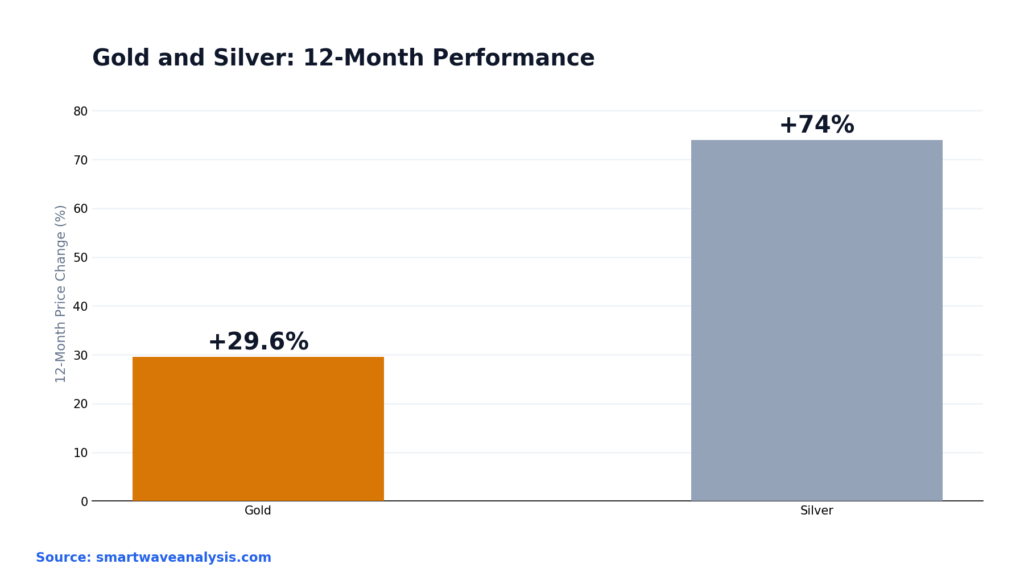
Gold traded near $4,400 an ounce this week, up modestly on the day and sitting on gains of roughly 6.8% over the past month and close to 30% over the past year. Silver has moved even further, touching a seven-week high around $65.84 and posting a 12-month gain approaching 74% — nearly double gold’s own strong run.
Both metals have been supported by steady central bank buying and heavy institutional demand out of China, with gold-backed funds there logging one of their longest inflow streaks in months. The rally has coincided with softer US jobs data, which cooled expectations for the Federal Reserve holding rates higher for longer — typically a favorable backdrop for non-yielding assets like gold and silver.

Where Bitcoin Actually Stands
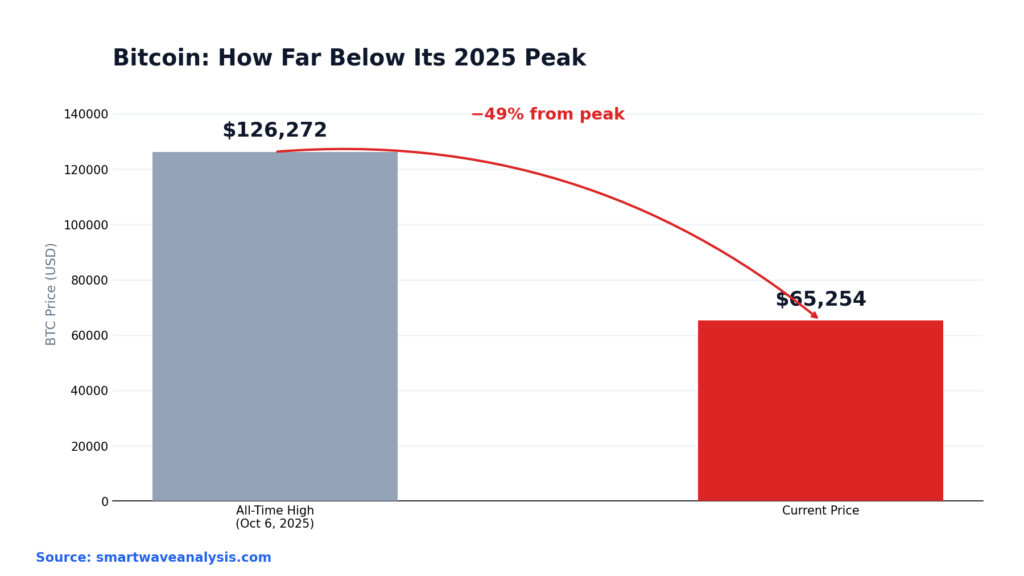
While gold and silver have been climbing, Bitcoin has been going almost nowhere. It traded near $65,254 this week, up less than 1% on the day, with a total market capitalization of roughly $1.31 trillion. Independent Elliott Wave trackers have described Bitcoin’s recent price action as stuck in the “gravity” of the mid-$60,000s for weeks running, with the asset sitting near its lowest levels in about two years.
That’s a meaningful drawdown from where this cycle started. Bitcoin’s all-time high of $126,272 was set on October 6, 2025 — meaning current levels represent a decline of roughly 49% from the peak, even after a partial recovery from this cycle’s lows.
Is Bitcoin Really the “Anti-Gold Trade”?
Schiff’s pattern-matching has some truth to it on recent charts, but the full history is messier than a clean inverse relationship would suggest. Gold itself slid below $4,000 as recently as June — and Bitcoin didn’t catch a bid on that weakness either, which is exactly what a true “anti-gold” asset should have done. If Bitcoin only sometimes moves opposite gold, the relationship looks less like a structural law and more like both assets occasionally responding to the same macro triggers — Fed policy, the dollar, and risk appetite — in different proportions.
That nuance matters for how much weight to put on Schiff’s framing. It’s a real pattern worth watching, but it isn’t the clean mechanical relationship the “anti-gold” label implies.
🚀 Don’t Miss the Next Move
Get daily Elliott Wave counts, live chart updates, and high-probability trade setups across crypto, forex, and stocks — before the market moves.
👉 Start Your 14-Day Trial for Just $0.99 →Cancel anytime. No long-term commitment. (Affiliate link — we may earn a commission at no extra cost to you.)
Strategy’s Bitcoin Sale: The Real Numbers
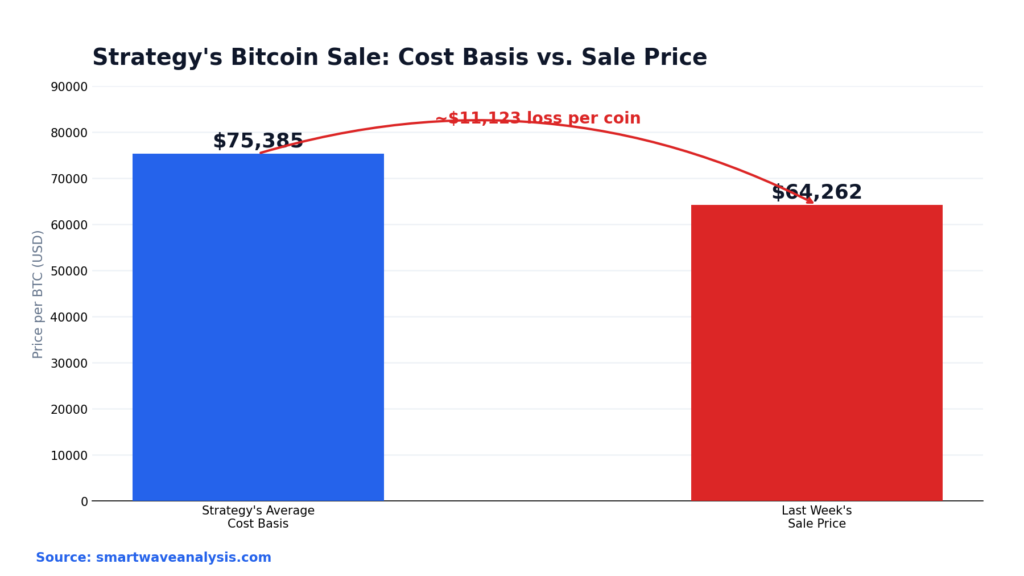
The Bitcoin sale that triggered Schiff’s comments has its own story worth unpacking. Strategy sold 1,690 BTC last week for $108.6 million, averaging $64,262 per coin after fees. That’s meaningfully below the company’s aggregate cost basis of roughly $75,385 per coin — meaning last week’s sale locked in a loss on those particular coins.
The proceeds didn’t go toward new Bitcoin purchases. Strategy used the cash to buy back shares of STRC, its preferred stock, which has been trading below its par value. Separately, the company raised $653.1 million by issuing 6.59 million common shares, pushing its dollar reserves to $4.65 billion as of August 9. Total Bitcoin holdings slipped to 840,447 BTC. Schiff reads the combination — selling coins at a loss while raising cash through multiple channels — as a sign of balance-sheet pressure rather than routine treasury management. Executive chairman Michael Saylor has maintained that he personally has never sold any of his own Bitcoin, even as the company continues to trim its holdings.
A Different Read: Not Everyone Agrees With Schiff
Schiff’s framing isn’t the only lens being applied to this divergence. Gordon Grant, a portfolio manager and head of derivatives at Bitwise, has pushed back on reading too much into short-term price action alone. His view centers Bitcoin’s “digital gold” credentials on a different test entirely — whether sanctioned states and similar actors adopt it as a reserve asset — rather than on how it trades against gold week to week. That’s a meaningfully different framework: one treats price divergence as the verdict, the other treats it as noise around a slower-moving adoption story.
What the Elliott Wave Charts Show
Technical analysis adds some texture to this debate without settling it outright. Wave counts on Bitcoin from earlier this summer had flagged bullish targets in the $66,700 to $72,700 zone — levels the current stall in the mid-$60,000s hasn’t yet reached, keeping that recovery scenario unconfirmed. Other Elliott Wave services tracking Bitcoin’s broader structure since the October 2025 peak have flagged a more bearish extended target zone as low as roughly $41,000 to $52,000 if the current corrective pattern continues rather than reverses. Neither count is confirmed — Bitcoin’s price action over the next few weeks should go a long way toward showing which is closer to right. Our own Bitcoin live Elliott Wave chart tracks this in real time.
On the metals side, the technical picture lines up with the strength in the headline numbers. We’ve been tracking silver’s own wave structure closely — see our recent Endeavour Silver coverage for the fuller picture — and gold’s rally back above $4,400 keeps its own bullish structure intact for now. Our Gold live analysis and Silver live analysis track both markets as the rally develops.
Frequently Asked Questions
What did Peter Schiff say about Bitcoin and gold?
Schiff said investors should sell Bitcoin and Strategy stock as gold rallies past $4,400 an ounce, arguing Bitcoin has become an “anti-gold trade” that falls whenever gold rises.
How much has gold and silver gained this year?
Gold is up roughly 29.6% over the past 12 months, while silver has gained nearly 74% over the same period, touching a seven-week high near $65.84.
Why did Strategy sell Bitcoin?
Strategy sold 1,690 BTC for $108.6 million to fund a buyback of its STRC preferred shares and raised additional cash through a common stock offering, even though the sale price was below the company’s average cost basis.
How far is Bitcoin down from its all-time high?
Bitcoin’s all-time high of $126,272 was set on October 6, 2025. At current levels near $65,000, that’s a decline of roughly 49% from the peak.
Do all analysts agree with Schiff’s Bitcoin view?
No. Some, like Bitwise’s Gordon Grant, argue Bitcoin’s “digital gold” case should be judged on longer-term adoption by institutions and states rather than short-term price moves against gold.
Bottom Line
Schiff’s “anti-gold” framing captures a real pattern in recent price action, but the fuller history — including Bitcoin’s failure to rally when gold fell in June — suggests the relationship is looser than a clean inverse trade. What’s harder to argue with is the raw math: gold and silver are both posting strong double-digit gains, Bitcoin is roughly halved from its October peak, and Strategy sold coins last week below its own cost basis. Whichever asset ends up right long-term, right now the data is doing more of the talking than any single call.
This article is for informational purposes only and does not constitute financial or investment advice.