

JPMorgan has now moved its year-end S&P 500 target four separate times in 2026, and each revision has pointed the same direction: higher. The latest call puts the bank’s target at 8,000, and the reasoning this time comes down to a single question that’s dogged the AI trade for two years — is the spending actually turning into revenue?
Quick answer: JPMorgan strategists led by Dubravko Lakos-Bujas raised their year-end S&P 500 target to 8,000 from 7,800, implying about 3% upside from the index’s recent close of 7,757.64. The call is built on strong Q2 2026 earnings — up roughly 32% — and evidence that AI hyperscalers’ capital spending is converting into real cloud revenue and backlog growth at Alphabet, Amazon, and Microsoft. JPMorgan’s new target is slightly above the 7,845 average of 20 strategists tracked by Bloomberg, and it joins Goldman Sachs and Deutsche Bank among banks now targeting 8,000.
A Year of Upgrades: How JPMorgan Got to 8,000
What stands out about this call isn’t just the number — it’s how often JPMorgan has revised it. The bank’s year-end S&P 500 target has climbed in four separate steps so far in 2026:
| Date | New Target | Prior Target | Index Level at the Time |
|---|---|---|---|
| ~January 2026 | 7,500 | — | — |
| April 21, 2026 | 7,600 | 7,200 | 7,109 |
| June 24, 2026 | 7,800 | 7,600 | ~7,365 |
| August 10, 2026 | 8,000 | 7,800 | 7,757.64 |

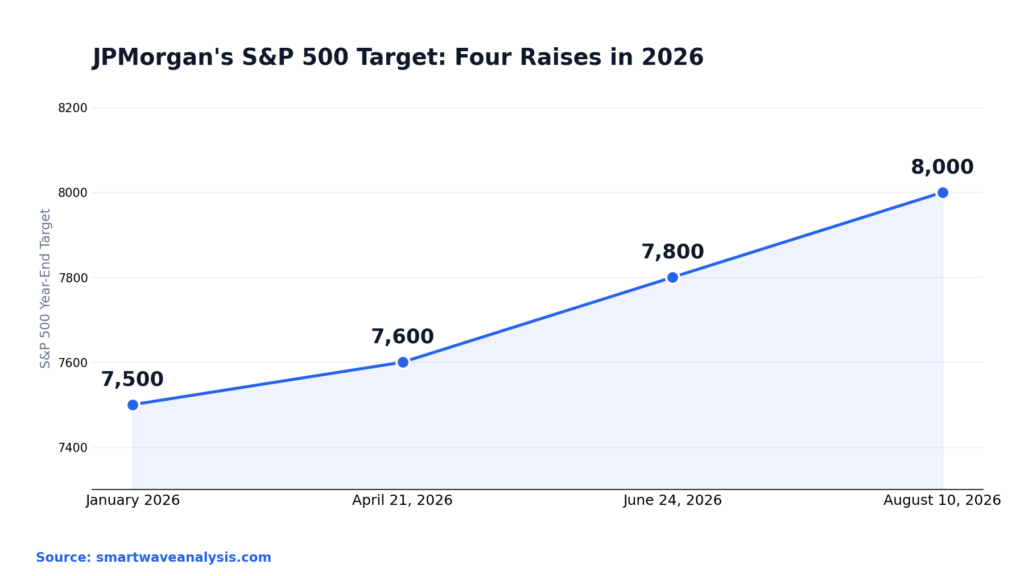
Each step has leaned on a similar story — strong earnings outpacing already-raised expectations — but the details behind the latest move are worth breaking down on their own.
Why JPMorgan Raised Its Target This Time
With 87% of S&P 500 companies having reported second-quarter results, JPMorgan’s strategists described the earnings picture as strong and broad-based across sectors, with overall earnings growth landing around 32% — well ahead of the roughly 22% growth the bank had penciled in back in June. That beat gave JPMorgan room to raise its 2026 earnings-per-share estimate to $365, up from $350 and implying 35% year-over-year growth, above the Street’s consensus of $358. The bank’s 2027 EPS estimate moved up to $420, or 15% growth.
One detail worth flagging: JPMorgan noted that private-company stake valuations are boosting 2026 EPS by roughly $18 based on first-half marks. Strip that out, and normalized EPS growth still comes in at a strong 28% year-over-year — a reminder that not every dollar of the headline number comes from operating performance. Despite the stronger earnings outlook, JPMorgan kept its forward price-to-earnings multiple unchanged at roughly 20x, citing still-elevated rates, geopolitical uncertainty, and heavy equity and debt supply yet to be absorbed by the market.
The AI Capex Question: Is the Spending Paying Off?
The core argument behind JPMorgan’s call is that the AI infrastructure boom is starting to show up as real revenue rather than just spending. The bank pointed to accelerating cloud growth and rising backlogs at Alphabet, Amazon, and Microsoft as evidence that customer demand is catching up to the capital hyperscalers have poured into data centers and chips. Cloud growth across the group has been striking: AWS revenue growth accelerated to 37% year-over-year, Azure grew 43%, and Google Cloud posted a record 82% increase. Backlogs moved just as fast — Google Cloud’s backlog rose $52 billion in a single quarter to $514 billion, while AWS’s backlog climbed to $496 billion, up 36% quarter-over-quarter.
Total capital expenditure across the S&P 500 is on pace for roughly $1.5 trillion this year, with AI now accounting for well over half of that figure — a share JPMorgan expects to keep growing. Separately, consensus estimates put AI-specific capex at around $900 billion by the end of 2026, up 85% year-over-year, and rising toward $1.2 trillion by the end of 2027.
The Catch: A Widening Free Cash Flow Gap
Here’s the part of the story that doesn’t make it into most of the bullish headlines. Even as revenue and backlogs grow, the hyperscalers’ free cash flow is under real pressure from the sheer scale of AI spending. Trailing-twelve-month net income across the group now stands at roughly $599 billion against just $169 billion of free cash flow — a gap of about $430 billion. As recently as the end of 2023, those two numbers were roughly equal. With the exception of Microsoft, most hyperscalers are projected to run negative free cash flow through 2026 and into 2027.

That gap doesn’t necessarily undercut JPMorgan’s thesis — strong backlogs and accelerating cloud revenue are genuine signs of demand, not just spending for its own sake. But it does mean the “AI capex is paying off” story is really a bet that today’s spending converts into tomorrow’s cash flow, and that conversion hasn’t fully shown up in the numbers yet. For readers tracking the hyperscaler most exposed to this dynamic, our Microsoft earnings coverage digs into that balance in more detail.
🚀 Don’t Miss the Next Move
Get daily Elliott Wave counts, live chart updates, and high-probability trade setups across crypto, forex, and stocks — before the market moves.
👉 Start Your 14-Day Trial for Just $0.99 →Cancel anytime. No long-term commitment. (Affiliate link — we may earn a commission at no extra cost to you.)
JPMorgan Isn’t Alone: Where Other Banks Stand
JPMorgan’s 8,000 target is no longer an outlier. Goldman Sachs raised its own year-end target to 8,000 back in May, citing similar earnings momentum, and Deutsche Bank has also put a 8,000 target on the board. Across the roughly 20 strategists Bloomberg tracks, the average year-end target sits near 7,845 — about 1% above the index’s recent level — with at least seven brokerages now expecting the S&P 500 to reach 8,000 by year-end.
| Bank | 2026 Year-End Target |
|---|---|
| JPMorgan | 8,000 |
| Goldman Sachs | 8,000 |
| Deutsche Bank | 8,000 |
| Bloomberg strategist average (20 banks) | 7,845 |

S&P 500: The Technical Picture
The fundamental story lines up with what wave analysts have been tracking on the chart. The index’s climb back to record territory this year has unfolded as a clean impulsive structure off its earlier-2026 lows, and it’s now trading well above the levels where past pullback risk was flagged. For the current wave count and key levels to watch, our S&P 500 Elliott Wave analysis and SPY wave setup break down the structure in more detail, and our live S&P 500 chart tracks it in real time.
Frequently Asked Questions
What is JPMorgan’s new S&P 500 target?
JPMorgan raised its year-end 2026 S&P 500 target to 8,000 from 7,800, implying roughly 3% upside from the index’s recent close of 7,757.64.
How many times has JPMorgan raised its S&P 500 target in 2026?
This is JPMorgan’s fourth upward revision in 2026, with the target moving from 7,500 to 7,600 in April, 7,800 in June, and 8,000 in August.
Why is JPMorgan bullish on AI capex right now?
JPMorgan points to accelerating cloud revenue growth and rising backlogs at Alphabet, Amazon, and Microsoft as evidence that AI infrastructure spending is converting into real customer demand rather than just capital outlay.
Do other banks share JPMorgan’s 8,000 S&P 500 target?
Yes. Goldman Sachs and Deutsche Bank have also set year-end 2026 targets of 8,000, and at least seven brokerages now expect the index to reach that level.
What is the risk to the AI capex story?
Hyperscalers’ free cash flow has fallen well behind net income — a roughly $430 billion gap — as AI spending outpaces the cash actually being generated. Most hyperscalers besides Microsoft are projected to run negative free cash flow through 2027.
Bottom Line
JPMorgan’s fourth target raise of the year captures something real: earnings have kept beating already-elevated expectations, and hyperscaler cloud businesses are showing genuine acceleration rather than just rising bills. But the widening gap between hyperscaler net income and free cash flow is the detail worth watching heading into the rest of this earnings cycle — it’s the difference between AI capex that’s paying off and AI capex that simply hasn’t been tested by a slower quarter yet.
This article is for informational purposes only and does not constitute financial or investment advice.