

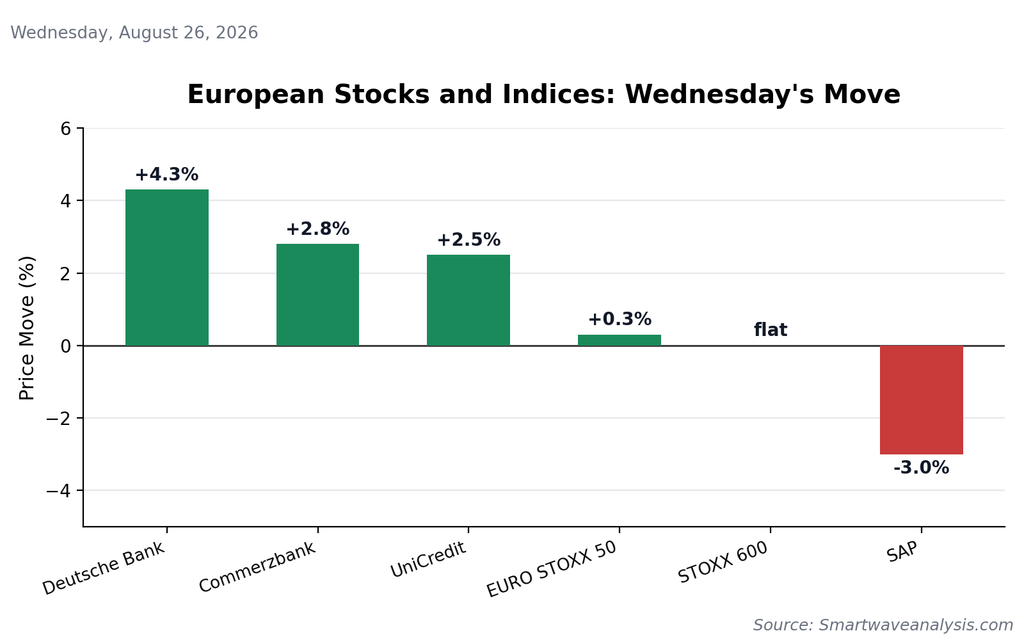
European stocks closed slightly higher on Wednesday, August 26, 2026, with bank stocks leading the gains and technology stocks lagging behind. The moves trace to three clear causes: a Deutsche Bank share buyback, a takeover story at UniCredit and Commerzbank, and a hotter than expected US inflation report. Oil prices, tied to hopes for reopening the Strait of Hormuz, remain the biggest swing factor for the region this week. Every figure below comes from named financial outlets and official data sources, listed at the end.
What Are European Stocks Doing Today?
| Index or Stock | Move | Main Driver |
|---|---|---|
| EURO STOXX 50 | Up 0.3% to 6,475 | Bank sector strength |
| STOXX Europe 600 | Nearly flat, closed at 656.41 | Bank gains offset by tech weakness |
| Deutsche Bank | Up 4.3%, highest since July 2011 | Started a 500 million euro share buyback |
| UniCredit | Up 2.5% | CEO meeting with German finance minister on Commerzbank |
| Commerzbank | Up 2.8% | Takeover talks with UniCredit advancing |
| SAP | Down 3% | UBS downgrade after weak Intuit earnings in the US |

Why Are European Stocks Rising Today?
Two company specific events did most of the work. Deutsche Bank started a 500 million euro share buyback, sending its stock to the highest level since July 2011. UniCredit CEO Andrea Orcel was scheduled to meet German Finance Minister Lars Klingbeil, the first direct engagement between Berlin and UniCredit over its pursuit of Commerzbank, according to Reuters reporting carried by the Irish Times. Falling oil prices added a third tailwind, easing inflation pressure across the region even as US inflation data came in hotter than forecast.
What Is Happening in the European Stock Market Today?
Banks led the market, with the STOXX 600 banking sector up about 1% as a group. Industrial stocks held on to strong gains from the prior session, with Safran and Rheinmetall both up more than 2% after a strong run for defense and aerospace names. Technology stocks were the weak point, dragged down by SAP. On Wall Street, the reaction was more subdued. Both the Dow Jones Industrial Average and the Nasdaq Composite opened about 0.2% lower after the hot US inflation reading, showing that American markets read Wednesday’s data more cautiously than European ones did.
Why Is SAP Falling Today?
SAP fell 3% after US software company Intuit issued a disappointing earnings forecast, raising concern about enterprise software spending broadly. UBS responded by downgrading SAP to neutral. The move shows how closely European technology stocks now track US software earnings, even when the news has nothing directly to do with the European company itself.
What Is the STOXX Europe 600?
The STOXX Europe 600 is a stock index covering 600 companies of different sizes across 17 European countries, including the United Kingdom, Germany, France, and Switzerland. It is one of the two most watched gauges of the European stock market, alongside the EURO STOXX 50, and it covers a broader slice of the market since it includes small and mid sized companies, not just the largest ones.
What Is the EURO STOXX 50?
The EURO STOXX 50 tracks 50 of the largest, most traded companies in the eurozone. It is the blue chip version of the STOXX Europe 600, holding fewer stocks but larger, more heavily traded ones. Because it holds fewer names, the EURO STOXX 50 tends to move faster and further than the broader STOXX 600 on any given day.
🚀 Don’t Miss the Next Move
Get daily Elliott Wave counts, live chart updates, and high-probability trade setups across crypto, forex, and stocks — before the market moves.
👉 Start Your 14-Day Trial for Just $0.99 →Cancel anytime. No long-term commitment. (Affiliate link — we may earn a commission at no extra cost to you.)
How Do Oil Prices Affect European Stocks?
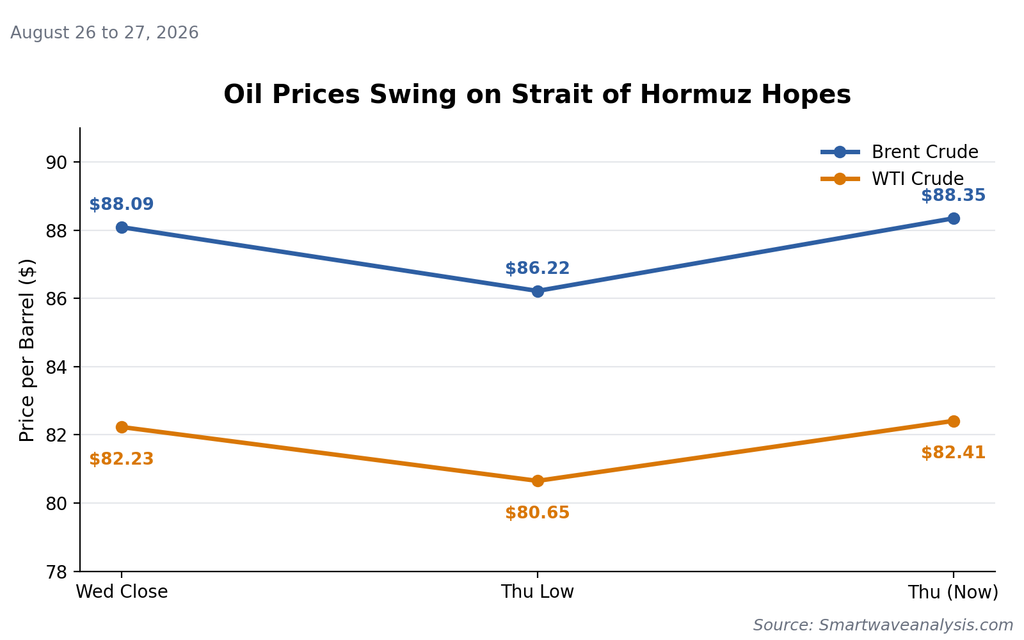
Lower oil prices generally help the European market as a whole, since Europe imports most of its oil and lower energy costs ease inflation and reduce expenses for most businesses. The effect is not the same across every sector, though. On Wednesday, energy names BP and Shell fell 1.1% and 0.5% as Brent crude dropped to $88.09 a barrel. By Thursday morning, Brent had climbed back to $88.35 after briefly falling to $86.22, according to Reuters.
The reason oil keeps swinging traces back to the Strait of Hormuz, a narrow waterway between Iran and Oman that carried about one fifth of the world’s oil and natural gas supply before a US Israel Iran conflict effectively closed it in late February 2026. Iran and Oman are now negotiating a framework to restore safe shipping through the strait. Qatar’s prime minister traveled to Iran on Thursday to help relaunch the broader talks. Any real progress tends to push oil prices down and European stocks up, while any breakdown in talks does the opposite.
How Serious Is the Strait of Hormuz Disruption?
The scale of this event is larger than most daily market coverage explains. The conflict has run for nearly six months. Saudi Arabia’s crude exports fell from 7.28 million barrels per day in February to 3.99 million barrels per day in April, a 45% drop, as shipping through the strait became too risky for many tankers. The US Strategic Petroleum Reserve has fallen below 300 million barrels, the lowest level since January 1983, as the government released reserves to offset the shortfall.
On August 25, 2026, President Trump stated that mines had been cleared from international waters in the strait, though actual shipping traffic remains well below pre conflict levels. West Texas Intermediate crude settled at $82.23 a barrel on Wednesday, its third straight daily decline, before recovering slightly Thursday morning. This is the scale of disruption that explains why a single diplomatic meeting between Iran and Oman can move European bank and industrial stocks thousands of miles away.
How Do Interest Rates Affect European Stocks?
Higher interest rates typically pressure stock prices, since borrowing costs more for companies and safer government bonds become more attractive by comparison. European Central Bank policymakers are prepared to raise rates at their September meeting to counter inflation caused by the Middle East conflict, though they have signaled reluctance to commit to further hikes beyond that single move, according to Reuters.
The same pressure is building in the United States. The Personal Consumption Expenditures price index, the Federal Reserve’s preferred inflation gauge, rose 0.2% in July and 3.7% over the past year, both above economist forecasts, the Bureau of Economic Analysis reported Wednesday. Markets now price a 40.1% chance the Fed raises rates at its September meeting, up from 33.1% a week earlier, according to CME Group’s FedWatch tool cited by Forbes. Fed Chair Kevin Warsh delivers his first speech at the Jackson Hole symposium on Friday, and investors expect him to address the rate path directly.
The UniCredit and Commerzbank Story, Explained
Most coverage of Wednesday’s UniCredit gain mentioned the Klingbeil meeting without explaining what is actually at stake, so here is the background. UniCredit began building a stake in Commerzbank in September 2024 and later launched a formal takeover offer. When the tender offer period closed in July 2026, UniCredit’s total position moved close to 48% of Commerzbank, according to market reporting. Germany’s financial regulator, BaFin, cleared UniCredit’s application to hold a controlling stake in early August, and Bloomberg reported on August 12 that the European Central Bank was leaning toward approval as well.
A final regulatory decision is expected in September or October 2026. The German government opposed the deal for most of 2025 and early 2026 but reportedly stopped signaling resistance by late August. Commerzbank shares are up close to 9% for the year and trade near a 52 week high, reflecting a market that increasingly expects the deal to close. If it does, it would create one of the largest cross border bank mergers in the eurozone since the currency was introduced.
What Is the Outlook for European Stocks?
The path forward depends on a small number of specific, dated events rather than general sentiment. If Iran and Oman finalize their framework for the Strait of Hormuz, oil prices likely continue falling and European stocks gain further support, particularly banks and industrials. If those talks stall again, energy costs and inflation pressure could return quickly, as they have multiple times since February.
Three events stand out for the days ahead. The ECB’s September meeting will confirm or walk back its stated openness to a rate hike. The European Central Bank’s final decision on the UniCredit Commerzbank deal is expected in the same window. Nvidia’s next earnings report will test whether AI spending keeps supporting technology stocks on both sides of the Atlantic, a sector where Europe has lagged the US for most of 2026.
This article is for informational purposes only and is not investment advice. Verify current figures before making any investment decision.