


The biggest crypto investment opportunity in 2026 is not one coin. It is not one trade either. It is the infrastructure being built around digital assets. Stablecoin supply passed 310 billion dollars this year. Tokenized funds from BlackRock and Franklin Templeton now hold billions in real government debt on public blockchains. Banks such as BNY Mellon and State Street now provide regulated custody for crypto held by pension funds and asset managers. Crypto is turning into financial infrastructure. Wall Street, Washington, and everyday investors are all building around it at the same time.
This article explains what is driving that shift. It shows where the real numbers stand today. It also lays out the honest risks. No hype. Just facts, with sources you can check.
What Is Driving Crypto Investment Right Now?
Three things changed at once.
First, regulation caught up. Congress passed the GENIUS Act in July 2025. It is the first federal law that sets clear rules for payment stablecoins. The Securities and Exchange Commission is based in Washington, D.C. It dropped an old accounting rule known as SAB 121. That rule had made it costly for banks to hold crypto for customers. The Office of the Comptroller of the Currency acted too. It confirmed that national banks can offer crypto custody and stablecoin services under normal banking rules. They no longer need special permission for each case.
Second, the largest firms in finance moved in. BlackRock manages more than 13 trillion dollars in assets. It is the world’s largest asset manager. In 2026, it filed new paperwork with the SEC to expand its lineup of tokenised funds. The Depository Trust and Clearing Corporation is another major player. It settles most U.S. stock trades. In 2026, it began testing production systems. The goal is to bring Russell 1000 stocks and major ETFs onto blockchain rails.
Third, institutional investors stopped watching from the sidelines. EY ran a 2026 survey of institutional investors. Most of them now spread digital asset holdings across more than one custodian. That is a sign this money is treated like any other regulated asset class. It is no longer a side experiment.
Together, these three shifts explain why analysts increasingly describe this as an infrastructure story rather than a price story.
Stablecoin Settlement Is Becoming Real Financial Infrastructure
A stablecoin is a digital token. It is built to hold a steady value. Almost every stablecoin tracks one U.S. dollar. Unlike Bitcoin, it is not meant to rise or fall in price. It is meant to move money fast, at any hour of the day.

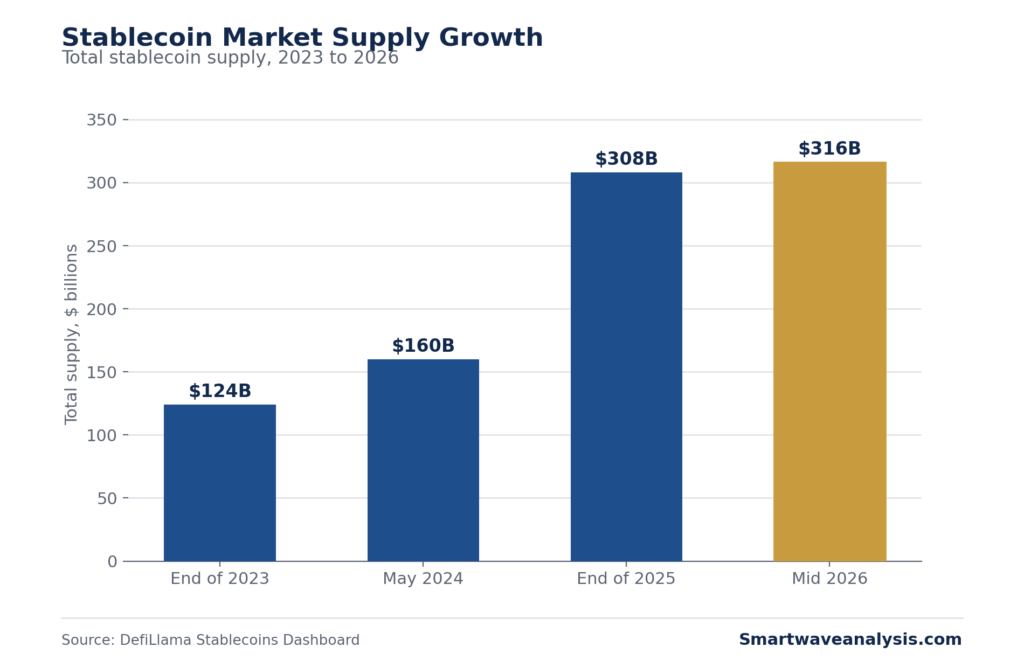
Total stablecoin supply reached roughly 310 to 320 billion dollars by mid 2026. That figure comes from DefiLlama, the tracker most widely cited across crypto industry reporting. Supply stood near 124 billion dollars at the end of 2023. That is growth of more than 150 percent in under three years.
Two tokens dominate this market. Tether’s USDT holds close to 59 percent of total supply. Circle’s USDC holds close to 24 percent. Together, they make up roughly 83 percent of every stablecoin dollar in circulation.
This matters for stablecoin settlement. Banks and payment firms now build directly on these tokens. They no longer treat stablecoins as a side project. Visa reported strong growth in its own use of stablecoins. Its settlement volume reached a yearly rate near 4.5 billion dollars by January 2026. Business to business stablecoin payments grew fast too. They rose from under 100 million dollars a month in early 2023. By mid 2025, they topped 6 billion dollars a month. A major reason is cross border payments. Money can settle in minutes instead of days. It often costs less than a bank wire too.
Some analysts see even bigger growth ahead. The U.S. Treasury Secretary has pointed to a possible 1 trillion dollar stablecoin market by the end of the decade. That is a projection, not a guarantee. Still, it explains why some commentators call regulated, dollar backed stablecoins a kind of digital dollar. They extend the reach of U.S. currency into markets that never had easy access to dollar banking before.
Tokenized Securities Are Moving Old Assets Onto New Rails
Asset tokenization takes something that already exists. This could be a Treasury bond. It could be a share of a fund. The asset gets a blockchain based token that represents ownership of it. The token can trade almost instantly. It can also serve as collateral almost instantly. It does not need to wait for the normal settlement window. That window can take a full day or more in traditional markets.
BlackRock’s USD Institutional Digital Liquidity Fund is the clearest example. It is known as BUIDL. The fund holds U.S. Treasuries. It runs across nine different blockchain networks. In mid 2026, it held roughly 2.5 billion dollars in assets, based on figures reported by CoinDesk and Messari. Franklin Templeton, Fidelity, Apollo, and Hamilton Lane have launched similar products. These cover government debt, private credit, and real estate.
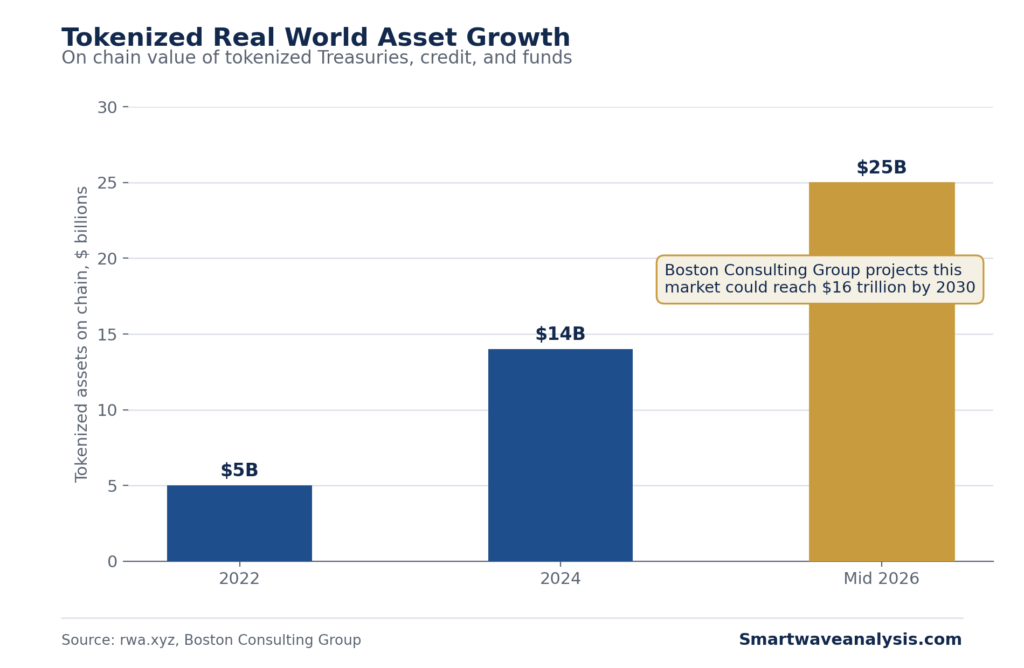
The total market for tokenized real world assets is smaller but growing fast. It sits somewhere between 22 and 36 billion dollars. The exact number depends on which categories a given tracker counts. That is still up from under 5 billion dollars in 2022. The Boston Consulting Group has made a bold projection. It expects tokenized assets could reach 16 trillion dollars by 2030. That forecast assumes institutional adoption keeps expanding at its current pace. It is a forecast, not a promise. Still, it explains why major banks are moving now instead of waiting.
The Depository Trust and Clearing Corporation is based in New York City. It sits at the center of how nearly every U.S. stock trade settles. It expects to begin commercial tokenized security services in late 2026. The rollout starts with Russell 1000 equities and major exchange traded funds. If it works as planned, this would be a big step. It would connect New York Stock Exchange and Nasdaq listed companies directly to blockchain settlement, at real scale, for the first time.
🚀 Don’t Miss the Next Move
Get daily Elliott Wave counts, live chart updates, and high-probability trade setups across crypto, forex, and stocks — before the market moves.
👉 Start Your 14-Day Trial for Just $0.99 →Cancel anytime. No long-term commitment. (Affiliate link — we may earn a commission at no extra cost to you.)
Why Digital Asset Custody Decides Who Wins Institutional Liquidity
Custody is a simple idea. It means who actually holds the keys or records that prove ownership of a digital asset. For pension funds, insurance companies, and endowments, this often matters most. It is often the biggest barrier to entry. A fund manager cannot buy an asset if compliance teams cannot verify it is safely held.
That barrier is falling fast. BNY Mellon and State Street are two of the largest custody banks in the world. Both now offer institutional grade digital asset custody. Fidelity Digital Assets was founded in 2018. It was one of the first traditional finance firms to offer this service, and it continues to expand that service in 2026. In late 2025, U.S. regulators took a big step. The Office of the Comptroller of the Currency granted conditional trust bank charters to five digital asset firms, including Circle and Fidelity Digital Assets. This moved custody and stablecoin activity further inside the regulated banking system.
EY’s 2026 survey looked closely at custody habits. It found that 61 percent of institutions now use more than one custodian. Only 36 percent rely on a single provider. That split shows how seriously large investors treat custody risk. It also explains a bigger trend. Institutional liquidity keeps concentrating around a small group of trusted custodians. It does not spread evenly across every platform on the market. Firms that pass strict audit and regulatory review capture most new institutional money.
Crypto Stocks: A Second Way to Reach This Opportunity
Not every investor wants to hold digital tokens directly. Buying shares in public companies is one alternative. These companies are tied to crypto infrastructure. Investors can buy them through a normal brokerage account, the same account used for any other stock.
Coinbase trades under the ticker COIN on the Nasdaq. It runs the largest regulated crypto exchange in the United States and joined the S&P 500 in 2025. Circle Internet Group trades under the ticker CRCL on the NYSE. Circle is the issuer of USDC. It went public in 2025. In parts of 2026, it reported close to 193 million dollars in monthly revenue, mostly from interest earned on the reserves backing its stablecoin. Strategy trades under the ticker MSTR on the Nasdaq. It was formerly known as MicroStrategy and holds Bitcoin directly on its corporate balance sheet, so its stock price tends to track Bitcoin’s price closely. Robinhood trades under the ticker HOOD on the Nasdaq. It offers crypto trading to retail investors and gained roughly 185 to 190 percent in value during 2025.
Performance across these crypto stocks has varied a lot. In the first half of 2026, an index of crypto related equities gained about 23 percent. During that same stretch, many crypto tokens fell around 36 percent. This data comes from Bitwise. The gap shows something important. These stocks do not always move together with the coins they are connected to.
What Are the Real Risks?
This is where honesty matters more than excitement.
Several major crypto companies went public between mid 2025 and mid 2026. Many of them now trade well below their opening prices. Gemini has fallen roughly 89 percent since its September 2025 debut. BitGo trades nearly 77 percent below its initial 2026 price. Circle had a strong start, but it still dropped about 75 percent from its post IPO high by mid 2026. Coinbase is a much older and larger company. It is still down about 69 percent from its all time high.
Three risks stand out. First, there is concentration risk. Nearly 83 percent of the entire stablecoin market rests on just two issuers, Tether and Circle. A serious problem at either firm would ripple across the whole digital asset market. Second, there is regulatory risk. The GENIUS Act and related rules are still new. Future legislation could change how these markets work, including the proposed Digital Asset Market Clarity Act. Third, there is plain volatility. Even products built around stable infrastructure are new, including tokenized funds. None of them have been tested through a full market cycle yet.
None of this means the opportunity is not real. It means the opportunity should be studied like any other emerging financial sector. It should be sized carefully too. It is not a sure win.
Frequently Asked Questions
What is stablecoin settlement?
Stablecoin settlement means using a dollar pegged digital token to complete a payment or trade. It replaces a traditional bank transfer. It usually takes minutes rather than days.
What are tokenized securities?
Tokenized securities are traditional financial assets, such as Treasury bonds, fund shares, and private credit. These get represented as digital tokens on a blockchain. They carry the same ownership rights as the original asset, but they can settle and trade faster.
What does digital asset custody mean?
This term covers who holds and protects the private keys or account records that prove ownership of a crypto asset. Banks such as BNY Mellon, State Street, and Fidelity Digital Assets now offer this service to institutional investors.
Are crypto stocks safer than buying crypto directly?
Not necessarily. Crypto stocks such as Coinbase, Circle, and Strategy carry normal stock market risk plus added exposure to crypto prices and regulation. Several have fallen sharply from their highs, even as the digital asset infrastructure behind them kept growing.
Is a stablecoin the same thing as a digital dollar?
Not officially. The United States has not issued a government backed digital dollar. Regulated, dollar backed stablecoins such as USDC serve a similar payment role today, which is why some analysts use the term informally.
Where does the biggest crypto investment opportunity sit for 2026?
Based on the data above, the strongest opportunity sits in the infrastructure layer. This includes stablecoin settlement, tokenized funds, and institutional custody. It goes well beyond buying and holding a single coin.
Disclaimer
This article is for information only. It is not investment, legal, or tax advice. Digital assets and crypto related stocks carry real risk, including the risk of losing money. Speak with a licensed financial advisor before making any investment decision.